Drone Flight Endurance Extended Up to 85% by Nanoveu’s Sub-1mW ECS-DoT AI Chip

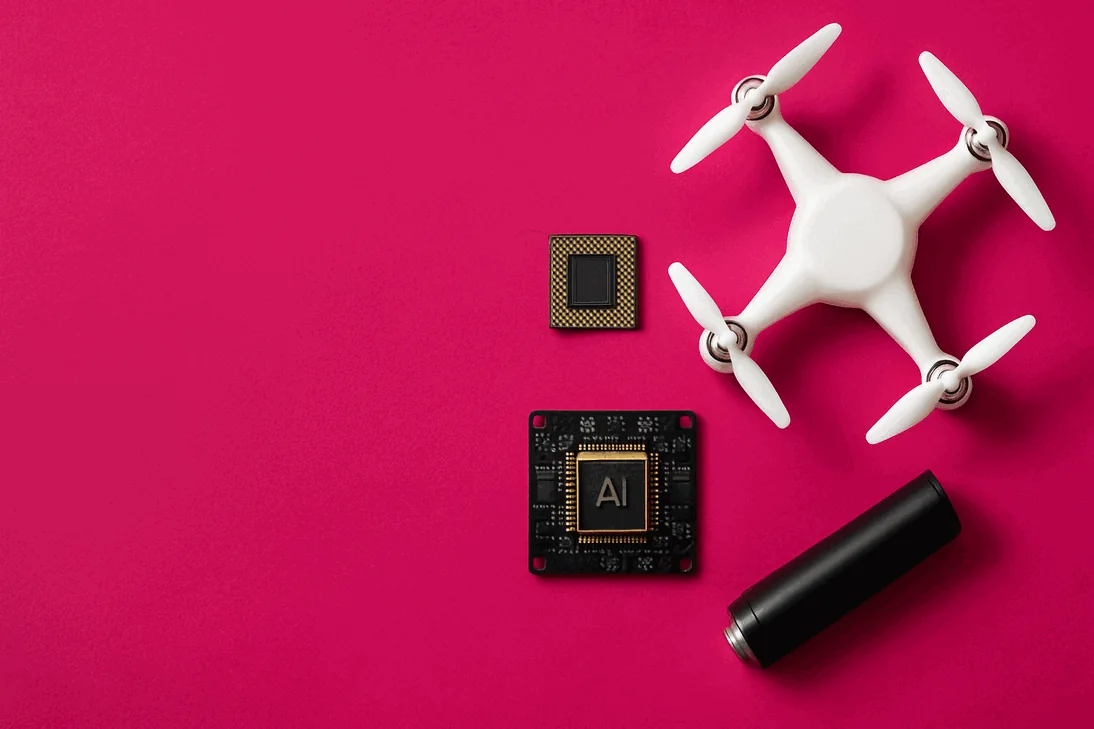
Nanoveu’s subsidiary EMASS has demonstrated a remarkable leap in drone endurance using its ECS-DoT ultra-low-power AI chip, achieving average flight time extensions of 60% across multiple drone types in over 300 simulated trials.
- ECS-DoT AI chip extends drone flight endurance by up to 85% without hardware changes
- Over 300 simulation scenarios across quadcopter, hexacopter, and octocopter platforms
- Sub-1 milliwatt power consumption enables real-time AI control at 50Hz
- Nanoveu progressing to live flight trials and engaging global drone manufacturers
- Patent filings underway to protect proprietary AI energy optimization technology
 Add us as a preferred source on Google
A New Frontier in Drone Endurance
Nanoveu Limited, through its subsidiary EMASS, has unveiled groundbreaking results from its Phase 2 drone evaluation program, showcasing the ECS-DoT ultra-low-power AI chip’s ability to significantly extend drone flight times. In a comprehensive series of over 300 simulated trials, the chip demonstrated average flight endurance improvements of around 60%, with peak gains reaching 85% on heavy-lift octocopters. These results mark a potential paradigm shift in drone technology, tackling the long-standing bottleneck of limited battery life without requiring any changes to batteries, rotors, or propulsion systems.
Simulation at Scale Validates Real-World Potential
The extensive testing leveraged Gazebo and ArduPilot, sophisticated open-source robotics simulators trusted by NASA and DARPA, to replicate realistic flight conditions including varied payloads, wind profiles, and complex mission geometries. ECS-DoT’s AI engine operated at less than 1 milliwatt of power, executing 50Hz closed-loop control cycles that optimized energy consumption in real time. This ultra-low power draw is critical, enabling smarter onboard decision-making without latency or reliance on cloud computing, a key advantage for autonomous UAVs operating in remote or contested environments.
Diverse Drone Platforms, Consistent Gains
The chip’s performance was tested across the most common drone configurations, quadcopters, hexacopters, and octocopters. Quadcopter platforms, prevalent in both consumer and enterprise markets, saw up to 80% mission endurance improvements, averaging 60%. Hexacopters, favored in agriculture and logistics for their payload capacity, achieved up to 75% gains under stress testing. Even the complex octocopters, used in industrial inspection and defence, recorded consistent improvements up to 85%, averaging 57%. These results underscore ECS-DoT’s versatility and robustness across a wide range of UAV applications.
Commercial Implications and Next Steps
With the global drone market projected to exceed USD 163 billion by 2030, Nanoveu is positioning EMASS to capitalize on this growth by engaging directly with original equipment manufacturers (OEMs) and avionics suppliers. The company plans to transition from simulation to live flight trials, validating ECS-DoT’s performance in operational environments. Concurrently, patent filings are underway to secure intellectual property rights over the chip’s AI-powered energy modelling and control architecture, laying the groundwork for future licensing and strategic partnerships.
Redefining Autonomous Flight Efficiency
Dr. Mohamed M. Sabry Aly, EMASS’s Founder and CTO, highlighted the transformative nature of the technology, “ECS-DoT doesn’t just extend drone flight time but redefines the role of edge AI in aerospace. Every electron is turned into range.” This innovation could unlock new mission profiles in delivery, precision agriculture, defence, and infrastructure inspection, where endurance and autonomy are critical. As Nanoveu advances to live trials and commercial integration, the industry will be watching closely to see if these simulation successes translate into real-world breakthroughs.
Bottom Line?
Nanoveu’s ECS-DoT chip could soon redefine drone endurance, but real-world trials will be the true test of its transformative potential.
Questions in the middle?
- How will ECS-DoT perform under unpredictable real-world flight conditions beyond simulations?
- What timelines and terms will Nanoveu establish with global drone OEMs for ECS-DoT integration?
- Can Nanoveu’s patent strategy effectively protect its AI energy optimization technology amid growing competition?