Can Nanoveu’s New Voice AI Tech Overcome Battery Life Challenges in Wearables?

Nanoveu’s subsidiary EMASS has unveiled a breakthrough reference design that integrates inertial sensing with edge AI to enable always-on, ultra-low-power voice interaction in hearable devices. This innovation promises to extend battery life while delivering real-time, hands-free voice control without cloud reliance.
- EMASS co-develops reference design combining STMicroelectronics IMU with ECS-DoT AI SoC
- Always-on keyword spotting triggered by jaw movement reduces power consumption
- Sub-milliwatt operation and sub-10ms response latency for seamless voice interaction
- Eliminates cloud dependency, enhancing privacy and reducing latency
- Targeting the rapidly growing hearable and wearable market projected to exceed US$232 billion by 2030
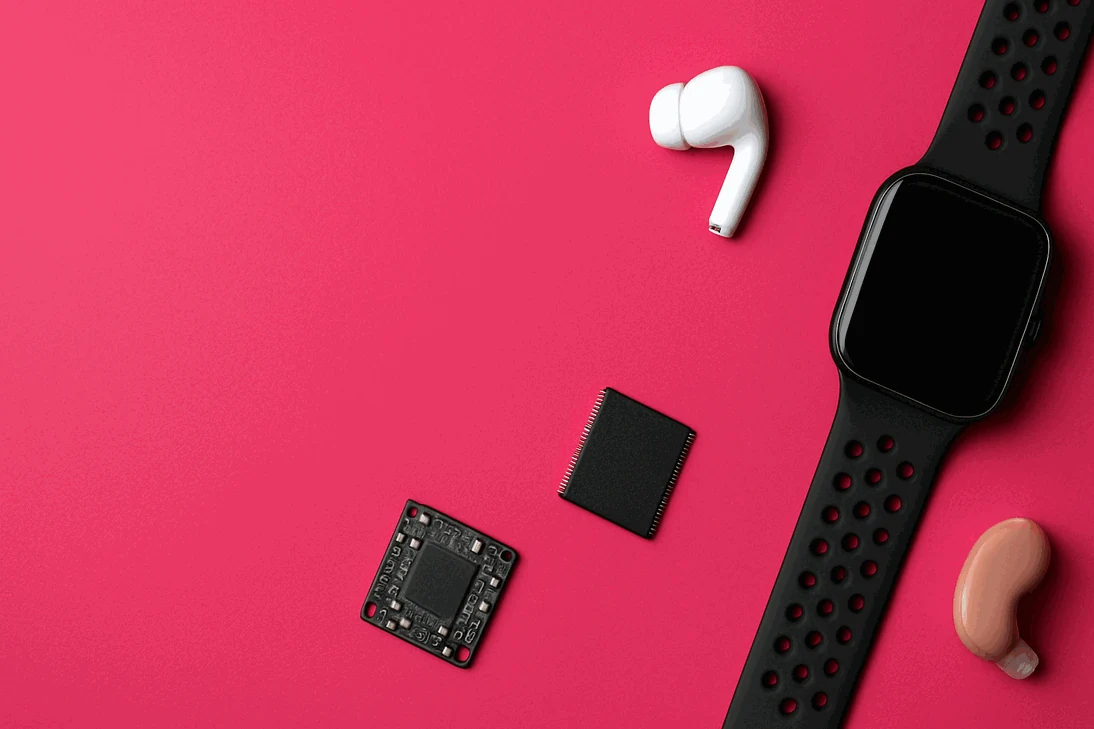

A New Era for Hearables
Nanoveu Limited’s wholly owned subsidiary, Embedded A.I. Systems (EMASS), has announced a significant technological advancement in the hearable device space. By integrating STMicroelectronics’ inertial measurement unit (IMU) technology with EMASS’s ECS-DoT edge AI System-on-Chip (SoC), the company has developed a reference design that enables always-on keyword spotting with ultra-low power consumption. This breakthrough addresses a longstanding challenge in hearable devices: how to maintain responsive, hands-free voice interaction without rapidly draining battery life.
How It Works
The innovation hinges on combining motion-triggered wake-up detection with on-device AI inference. STMicroelectronics’ LSM6DSV16BX IMU detects jaw movement, which acts as a trigger to activate the audio processing subsystem only when the user is likely speaking. This eliminates the need for continuous microphone monitoring, a major drain on battery life in current devices. Once activated, EMASS’s ECS-DoT SoC performs real-time keyword recognition locally, delivering sub-10 millisecond response latency at sub-milliwatt power levels. Crucially, this system operates entirely on-device, removing the need for cloud-based processing and thereby enhancing user privacy and reducing latency.
Market Implications
The hearable and wearable market is one of the fastest-growing segments in consumer electronics, projected to exceed US$232 billion by 2030. Always-on voice interaction is becoming a critical differentiator for products such as bone-conduction earphones, hearing aids, and smart glasses. EMASS’s reference design offers engineers and original equipment manufacturers (OEMs) a validated blueprint to rapidly integrate intelligent voice recognition capabilities without compromising battery life or device form factor.
Showcasing Innovation
EMASS will demonstrate this integrated system live at Embedded World 2026 in Nuremberg, Germany, from 11 to 13 March. The showcase will provide attendees with a firsthand experience of the seamless, low-power voice interaction enabled by the combined inertial sensing and edge AI technology. Nanoveu’s CEO of Semiconductor Technologies, Mark Goranson, emphasised the significance of this development, highlighting how it unlocks capabilities previously impractical in wearable form factors.
Strategic Positioning
This reference design not only expands Nanoveu’s footprint in the hearable and wearable markets but also demonstrates EMASS’s multi-modal AI capabilities by orchestrating sensor data from both motion and audio inputs. This multi-sensor approach sets EMASS apart from competitors relying on single-modality solutions, positioning the company as a key player in the evolving edge AI and wearable technology landscape.
Bottom Line?
Nanoveu’s EMASS is poised to redefine hearable device interaction, but the market will watch closely for commercial adoption and customer traction post-Embedded World 2026.
Questions in the middle?
- Which OEMs or partners are engaging with EMASS to adopt this reference design?
- What is the expected timeline for commercial products incorporating this technology?
- How will this innovation impact Nanoveu’s revenue and market share in the near term?