Beecher Resource Updated to 3.03Mt at 1.00% Li2O and 0.116% Rb2O

IRIS Metals has revealed a 3.03Mt lithium resource at its fully permitted Beecher Project in South Dakota, featuring a notable rubidium component with a high-grade zone containing around 2,100 tonnes of Rb2O. This positions Beecher as a rare multi-commodity critical minerals asset in a top US mining jurisdiction.
- 3.03Mt lithium-rubidium resource at Beecher
- High-grade rubidium zone with 2,100 tonnes Rb2O
- Rubidium quantified as a by-product in US resource
- Lithium mineralisation amenable to conventional processing
- Ongoing metallurgical studies to assess rubidium recovery
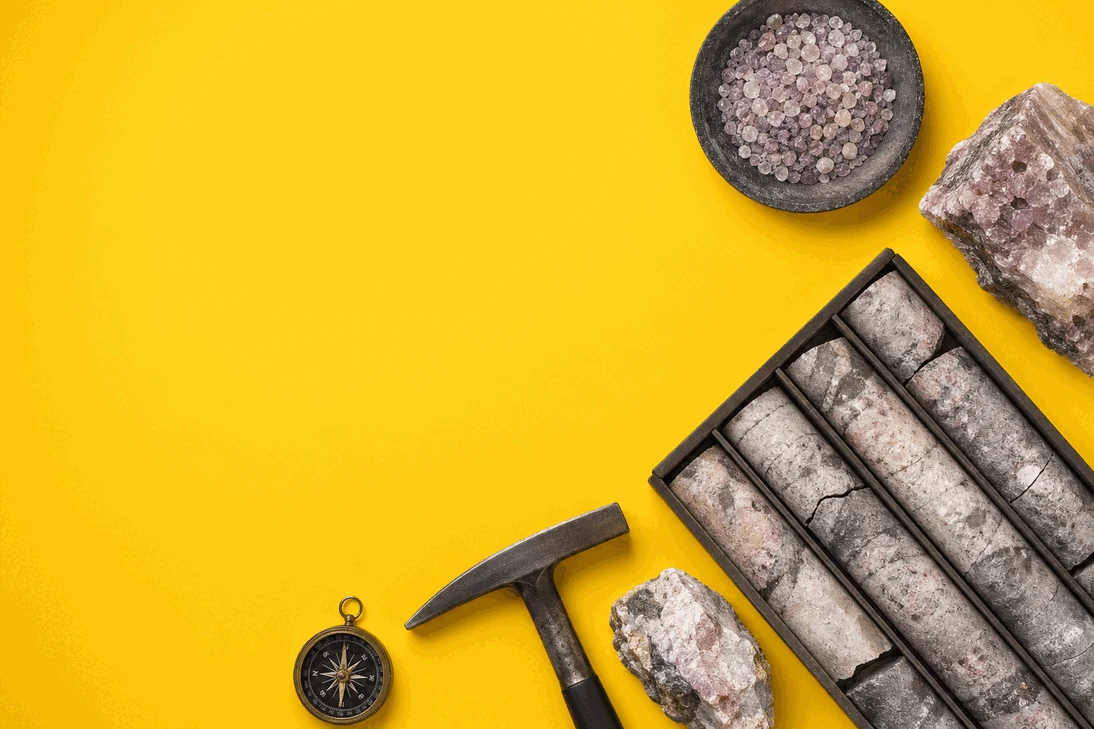

Significant Rubidium Component Defines Beecher's Strategic Edge
IRIS Metals Limited (ASX:IR1) has updated its JORC 2012 Mineral Resource Estimate (MRE) for the Beecher Project in South Dakota, reporting a 3.03 million tonne resource averaging 1.00% lithium oxide (Li2O) and 0.116% rubidium oxide (Rb2O). Notably, this is one of the first US mineral resources to explicitly quantify rubidium, a critical mineral with no primary global production and supply heavily concentrated in China. Within the resource, a high-grade rubidium zone of 1.04Mt at 0.203% Rb2O (Indicated) contains approximately 2,100 tonnes of in-situ Rb2O, underscoring Beecher's potential as a rare multi-commodity critical minerals project in a tier-one mining jurisdiction.
Rubidium’s strategic importance is underscored by its applications in defence, quantum computing, telecommunications, and medical imaging, with the US currently reliant on 100% imports. IRIS Metals’ President of US Operations, Matt Hartmann, highlighted that Beecher’s rubidium deposit is among the most significant recorded domestically, aligning with America’s drive for secure critical mineral supplies.
Robust Geological Model Supported by Extensive Drilling
The updated MRE, prepared by SRK Consulting and effective 31 March 2026, is based on 123 drill holes totaling nearly 16,000 metres completed from 2023 to 2025. The resource encompasses three spodumene-bearing pegmatite deposits: Longview, Black Diamond, and Beecher Lode. Lithium mineralisation is hosted primarily in spodumene, with rubidium associated with mica minerals and microcline. The resource is classified as Indicated and Inferred, with no Measured category due to the complex pegmatite zonation and sampling challenges common to spodumene deposits.
The project’s location in the Black Hills, a mining-friendly US jurisdiction with an existing mining licence, enhances its appeal. The resource is constrained within optimised economic volumes for both open pit and underground mining scenarios, with an effective cut-off grade of 0.50% Li2O applied. Preliminary metallurgical test work confirms lithium mineralisation is amenable to conventional dense media separation and flotation, achieving up to 80% lithium recovery to produce SC6 spodumene concentrate.
Rubidium By-Product Potential Under Evaluation
While rubidium is not currently included in the economic cut-off grade or engineering criteria, IRIS Metals is advancing metallurgical programs to evaluate rubidium recovery pathways. The high-grade rubidium zone’s clustered distribution suggests potential for selective mining and economic by-product credits, pending further technical and market assessments. Representative Beecher material has been provided to third parties for independent evaluation of lithium and rubidium content and processing options.
This development follows IRIS Metals’ recent capital raise and portfolio expansion, including a farm-in for a tungsten project in Montana, reinforcing its US critical minerals strategy. The company’s focus on multi-commodity assets aligns with growing demand for secure domestic supplies of battery metals and strategic minerals amid global supply chain uncertainties. The Beecher Project’s unique rubidium component adds a new dimension to its value proposition, complementing its lithium resource base and positioning it distinctively in the US market.
IRIS Metals continues to progress technical studies aimed at advancing Beecher towards a production decision, with ongoing engagement with potential counterparties and exploration of near-term commercialisation pathways including direct shipping ore opportunities.
Bottom Line?
IRIS Metals’ inclusion of rubidium in its Beecher resource highlights a rare US critical minerals opportunity, but commercial viability hinges on forthcoming metallurgical and market evaluations.
Questions in the middle?
- How will ongoing metallurgical test work clarify rubidium recovery economics at Beecher?
- What impact could domestic rubidium supply from Beecher have on US strategic mineral security?
- Could selective mining of the high-grade rubidium zone materially enhance project economics?