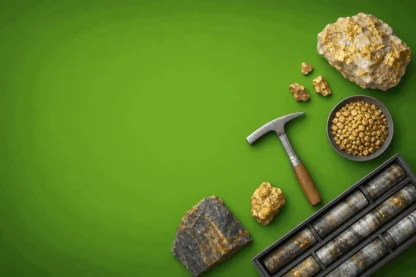
Six Holes Return Copper, Indium, Antimony Intercepts at Federation Project

Octava Minerals has delivered its first drilling results in nearly 50 years at the Federation Project in Tasmania, revealing significant copper, indium, tin, antimony, lead, and zinc mineralisation across multiple styles.
- First drilling at Federation in 50 years
- Significant intercepts include copper, indium, tin, antimony, and zinc
- Discovery of new antimony-zinc lode open in all directions
- Feeder-style sulphide breccia pipe mineralisation confirmed
- Further assays and downhole EM surveys pending
 Add us as a preferred source on Google
Maiden Drilling Campaign Reveals Polymetallic Potential
Octava Minerals Ltd (ASX:OCT) has completed its first drilling program at the Federation Project in western Tasmania after nearly half a century, uncovering multiple significant polymetallic mineralised zones. The eight-hole diamond drilling campaign, focused on the Sweeney’s and Anomaly 1 prospects, returned assays from six holes featuring copper, indium, silver, tin, antimony, lead, and zinc mineralisation. Highlights include a 6m intercept grading 0.79% copper with 336.7ppm indium and 0.59% tin, and a newly discovered 2m zone carrying 1.85% antimony, 2.38% lead, and 7.95% zinc that remains open in all directions.
The drilling confirmed three distinct mineralisation styles: near-surface vein-hosted and disseminated mineralisation, a deeper feeder-style sulphide breccia pipe, and the newly identified antimony-zinc lode. The feeder-style target, interpreted as a steeply plunging pipe-like body, remains open down plunge and is considered a high-priority target for follow-up.
Geophysical Surveys Validate Sulphide Targets
Supporting the drilling results, Octava’s fixed-loop electromagnetic (EM) survey successfully detected sulphide-rich lodes, as demonstrated by the mineralisation intersected in drillhole OFD003. Subsequent downhole EM (DHEM) surveys have modelled multiple small, highly conductive plates consistent with the interpreted feeder-style mineralisation geometry, providing a robust framework for targeting deeper mineralisation. The company plans to test these off-hole conductive plates further, with holes OFD007 and OFD008 cased and ready for DHEM evaluation.
This campaign builds on earlier geophysical and surface sampling work that hinted at the polymetallic potential of the Federation Project. The results also echo previous findings at Sweeney’s, where high-grade indium and other critical minerals were confirmed in rock chips and historic drillholes, underscoring the project’s strategic importance in Tasmania’s mineral landscape. The recent drilling and geophysical work align with Octava’s strategy to expand the mineralisation footprint in a region with established mining infrastructure and hydroelectric power access.
New Targets and Exploration Upside
Octava’s Managing Director Bevan Wakelam noted the significance of these initial results, highlighting the discovery of a new antimony-zinc lode that remains open in all directions and the ongoing potential of the feeder-style sulphide breccia pipe. The company intends to explore parallel lodes that may be blind at surface and to drill the prospective 750m zone between Sweeney’s and Anomaly 1, an area previously untested.
Pending assays from the two final drillholes and further DHEM surveys will be critical in refining the geological model and guiding the next phase of drilling. The Federation Project’s polymetallic nature, including critical minerals like indium and tin, positions Octava to tap into growing demand driven by clean energy and technology sectors.
With the Federation Project covering over 120 square kilometres near Zeehan, Tasmania, and supported by nearby processing infrastructure, Octava’s exploration campaign is well placed to unlock value from this historically underexplored terrain. The company’s recent advances at Federation complement its broader portfolio, including the Byro Critical Minerals Project in Western Australia, where it recently completed a strategic acquisition and is progressing bioleaching testwork for rare earth elements and lithium.
Octava’s drilling success at Federation follows a series of encouraging results earlier this year, including visible sulphides and high-grade polymetallic surface samples, reinforcing the project’s potential to host economically significant mineralisation. The combination of modern drilling techniques and geophysical targeting appears to be paying dividends in a region dormant for decades.
Get ASX:OCT news the moment it breaks
 iPhone & iPad
 Android
Bottom Line?
Octava’s maiden drilling at Federation has unveiled multiple polymetallic zones and new lodes, setting the stage for targeted follow-up that could significantly expand the project’s resource potential.
Questions in the middle?
- Will assays from OFD007 and OFD008 confirm deeper feeder-style mineralisation?
- How extensive is the newly discovered antimony-zinc lode beyond current drill coverage?
- Can further DHEM surveys delineate additional blind sulphide targets between Sweeney’s and Anomaly 1?