Tungsten Prices Surge Over 8x as Critical Resources Advances NZ Fieldwork

Critical Resources has confirmed significant greisen-hosted tungsten mineralisation at Granite Creek, boosting its exploration priority in a market where tungsten prices have surged over eightfold since early 2025. Assay results from ongoing New Zealand field programs are due mid-2026.
- First-pass fieldwork completed at Lammerlaw and Croesus projects
- Greisen-hosted tungsten system confirmed at Granite Creek
- Tungsten prices surged 8x due to Chinese export restrictions
- Assay results expected mid-May and early June 2026
- Follow-up drilling planned across New Zealand portfolio
Granite Creek Emerges as Tungsten Focus
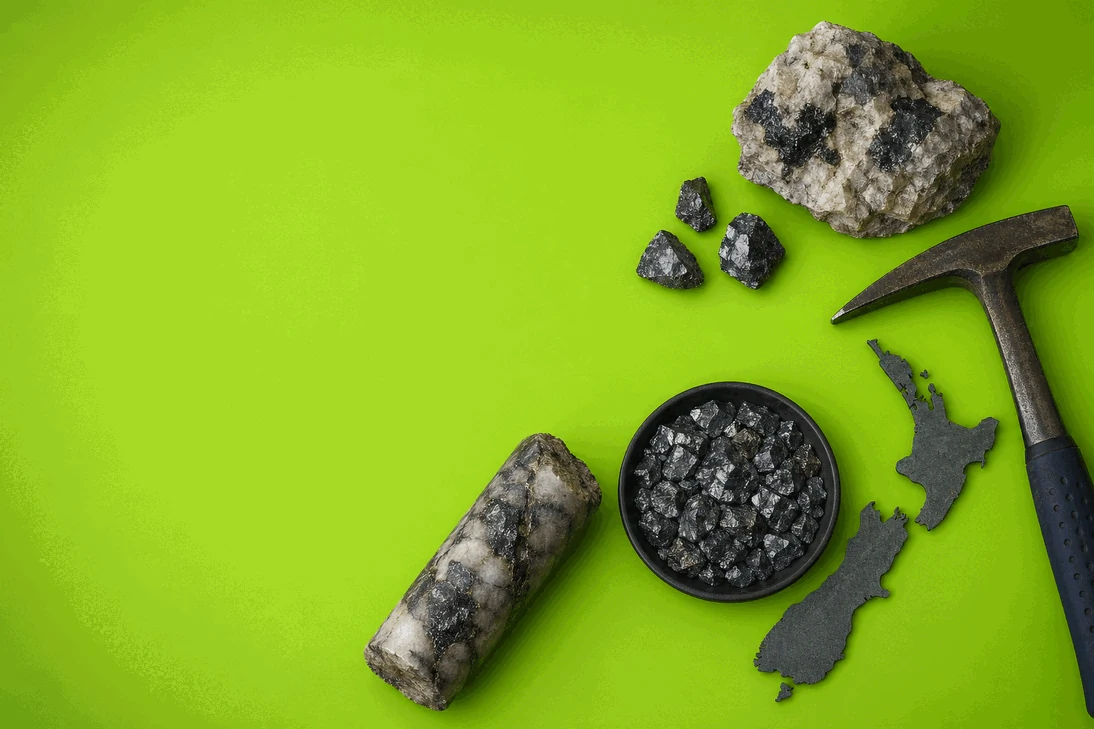
Critical Resources Limited (ASX:CRR) has elevated the Granite Creek tungsten target within its New Zealand portfolio after first-pass fieldwork confirmed greisen alteration and quartz vein outcrops consistent with historically reported high-grade tungsten mineralisation. The field team’s verification at Croesus, part of the 183 km² prospecting permit in the Reefton Goldfields region, substantiates historical grab samples that reached up to 42.6% WO3 from scheelite-rich quartz veins, exceptional grades that underscore the project's potential despite the selective nature of these samples.
The confirmation of greisen-hosted tungsten beyond previously sampled areas suggests a broader mineralised system than documented in the 1980s, though assay results from recent samples are pending, with initial laboratory returns expected in early June 2026. This development positions Granite Creek as a strategic priority amid a structurally tightened tungsten market, where prices have soared from roughly $335 per metric tonne unit (MTU) in January 2025 to between $2,900 and $3,200/MTU by April 2026, largely driven by Chinese export restrictions and accelerating Western demand.
Field Programs Advance Gold and Tungsten Targets
Alongside Croesus, Critical Resources completed first-pass fieldwork at the Lammerlaw Gold Project, located near Central Otago’s prolific Macraes gold operations. The program involved structural mapping and geochemical sampling across key trends including the OPQ Trend and Stony Creek, with assay results anticipated by mid-May 2026. These efforts complement ongoing exploration at Cap Burn and Rock and Pillar permits, where follow-up drilling and soil geochemistry mapping continue to test extensions of known gold systems.
These New Zealand initiatives build on the company’s broader 2026 exploration agenda, which also includes lithium and base metals projects in Canada and Australia. The rapid mobilization of field teams following permit approvals exemplifies Critical Resources’ commitment to advancing its critical minerals portfolio at pace, leveraging New Zealand’s pro-investment Fast-Track reforms and the country’s strategic alignment with Western critical minerals policies.
Strategic Importance of Tungsten in Western Supply Chains
Tungsten’s designation as a critical mineral by jurisdictions including the US, EU, UK, Japan, New Zealand, and Australia reflects its indispensable role in defence, aerospace, semiconductor manufacturing, and industrial tooling. With China controlling approximately 80-85% of global mine supply and recent export licensing restrictions tightening Western access, securing new sources in politically stable, Western-aligned jurisdictions has become a priority.
Critical Resources’ confirmation of a greisen-hosted tungsten system in New Zealand offers exposure to a strategically relevant supply opportunity. The company’s landholding of 1,694 km² across gold and critical mineral provinces provides a large-scale platform for exploration and potential resource development, with follow-up fieldwork and drilling planned to build on these early findings.
While the historic tungsten grades at Croesus are impressive, Critical Resources cautions that these are selective samples and not necessarily representative of continuous mineralisation. The pending assay results and subsequent exploration will be critical in defining the economic potential of these targets.
These developments follow earlier reports of the company’s advancing New Zealand exploration, including the confirmation of orogenic gold systems and initial field activities at Lammerlaw and Croesus, which have been supported by a $1.75 million capital raise earlier this year to fund these programs field exploration commenced. The company’s ongoing work at Cap Burn and Rock and Pillar further underscores its strategic focus on multi-commodity critical mineral districts in the region Cap Burn drilling confirms broad orogenic gold.
Bottom Line?
Critical Resources’ confirmation of greisen-hosted tungsten at Granite Creek arrives at a pivotal moment for tungsten markets, but assay results and follow-up exploration will be decisive in translating historic promise into tangible resource potential.
Questions in the middle?
- Will assay results confirm continuous tungsten mineralisation beyond selective high-grade samples?
- How will Critical Resources balance exploration across gold and critical minerals in New Zealand’s evolving portfolio?
- What impact will ongoing Chinese export restrictions have on tungsten project economics in Western jurisdictions?