Pure Resources' Carbon Nanotube Fibre Surpasses Copper and Aluminium in Thermal Conductivity

Pure Resources has demonstrated that its Carbon Nanotube Fibre (CNTF) achieves thermal conductivity up to 600 W/m·K, outperforming copper by 1.5 times and aluminium by up to 3 times, positioning it as a breakthrough for AI, defence, and high-power electronics cooling.
- CNTF thermal conductivity reaches ~600 W/m·K
- Performance exceeds copper by 1.5x, aluminium by 2.5-3x
- Flexible, textile-processable form enables new thermal designs
- Early talks with hyperscale data centres and defence primes
- Advancing US government funding via DoD and DoE programs

Thermal Conductivity Breakthrough Challenges Metal Standards
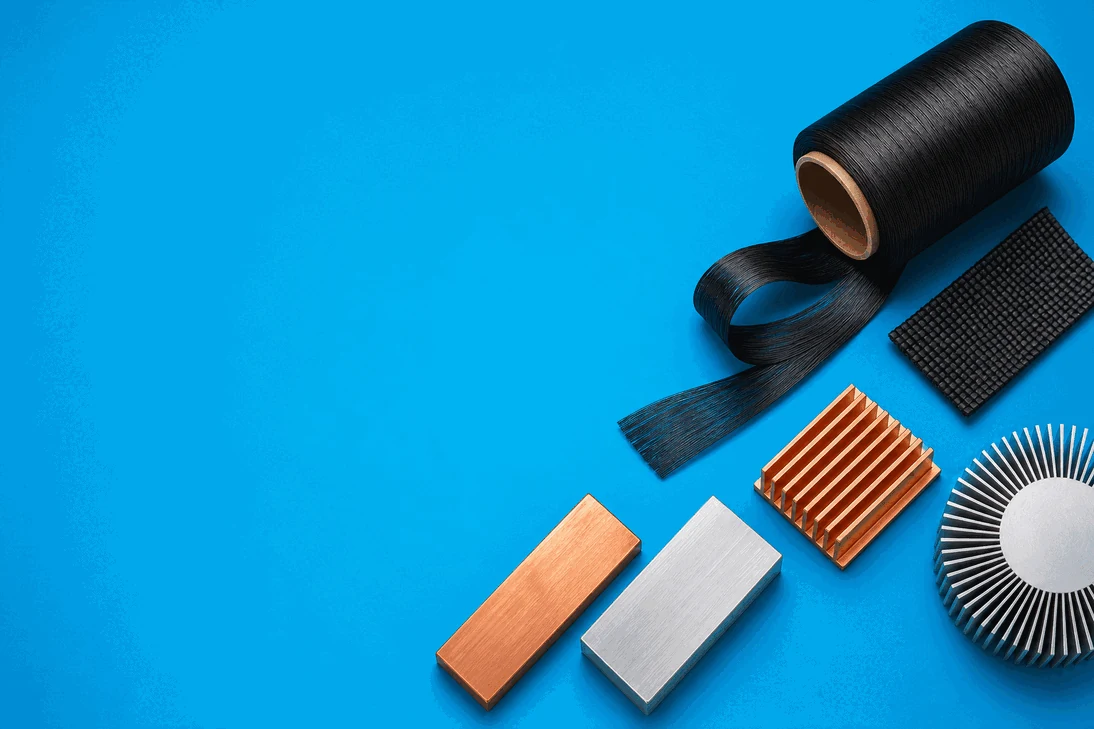
Pure Resources Limited (ASX:PR1) has revealed that its Carbon Nanotube Fibre (CNTF) achieves thermal conductivity levels of up to approximately 600 W/m·K, a figure that outstrips copper by about 1.5 times and aluminium by 2.5 to 3 times. These metals have been the backbone of thermal management for over fifty years, but CNTF's performance signals a potential paradigm shift, especially as AI data centres and high-power electronics grapple with intensifying cooling challenges.
Unlike rigid copper or aluminium, CNTF is flexible and can be processed into textiles, woven, knitted, or braided, enabling three-dimensional thermal architectures impossible with conventional metals. This opens doors to innovative cooling designs tailored for increasingly dense and power-hungry systems.
Commercial Engagement Accelerates with Strategic Partners
Pure Resources is actively engaging with hyperscale data centre operators, defence prime contractors, and advanced electronics manufacturers. These discussions span prototype evaluation, jointly funded development, and integration testing, indicating early traction in sectors where thermal management is a critical bottleneck.
The company is also advancing a structured funding strategy targeting the United States Department of Defense and Department of Energy programs. This dual approach of commercial collaboration and government funding aims to bridge the gap between technical validation and pilot-scale deployment, accelerating CNTF's path to market.
This momentum builds on Pure’s ongoing research collaboration with Rice University, where post-processing techniques like annealing and doping are being refined to push CNTF’s conductivity closer to the theoretical limits of individual carbon nanotubes. The partnership leverages graphite sourced from Pure's 100% owned Garnet Hills Project, integrating upstream mineral assets with advanced materials innovation Rice University collaboration details.
Strategic Material Advantages and Market Potential
CNTF’s reliance on non-critical minerals offers a strategic advantage amid global supply chain concerns for critical materials. The Garnet Hills Project itself benefits from a US Department of Energy partnership focused on rare earth recovery, complementing Pure’s vertically integrated approach from mine to advanced material Garnet Hills partnership with US DOE.
Interim CEO Rocco Tassone emphasised the broader implications: if upcoming property and performance data continue to validate CNTF’s promise, the addressable market could expand beyond AI infrastructure into defence applications like directed energy weapons and hypersonics, electric vehicle battery thermal management, aerospace, robotics, and grid-scale power electronics. Each represents a multibillion-dollar opportunity hinging on next-generation thermal management solutions.
Technical Nuances Beyond Conductivity
While the headline conductivity figure is impressive, Pure highlights that thermal management efficacy depends on more than bulk conductivity. CNTF maintains performance over wider temperature ranges and resists oxidation and creep issues that limit metals at high operating temperatures, critical factors for defence and aerospace applications.
Moreover, CNTF’s textile form factor allows for heat dissipation designs that conventional metals cannot replicate, addressing heat flux challenges in compact, high-power devices. This positions CNTF not just as a material upgrade but as an enabling technology for novel thermal architectures.
Bottom Line?
CNTF’s superior thermal properties and flexible form factor position Pure Resources at the forefront of next-gen cooling, but commercial scale-up and integration remain key hurdles ahead.
Questions in the middle?
- How quickly can Pure Resources transition CNTF from prototype to commercial deployment?
- What milestones will US government funding programs set for CNTF development?
- Can CNTF’s textile architectures be manufactured at scale to meet hyperscale data centre demands?