Six Drill Holes Return Significant Antimony at Desert Mine

Locksley Resources’ maiden diamond drilling at the Desert Antimony Mine reveals high-grade antimony mineralisation extending beneath historic underground workings, including a standout 33.51% Sb intercept.
- High-grade antimony confirmed below historical workings
- Peak assay of 33.51% Sb over 0.4m
- Six of eight drill holes yield significant mineralisation
- Drilling supports larger hydrothermal system hypothesis
- El Campo rare earth assays pending
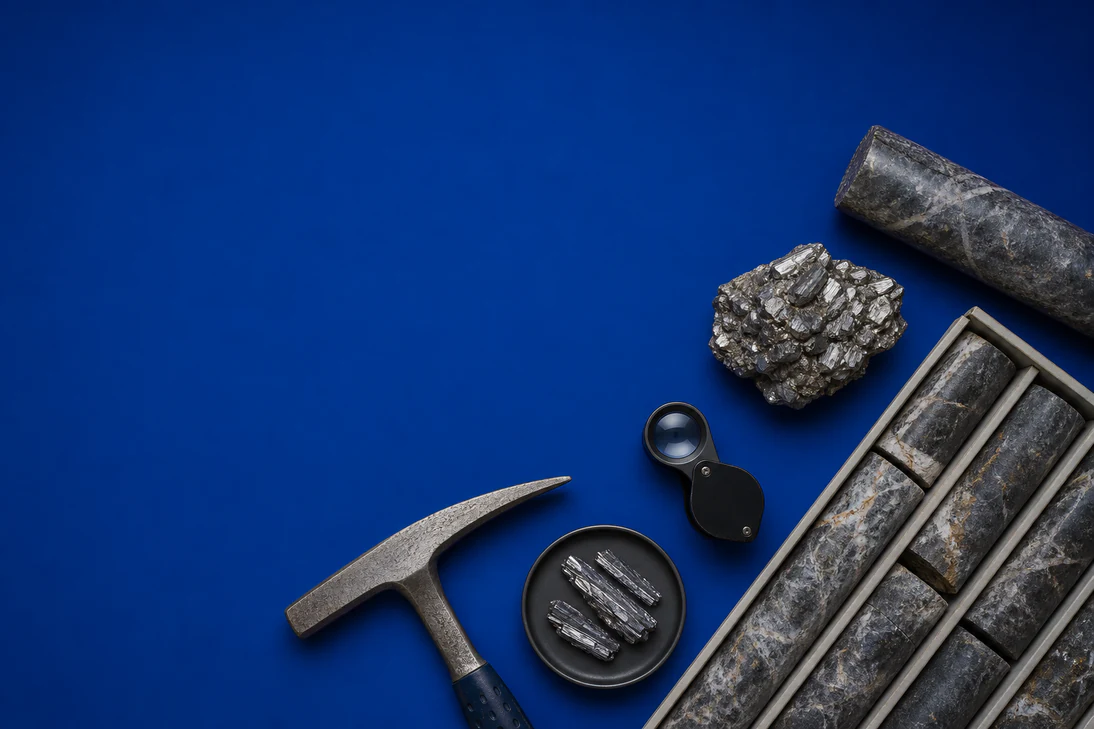

High-Grade Antimony Extends Below Historic Mine
Locksley Resources Limited (ASX:LKY) has delivered a strong validation of the Desert Antimony Mine’s untapped potential with assay results from its inaugural diamond drilling program. The campaign confirmed continuous high-grade antimony mineralisation beneath historical underground workings, a critical step in advancing the company’s mine-to-market strategy for U.S. domestic antimony supply.
Six of the eight completed drill holes intersected significant antimony, with one standout intercept in hole DADD0005A grading 33.51% Sb over 0.4 metres within a broader 4.0-metre zone averaging 4.87% Sb. Other notable results include 1.4 metres at 5.62% Sb and 2.0 metres at 2.69% Sb in separate holes. These results confirm that the mineralised veins persist well below the known workings, extending the resource footprint and supporting the geological model of a structurally controlled hydrothermal system.
Geological Model Strengthened by Drilling
The drilling targeted quartz-stibnite veins and breccias hosted within granite gneiss and tonalite, intersecting mineralisation up to 90 metres below the old underground levels. This continuity, combined with surface sampling and underground mapping, reinforces the interpretation of a larger mineralised system rather than isolated pockets. The findings will refine Locksley’s 3D geological model, improving future drill targeting and exploration efficiency.
Non-Executive Technical Director Ian Stockton noted the significance of confirming mineralised veins below historical workings, highlighting ongoing work to understand structural controls and integrate remaining assay results. This drilling milestone builds on the company’s previous activities, including the maiden drilling commencement at Desert Antimony Mine and the recent 99.5% pure antimony trioxide production breakthrough, underscoring the advancing domestic supply ambitions.
El Campo Rare Earth Drilling Completes with Assays Pending
Alongside Desert Antimony, Locksley has completed a four-hole diamond drilling program at the El Campo Rare Earth Element (REE) prospect within the Mojave Project. All drill core samples have been submitted for assay, with results expected shortly. The El Campo prospect lies adjacent to the Mountain Pass REE mine, the only operating rare earth deposit in the district, making it a strategically important target for critical mineral supply chains.
Ongoing exploration includes detailed radiometric surveys and geological mapping to follow up on priority anomalies identified in late 2025. This regional work aims to capitalise on newly revealed targets and supports a comprehensive approach to resource definition across the Mojave Project.
Next Steps Focus on Integration and Expansion
Locksley plans to progressively report remaining assay results from both Desert Antimony and El Campo drilling. The company will integrate these data into updated 3D models to optimise follow-up drilling and assess the potential for parallel mineralised structures. Metallurgical and mineralogical studies are also underway to evaluate processing pathways.
With the Desert Antimony results indicating a potentially larger hydrothermal system, the company’s broader exploration strategy includes re-assaying historical samples and ground radiometric surveys to delineate additional high-priority targets. This multi-pronged approach aims to build a robust pipeline of critical mineral resources in California.
Bottom Line?
The Desert Antimony drilling results mark a pivotal step in verifying substantial high-grade mineralisation, yet pending assays and further modelling will be crucial to defining the project’s full potential.
Questions in the middle?
- Will pending assays from Desert Antimony and El Campo confirm further high-grade zones?
- How will metallurgical studies influence the economic viability of the antimony mineralisation?
- Can Locksley’s integrated mine-to-market strategy accelerate U.S. critical mineral supply chain independence?