Haranga Completes Deep RC Drilling at Ibel South with Extensive Alteration

Haranga Resources has wrapped up its Phase 3 Reverse Circulation drilling at Senegal’s Ibel South, revealing pervasive hydrothermal alteration and pyrite mineralisation consistent with a Birimian-style gold system. Assay results expected by end June will determine the next exploration steps.
- 3,244m RC drilling completed across 19 holes
- Extensive hydrothermal alteration and pyrite mineralisation observed visually
- Three holes ended in mineralised material, open at depth
- Photon Assay samples dispatched, results due end June
- Follow-up RC and Diamond Drilling planned pending assays
 Add us as a preferred source on Google
Drilling Campaign Expands Depth and Strike at Ibel South
Haranga Resources (ASX:HAR) has completed a 3,244-metre Reverse Circulation (RC) drilling campaign at its Ibel South Gold Project in Senegal, testing 19 holes across 11 drill lines. The program notably pushed testing depths up to 306 metres, a significant increase from previous aircore drilling that averaged around 30 metres depth. This expansion has allowed Haranga to explore deeper and along strike over approximately 1.5 kilometres of prospective Birimian-aged greywacke, a style of geology known for hosting orogenic gold deposits.
The Phase 3 drilling targeted priority Termite Mound Sampling (TMS) anomalies, including extensions of the previously reported high-grade intercept at TMS Anomaly 3, which yielded 20 metres at 6.0 g/t gold from 12 metres, including 4 metres at 14.1 g/t gold. The campaign also tested previously untested anomalies at TMS 1 and TMS 2, broadening the exploration footprint.
Visual Logging Reveals Extensive Hydrothermal Alteration and Pyrite
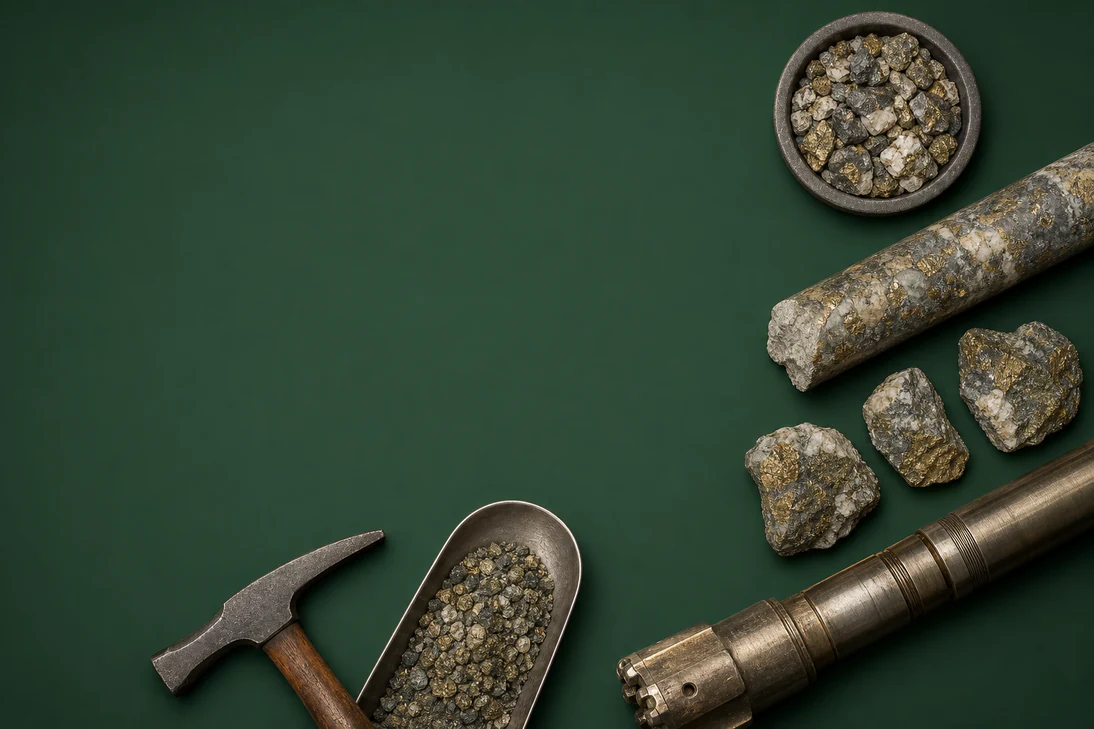
While assay results are pending, visual geological logging has identified significant hydrothermal alteration and pyrite mineralisation in 10 of the 19 holes. Noteworthy intersections include 75 metres of brecciated and silicified pyrite-bearing greywacke in hole RC0003 and 45 metres in hole RC0017. Three holes (RC0013, RC0016, and RC0017) ended within mineralised material, indicating the system remains open at depth and reinforcing the potential for further mineralisation below current drill depths.
Haranga’s Chief Operating Officer, Jean Kaisin, led detailed chip logging and structural interpretation, which now converges with reprocessed regional aeromagnetic data and surface mapping of two artisanal gold workings. These collectively delineate two structural corridors trending 060°–070° and 010°, the latter coinciding with artisanal mining activity. This integrated structural framework provides a robust model for targeting follow-up drilling.
Photon Assay Samples Dispatched, Results Expected by June
Samples from the RC program have been dispatched to MSA Labs in Bamako, Mali, for Photon Assay analysis, a non-destructive, high-throughput technique that analyses large sample masses (~500 g) to reduce the nugget effect common in coarse gold systems. This JORC-compliant method is widely used by Australian gold producers and offers rapid turnaround. Haranga expects to receive the first batch of assay results by the end of June 2026.
Pending positive assay outcomes, the company plans a follow-up Phase 4 campaign combining RC and diamond drilling to test depth extensions below the three holes that ended in mineralised material and to infill and expand strike coverage. This next phase aims to refine the geological model and potentially delineate a resource. The program also contemplates verification assays using traditional fire assay methods, leveraging the non-destructive nature of Photon Assay samples.
Permit Renewal and Project Advancement
Haranga is concurrently preparing its permit renewal application for the Ibel South Exploration Permit, which expires in August 2026. The renewal submission is due by 18 June 2026 and will include a comprehensive report summarising the four-year permit term, incorporating the new geological and structural insights gained from the Phase 3 drilling.
This drilling campaign builds on Haranga’s recent momentum, following its delivery of a maiden JORC Mineral Resource Estimate of 402,000 ounces at 5.1 g/t gold at the Lincoln Gold Project in California, which benefits from substantial infrastructure and permits for mining. The Ibel South program complements this brownfield asset by advancing a greenfield opportunity with promising early-stage results and a well-defined structural framework. The company’s strategic approach to integrating multiple datasets and deploying advanced assay technology positions it well to unlock value from its Senegal portfolio.
Haranga’s decision to conclude the Phase 3 RC drilling at 3,244 metres, slightly below the initially planned 4,000 metres, reflects a pragmatic balance between testing depth extensions and managing budget, especially given challenging ground conditions encountered. The campaign was completed safely and efficiently under difficult field conditions, including wet saprolite zones requiring adapted drilling techniques.
With assay results imminent, the market will be watching closely to see if the visual indications of a Birimian-style orogenic gold system translate into meaningful gold grades, which could set the stage for a transformative exploration phase in Senegal for Haranga.
These developments follow Haranga’s recent 402koz maiden JORC resource announcement at Lincoln and its 4,000m RC drilling launch earlier this year, underscoring a dual-track growth strategy across its global assets.
Bottom Line?
Assay results expected by end June will be pivotal in confirming the gold potential at Ibel South and shaping Haranga’s next drilling phase.
Questions in the middle?
- Will the Photon Assay results confirm significant gold grades within the extensive pyrite mineralisation observed?
- How will the structural framework refined by drilling and aeromagnetic data guide future targeting and resource delineation?
- What impact will the permit renewal process have on the timing and scope of follow-up exploration at Ibel South?