Riversgold’s Saint John Project Yields High-Grade Copper and Gold Assays

Riversgold’s farm-in partner AIS Resources reports standout rock chip assays from the Saint John Project in New Brunswick, with multiple samples exceeding upper detection limits for copper, gold, silver, and antimony. These results underpin plans for systematic exploration and drilling.
- Six samples exceed 1% copper
- Two samples surpass 5 g/t gold
- Multi-element mineralization includes silver, antimony, and lead
- AIS progressing towards drilling phase
- Riversgold retains 25% free-carried interest
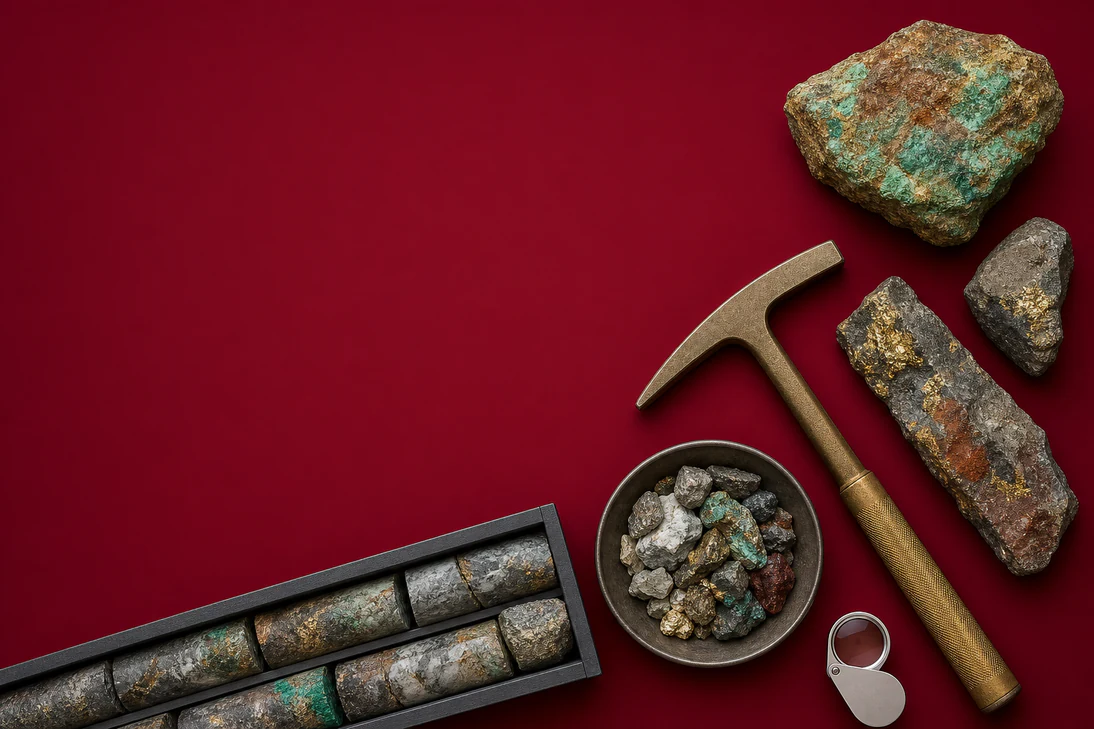

High-Grade Surface Assays Signal Potential
Riversgold Limited (ASX:RGL) has revealed encouraging early-stage assay results from its Saint John Project in New Brunswick, Canada, delivered by farm-in partner AIS Resources (TSXV:AIS). Among 24 rock chip samples analysed, six returned copper values above 10,000 ppm (equivalent to >1% Cu), while two samples from the Lepreau Prospect exceeded 5,000 ppb gold (over 5 g/t Au). Silver, antimony, and lead also featured prominently, with several samples surpassing preliminary upper detection limits.
Exploration Advancing Towards Drilling
These preliminary assays form part of AIS’s ongoing due diligence and exploration work, which includes geological mapping, prospecting, and geochemical sampling. The company has already contracted a local driller and is preparing for its maiden drill program, aiming to test the promising IOCG-style mineralisation model. Riversgold retains a 25% free-carried interest through to decision to mine, while AIS can earn up to 75% by spending C$4.4 million over four years.
Geological Setting Supports Multi-Element Targets
The Saint John Project sits within a complex Appalachian geological province, known for hosting copper, gold, silver, antimony, cobalt, nickel, and other critical minerals. The mineralisation appears linked to intrusive-related, magmatic copper-gold systems and structurally controlled copper-silver-gold veins. Historical data combined with AIS’s surface sampling reinforce the presence of multiple mineralisation styles across several prospects, including Prince of Wales, Lepreau, and Scott Falls Dam.
Assay Highlights and Next Steps
Noteworthy assay results include copper concentrations exceeding 10,000 ppm in six samples, gold values topping 5,000 ppb in two Lepreau samples, and antimony levels surpassing 500 ppm in six samples. Lead and molybdenum also showed elevated values in select locations. Some samples exceeded the upper detection limits and will be re-assayed using more appropriate laboratory methods to confirm these high-grade values.
Riversgold’s Executive Chairman David Lenigas emphasised the significance of the results, noting that the initial work has reconfirmed elevated critical mineral values and supports the need for continued systematic exploration. The company anticipates further assay updates as new samples are processed and integrated with geophysical data to refine drill targets.
Strategic Farm-In Partnership and Project Tenure
The farm-in agreement with AIS Resources offers Riversgold a capital-light pathway to advance the Saint John Project. AIS’s commitment to spend C$4.4 million over four years to earn a majority stake aligns with the company’s strategy to leverage partnerships for exploration funding. The project comprises five mineral claims in good standing, with annual renewal expenditures totaling approximately C$80,100. Riversgold holds the option to acquire 100% interest from Geosearcher Inc. and Robert Murray, subject to staged payments and royalty arrangements.
Bottom Line?
With high-grade surface assays confirming multi-element mineralisation, Riversgold’s Saint John Project is poised for a critical drilling phase that will test the true scale and economic potential of its IOCG-style targets.
Questions in the middle?
- Will the upcoming drill program validate the continuity and extent of high-grade mineralisation indicated by surface samples?
- How will the re-assaying of overlimit samples impact the interpretation of grade distribution and project economics?
- What role will integrated geophysical data play in refining drill targets and accelerating resource definition?