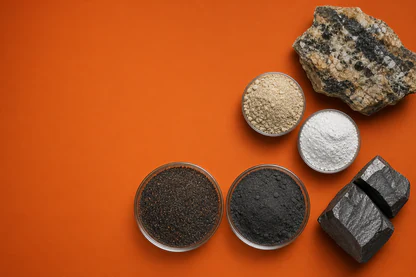
IperionX Titan DFS Confirms Shovel-Ready US Critical Minerals Project with US$813 Million NPV

IperionX’s Titan Definitive Feasibility Study outlines a shovel-ready Tennessee project targeting heavy rare earths, titanium, zirconium, and hafnium with robust economics and strategic US supply chain implications.
- After-tax NPV of US$813 million and 39.4% IRR
- Shovel-ready project with key permits and infrastructure
- Production ramp-up targeted for September 2028
- Focus on heavy rare earths, titanium, zirconium, and hafnium
- Vertically integrated US titanium supply chain platform
 Add us as a preferred source on Google
Titan Project Sets Stage for US Critical Minerals Independence
IperionX (ASX:IPX) has unveiled a comprehensive Definitive Feasibility Study (DFS) for its Titan Project in Tennessee, confirming a shovel-ready critical minerals operation with an after-tax net present value (NPV) of US$813 million and an internal rate of return (IRR) of 39.4%. The project targets a suite of strategic materials including heavy rare earths (Dy, Tb, Y), light rare earths (Nd, Pr), titanium, zirconium, and hafnium; all essential for defence, aerospace, nuclear, semiconductor, robotics, and advanced manufacturing supply chains.
With total capital expenditure pegged at US$381 million split across two development phases, Titan aims for a production ramp-up completion by September 2028. The project benefits from key state permits already granted, established infrastructure, and a clear execution pathway, positioning it as a cornerstone for US supply chain resilience amid growing concerns over foreign dependencies.
Strategic Mineral Streams Backed by Robust Economics
The DFS outlines a 14-year mine life with a total life-of-mine EBITDA of US$2.8 billion and after-tax free cash flow of US$1.9 billion. Phase 2 alone is forecasted to deliver average annual EBITDA of US$226 million and after-tax free cash flow of US$172 million. Operating costs are competitive, estimated at US$10.57 per tonne of ore during Phase 2.
Production targets include approximately 5,300 tonnes per annum of heavy rare earth concentrate (HREC) rich in dysprosium, terbium, and yttrium; 65,700 tonnes of zircon concentrate; and 143,300 tonnes of titanium minerals annually at full Phase 2 scale. These outputs are critical to addressing US supply bottlenecks, particularly in heavy rare earths where Titan’s projected dysprosium and terbium output materially exceeds that of MP Materials, the country’s leading rare earths producer.
Titanium Supply Chain Re-shoring with Proprietary Technologies
Beyond mineral extraction, IperionX is advancing vertically integrated titanium metal production in Virginia. The company’s patented HAMR and HSPT processes enable titanium powder and near-net-shape forged parts manufacturing, targeting defence and aerospace markets. Phase 2 production is expected to yield around 58,000 tonnes of contained titanium metal from ilmenite and rutile feedstocks annually, supporting a US titanium supply chain largely reliant on imports and high-cost processes.
This integrated approach aims to reduce US dependence on foreign titanium metal, especially from China and Russia, by leveraging domestic mineral reserves and advanced manufacturing technologies. IperionX’s titanium operations have recently expanded capacity, including commissioning advanced powder metallurgy presses, further underpinning the project’s strategic value.
Addressing Critical Defense and Technology Supply Gaps
Titan’s diverse mineral portfolio tackles several US supply chain chokepoints. Heavy rare earths like dysprosium and terbium are vital for high-temperature magnets in missiles, drones, and radar systems. Zirconium and hafnium support nuclear fuel systems, control rods, semiconductors, and advanced ceramics. The project’s hafnium supply is particularly timely given surging demand from AI memory technologies, which could strain global supply due to limited zircon feedstock and separation capacity.
With US government backing, including a US$47.1 million IBAS award from the Department of War, Titan is positioned to become a strategic domestic supplier across multiple high-tech sectors. Its proximity to infrastructure and shovel-ready status further enhance its appeal as a national security asset.
Comparative Scale and Industry Positioning
Titan’s ore reserves total 117 million tonnes at 3.17% total heavy minerals (THM), significantly larger in scale than Mountain Pass, MP Materials’ flagship rare earth mine, which holds 29 million tonnes at 5.9% total rare earth oxides (TREO). While grades differ due to reporting standards, Titan’s volume and multi-mineral output diversify US critical mineral supply beyond rare earths alone.
The project’s staged capital deployment and low-risk open-pit mining approach, avoiding drilling or blasting, add to its development appeal. The Titan DFS confirms no material changes to previously reported resource estimates and production targets, reinforcing confidence in the project’s fundamentals.
As IperionX advances construction and commissioning plans, market watchers will be keen to track funding progress and the company’s ability to scale titanium metal production in parallel with mineral extraction. The interplay between critical mineral supply and downstream manufacturing capacity remains pivotal for US industrial strategy in a geopolitically sensitive sector.
Bottom Line?
Titan’s shovel-ready status and diversified critical mineral output position it as a potential linchpin in US supply chain security, but execution and funding remain key hurdles ahead.
Questions in the middle?
- Will IperionX secure the necessary funding to meet its aggressive 2028 production ramp-up?
- How will Titan’s titanium metal production scale alongside mineral extraction to impact US supply chains?
- Can Titan’s heavy rare earth output effectively reduce US reliance on Chinese supply chains amid rising demand?