Nanoveu’s ECS-DoT AI Chip Boosts Drone Energy Efficiency by Up to 27.8% in Live Trials

Nanoveu’s ECS-DoT AI chip has demonstrated up to 27.8% improvement in drone cruise energy efficiency in live flight tests, achieving gains without any hardware changes and consuming negligible power.
- Up to 27.8% drone energy efficiency improvement in live flights
- ECS-DoT AI optimises speed tightly around aerodynamic optimum
- No hardware modifications required; sub-10 milliwatt power consumption
- Efficiency gains most pronounced during turns and transitions
- Advanced IP filings underway to protect proprietary technology
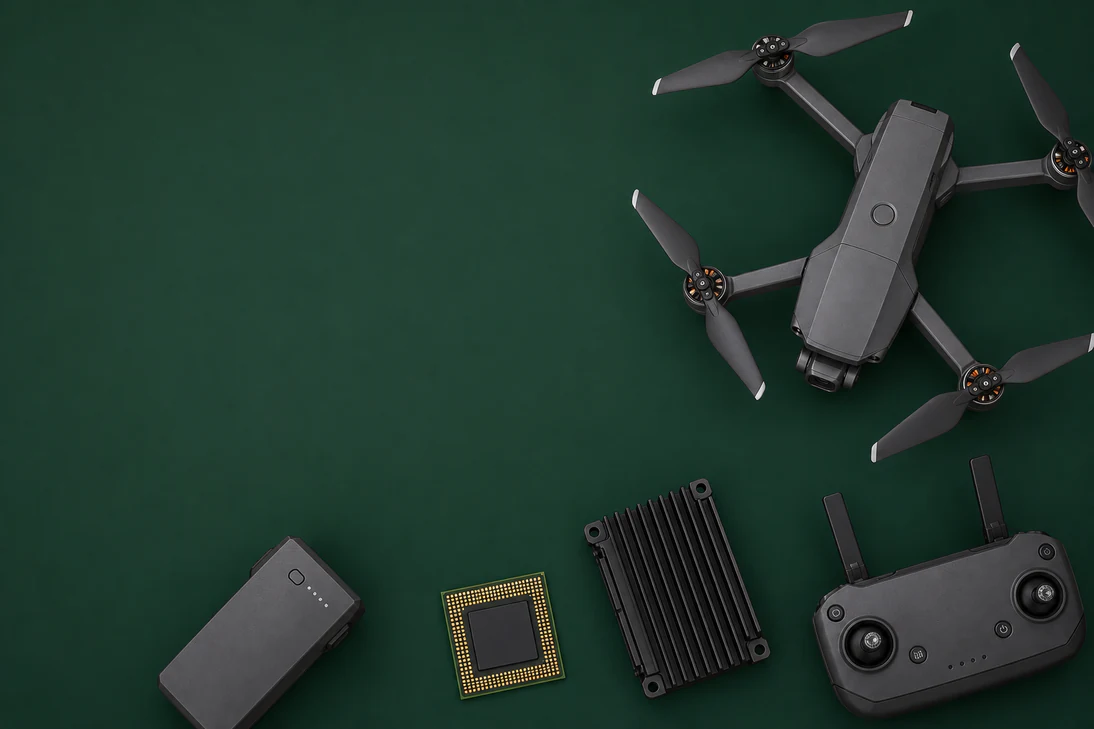

Live Drone Trials Confirm ECS-DoT’s Real-World Efficiency Gains
Nanoveu Limited (ASX:NVU) has taken a significant step forward in drone AI optimisation with its ECS-DoT chip demonstrating up to 27.8% improvement in drone energy efficiency during live flight trials. These gains, achieved without any changes to the drone’s battery, airframe, or propulsion, validate earlier simulation results and highlight the potential of software-driven endurance improvements in commercial drone operations.
The trials, conducted by Nanoveu’s subsidiary EMASS, employed a rigorous four-phase empirical method. Starting with fixed waypoints and speeds, the drone flew control runs under a standard PX4 autopilot, followed by identical flights with ECS-DoT active. This controlled setup isolated ECS-DoT as the sole variable, enabling a direct apples-to-apples comparison of battery consumption and flight efficiency.
Precision Speed Control Drives Efficiency at Every Flight Stage
The core of ECS-DoT’s advantage lies in its real-time AI optimisation of drone speed. Unlike traditional autopilots that allow speed variance around a target, ECS-DoT holds the drone tightly at its aerodynamic optimum, minimising energy waste. This was evident in cruise speed distribution charts showing a narrow, consistent speed cluster under ECS-DoT versus a broader spread with standard control.
Energy savings were particularly notable during turns and waypoint transitions; segments where conventional autopilots consume the most power due to deceleration and acceleration cycles. ECS-DoT’s AI adjusts speed continuously at 64 Hz, consuming less than 10 milliwatts of power; just 0.0002% of the drone’s total cruise energy; ensuring nearly all battery capacity is preserved for propulsion.
Consistent Gains Across Speeds and Flight Profiles
Testing at 4 m/s and 6 m/s cruise speeds yielded efficiency improvements of 27.8% and 26.7% respectively, averaging 27.2% across both conditions. The consistency suggests ECS-DoT’s AI adapts effectively across different flight regimes, from slower flights with frequent turns to faster, straighter legs closer to aerodynamic optimum. Efficiency overlays showed positive gains throughout entire flight paths, with the largest improvements clustered at corners.
These results represent a conservative baseline; Nanoveu expects further gains as AI models mature, testing expands to heavier drones, and multi-chip deployments compound endurance and onboard AI capabilities.
Commercial Applications and Integration Efforts Underway
Nanoveu is advancing ECS-DoT’s integration with third-party flight controllers, including closed proprietary systems common in commercial and defence drones. This plug-and-play approach allows ECS-DoT to optimise flight efficiency externally via telemetry inputs without requiring internal controller access.
The technology’s value proposition spans urban surveillance, precision agriculture, defence perimeter monitoring, and last-mile delivery. By reducing battery swaps and extending mission coverage, ECS-DoT promises lower operating costs and improved unit economics across these sectors.
Meanwhile, Nanoveu is in the final stages of filing major intellectual property protections covering its AI flight optimisation framework, endurance modelling, and UAV integration architecture; laying groundwork for a global licensing strategy.
Industry Experts Highlight Software-Driven Endurance Shift
Dr Mohamed M. Sabry Aly, EMASS founder, emphasised the significance of achieving endurance gains without hardware changes, stating that ECS-DoT’s sub-10 milliwatt AI loop holds drones closer to their aerodynamic optimum continuously. Dr Tan Chee How, CEO of Spinoff Robotics, noted that flight endurance has traditionally hinged on hardware improvements, but ECS-DoT’s software-centric approach could reshape the economics of commercial drone adoption.
Bottom Line?
Nanoveu’s ECS-DoT AI chip’s live trial success sets a new benchmark for drone endurance gains via software, but scaling across platforms and commercial uptake remain to be seen.
Questions in the middle?
- How will ECS-DoT perform on larger, heavier drone classes beyond initial trials?
- What timelines and partners will Nanoveu secure to commercialise ECS-DoT at scale?
- Can Nanoveu’s IP protections effectively fend off competitors in the drone AI optimisation space?