Turnstone Resources Reports High-Grade Copper-Gold Assays at Glava and Validates Historic Drilling

Turnstone Resources has reported standout rock chip assays up to 31.6g/t gold and 12.9% copper at its Glava project in Sweden, alongside validation of historic drill core at Torsby West, reinforcing the potential for a sizeable copper-gold system.
- Glava rock chips assay up to 31.6g/t Au and 12.9% Cu
- Geological mapping suggests larger mineralised system at depth
- Historic drilling at Torsby West core resampled and validated
- Drone magnetic surveys completed to refine exploration targets
- Turnstone finalising systematic exploration plan for Swedish licences
 Add us as a preferred source on Google
High-Grade Copper-Gold Sampling Boosts Glava Prospectivity
Turnstone Resources Ltd (ASX:TSR) has delivered compelling rock chip results from its Glava project in Sweden’s Värmland region, with assays reaching up to 31.6 grams per tonne (g/t) gold and 12.9% copper. These results, drawn from six samples collected at historic East and West Pit workings, confirm a robust copper-gold-silver association that underpins the company’s thesis of a concealed, larger mineralised system at depth.
The standout sample GLV6 returned 31.6g/t Au, 12.9% Cu, and 752g/t silver, accompanied by bornite and malachite mineralisation. Other samples similarly showed multi-gram gold grades and significant copper percentages, highlighting narrow vein systems rich in bornite and tellurides. Geological mapping has identified a southeast-plunging mineralised vein along a faulted contact, suggesting an intrusive-related source that may extend at depth.
Historic Drilling at Torsby West Validated by Core Resampling
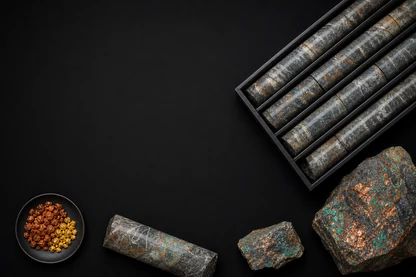
Turnstone’s exploration team has also revisited the Torsby West project, located within the structurally complex Sveconorwegian Orogeny. Here, the company resampled 29 core intervals from historic drill holes stored at the Swedish Geological Survey. The resampling results closely matched the original assays, reaffirming broad zones of copper mineralisation consistent with an IOCG-style (Iron Oxide Copper Gold) system.
The project’s geology features high-grade gneiss and reactivated shear zones with disseminated chalcopyrite-magnetite mineralisation, silicification, and iron-rich alteration along major structural corridors. A recent drone magnetic survey aims to delineate priority drill targets across a prospective 30-kilometre strike length, advancing the understanding of this underexplored district.
Strategic Licence Acquisition and Exploration Planning
Following the exercise of its option to acquire seven licences from McKnight Resources AB, including the pivotal Glava 100 permit, Turnstone is consolidating its foothold in south-west Sweden. The portfolio now offers exposure to multiple copper-gold discovery opportunities within a single district, with exploration activities staged to optimise cost-effectiveness.
Upcoming work includes planned ground-based geophysical surveys such as Induced Polarisation (IP) and Electromagnetic (EM) methods, designed to target sulphide-rich bodies at depth ahead of drilling. The company is finalising a 12-month exploration plan that will systematically advance its priority prospects, building on the recent geological mapping and sampling successes.
Implications for Turnstone’s Swedish Copper-Gold Ambitions
These latest results reinforce Turnstone’s narrative of a highly prospective copper-gold province in Värmland. The combination of high-grade surface assays at Glava and the validation of historic drilling data at Torsby West provides a strong foundation for the next phase of exploration. While the true scale and economic viability of these mineralised systems remain to be tested, the company’s methodical approach and expanding licence footprint position it to capture significant upside potential.
With drilling planned for the second half of 2026 and geophysical surveys underway, the market will be watching how Turnstone translates these early-stage findings into defined resources. The company’s ability to delineate drill targets that confirm a larger mineralised system at depth will be critical in shaping its path forward.
Bottom Line?
Turnstone’s high-grade assays and historic drill validation mark a promising step, but the real test lies in upcoming geophysics and drilling to define resource potential.
Questions in the middle?
- Will the planned IP and EM surveys at Glava successfully delineate a drill-ready target?
- Can Turnstone’s systematic approach uncover a sizeable copper-gold deposit at depth?
- How soon might drilling results from the expanded Swedish portfolio provide clarity on economic viability?