Gold Hydrogen Flows and Purifies Helium at Ramsay 1, Boosting Commercial Prospects

Gold Hydrogen has successfully flowed, purified, and bottled helium at its Ramsay 1 well, confirming a highly productive reservoir and advancing the project towards commercial viability with promising helium rates and purity.
- Helium flowed, purified, and bottled onsite at Ramsay 1
- Reservoir productivity index up to 34 bbl/day/psi, well above typical reservoirs
- Helium purity stabilised at 19%, raw gas helium concentration up to 13%
- Commercial viability possible with as few as two wells, per independent Worley report
- Accelerated FEED planned alongside ongoing Ramsay 2 and 3 testing
 Add us as a preferred source on Google
Helium Flow and Purification Achieved Onsite for First Time Since 2023
Gold Hydrogen Limited (ASX:GHY) has marked a significant milestone by successfully flowing helium to surface, purifying it onsite, and bottling at its Ramsay 1 well on South Australia’s Yorke Peninsula. This marks the first time helium has been concentrated and bottled in Australia since the closure of the Darwin plant in late 2023, re-establishing a domestic helium production footprint amid a tight global supply environment.
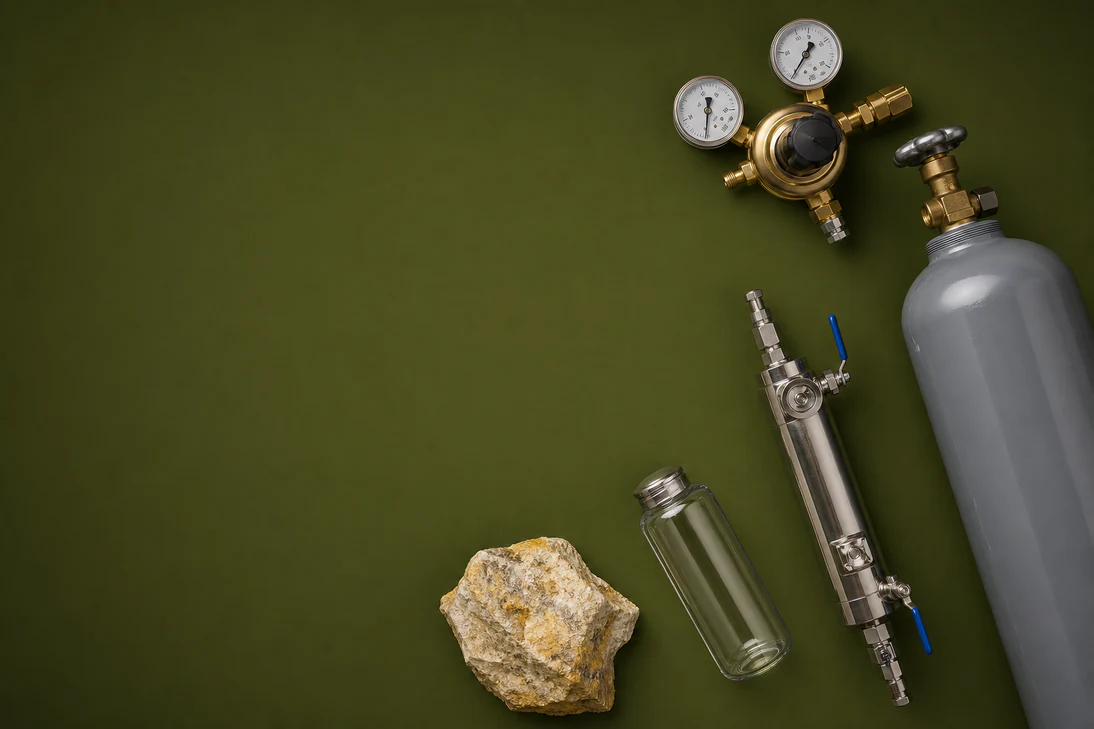
The company utilised purification equipment from Quantum Technology Corporation of Canada to separate and concentrate helium, achieving onsite helium purity stabilised at approximately 19% (air-corrected), with raw gas helium concentration reaching up to 13% and still rising when testing concluded. These purity levels compare favourably with global helium projects, many of which operate commercially at purities as low as 1%.
Exceptional Reservoir Productivity Surpasses Industry Norms
Flow testing at Ramsay 1 confirmed an exceptionally productive reservoir within the Kulpara Dolomite formation, delivering raw gas rates up to ~128 Mscf/day and helium rates up to ~24.3 Mscf/day. The well recorded a Productivity Index (PI) of up to 34 barrels per day per psi, a figure that substantially exceeds the sub-2 PI typical of commercial low-permeability reservoirs worldwide.
This high PI indicates strong reservoir deliverability, with the flow test limited not by the reservoir but by the installed pump capacity. The electrical submersible pump (ESP) used had a rated capacity of 2,000 bbl/day, which capped fluid production despite the reservoir’s ability to support significantly higher rates. Gold Hydrogen plans to deploy a 20,000 bbl/day ESP in the upcoming Ramsay 3 well to test higher flow rates.
Independent Worley Assessment Supports Commercial Viability with Minimal Wells
An independent assessment by Worley, referenced in Gold Hydrogen’s May 2026 release, evaluated three helium production scenarios and concluded that commercial development of the Ramsay Project may be viable with as few as two wells. Ramsay 1’s flow test results align with this assessment, confirming that reservoir deliverability is not a constraint and that engineering variables such as pump capacity are manageable.
The project’s development model is analogous to established dissolved-gas-in-water helium operations globally, including in Japan where strategic investors ENEOS and Mitsubishi Gas Chemical have operated similar projects for decades. This adds credibility to Gold Hydrogen’s commercial pathway and supports the company’s plans to accelerate Front-End Engineering Design (FEED) for a helium-focused development.
Toward Maiden Contingent Resources and Pilot Development
Ramsay 1’s flow test is a critical step toward booking maiden Contingent Resources for helium. The test demonstrated helium flow to surface, quantified reservoir deliverability, confirmed helium concentration under flowing conditions, and validated the recovery and processing route through onsite separation and purification.
Combined with forthcoming flow test results from Ramsay 2 and Ramsay 3, and the independent Worley assessment, the data package is expected to support the conversion of a portion of Gold Hydrogen’s Prospective Resources, currently estimated at a mean of 96 billion cubic feet of helium, into Contingent Resources.
Market Conditions and Next Steps
Global helium supply remains constrained, notably due to disruptions at Qatar’s Ras Laffan facility, which removed an estimated 30–35% of global supply for 12 to 18 months. Long-term contract prices have climbed above $600 per thousand cubic feet (MCF), positioning Gold Hydrogen to potentially re-establish domestic helium production in Australia, which has relied entirely on imports since 2023.
The company is progressing to zonal testing at Ramsay 2 throughout August, targeting gas-bearing reservoirs and prioritising natural hydrogen-bearing Parara Limestone zones. Ramsay 3 will follow with a purpose-built completion to accommodate higher-capacity pumping and more extensive testing.
While the results at Ramsay 1 are promising, they stem from an exploration well with a sub-optimal completion and limited flow rates. Laboratory confirmation of field measurements is pending, and both geological and development risks remain. The company cautions that commercial recoverability and sustained long-term flow rates have yet to be demonstrated.
Bottom Line?
Gold Hydrogen’s Ramsay 1 test delivers a rare Australian helium success story, but scaling production and securing commercial status hinge on upcoming flow tests and FEED progress.
Questions in the middle?
- Will Ramsay 2 and 3 flow tests confirm sustained high helium rates and purity at commercial scale?
- How will Gold Hydrogen manage engineering challenges to deploy higher-capacity pumps and surface facilities?
- What impact will tightening global helium supply and pricing have on the Ramsay Project’s commercial negotiations?