Core Lithium Extends High-Grade Lithium Mineralisation at BP33

Core Lithium has delivered high-grade lithium intersections at BP33, reinforcing the deposit's scale and underground mining potential with ongoing drilling set to expand resources further.
- NMRD100 drill hole returns 34m at 2.09% Li2O
- Results confirm extensions beyond 10.5Mt @ 1.53% Li2O resource
- Four additional holes planned to test mineralisation down dip and strike
- Blackbeard exploration drilling underway with rig expansion planned
- BP33 deposit characterised by uniform pegmatite ideal for underground mining
High-Grade Lithium Intersected Beyond Existing Resource
Core Lithium Ltd (ASX:CXO) has reinforced the potential of its BP33 deposit within the Finniss Lithium Operation with new drill results that confirm high-grade extensions beyond the current Mineral Resource Estimate (MRE). The first exploration diamond drill hole (NMRD100) intersected a substantial 34.08 metres grading 2.09% lithium oxide (Li2O) starting at 578.7 metres depth, including several thicker intervals exceeding 2.2% Li2O. A further 3.43 metres at 2.44% Li2O was also recorded deeper in the hole.
This follows a previous hole, NMRD085, which intersected 90.17 metres at 1.80% Li2O from 568.83 metres, already outside the existing resource boundary of 10.5 million tonnes at 1.53% Li2O. The new results from NMRD100 not only confirm the continuity of high-grade spodumene mineralisation but also demonstrate the deposit’s robust geometry and grade consistency.
BP33’s Unique Geology Supports Underground Mining
Managing Director Paul Brown highlighted BP33’s distinctive characteristics: "A large, continuous, uniform, sub-vertical pegmatite with consistent grade, minimal internal zoning and favourable geometry for underground mining." These traits underpin BP33’s role as a long-life, low-cost production base for Finniss, which is already advancing underground development with first ore targeted by mid-2027.
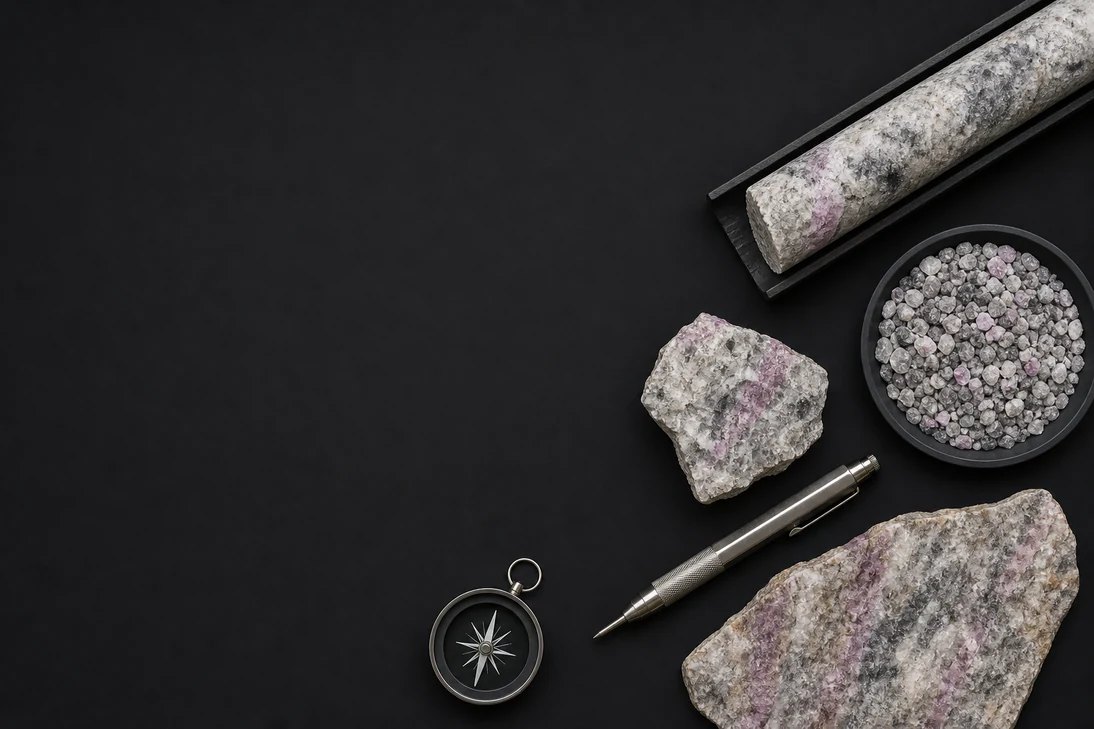
The coarse-grained spodumene mineralisation observed in drill core is typical of BP33’s orebody, supporting metallurgical processing and product quality. The deposit’s geometry, with true widths estimated between 50% and 90% of drilled thickness, enhances mining efficiency and resource confidence.
Ongoing Drilling to Expand Resource and Explore Targets
Drilling at BP33 is ongoing, with four additional holes planned to test extensions down dip and along strike from the recent high-grade intersections. These holes aim to further delineate mineralisation outside the current MRE footprint and explore a previously reported Exploration Target ranging from 3.9 to 6.5 million tonnes at 1.5% to 1.6% Li2O, located down-plunge to approximately 1,200 metres depth.
Given the depth of this target, future drilling may require underground platforms once mining advances to the relevant levels. This staged approach aligns with Core’s underground development plans and resource expansion strategy.
Blackbeard Prospect Drilling Accelerates
Beyond BP33, Core Lithium is also progressing exploration at the Blackbeard prospect within the Finniss Operation. The company has planned up to 12,150 metres of drilling and is deploying an additional diamond rig to accelerate the program. Results from Blackbeard are expected in the coming months and could provide a supplementary ore feed to the operation, enhancing production flexibility.
This exploration push complements recent milestones including the start of underground mining at BP33 and ongoing open pit operations at Grants, which together underpin Core Lithium’s growth trajectory and production targets for the coming years.
Bottom Line?
Core Lithium’s latest drill results at BP33 validate its high-grade underground mining potential, with ongoing exploration set to define a deeper, larger resource footprint.
Questions in the middle?
- How will the upcoming drill results from BP33 impact the timing and scale of underground production?
- What are the implications of Blackbeard’s exploration success for Finniss’s long-term ore supply?
- Could the deep Exploration Target at BP33 materially increase the mine life beyond current plans?