Pioneer Minerals Pinpoints Concealed Conductor at Springfield Tungsten Project

Pioneer Minerals has identified a high-priority bedrock electromagnetic conductor adjacent to the historic Springfield Tungsten Mine in Idaho, refining drill targets ahead of its maiden drilling campaign.
- VTEM airborne survey reveals shallow conductive body 50–70m deep
- Conductor interpreted as pyrrhotite-rich sulphide linked to tungsten mineralisation
- Multiple datasets converge to support high-confidence drill targeting
- Maiden drilling program preparations underway with detailed mapping and structural work
- North Pine Project tenure pending final BLM confirmation
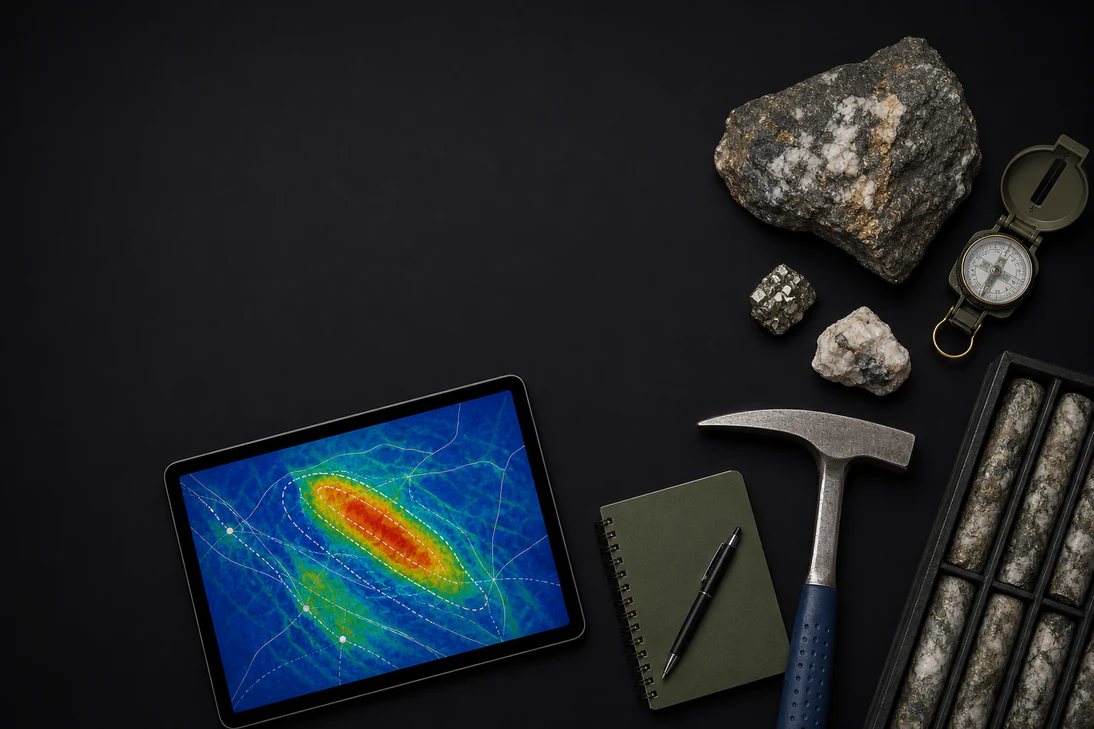

VTEM Survey Uncovers Concealed Bedrock Conductor Near Historic Mine
Pioneer Minerals (ASX:PMM) has taken a significant step forward in its Springfield Tungsten Project with the discovery of a high-priority electromagnetic conductor just adjacent to the historic Springfield Tungsten Mine in Idaho. The conductor, defined by an airborne VTEM™ electromagnetic survey interpreted independently by Mitre Geophysics, lies roughly 50 to 70 metres below surface and outlines a roughly 70 by 140 metre conductive plate.
This concealed target is believed to represent the pyrrhotite-rich sulphide component of the known scheelite tungsten mineral system, concealed beneath a shallow cover of bedrock. While the precise thickness and depth extent remain unconstrained by the VTEM data, the conductor’s location and geophysical signature provide a compelling new drill target for Pioneer.
Integration of Multiple Datasets Strengthens Exploration Model
The VTEM conductor aligns spatially with a previously identified regional magnetic anomaly and historic tungsten workings, reinforcing the geological model underpinning the project. Previous petrographic studies have confirmed scheelite mineralisation occurs intimately with pyrrhotite-rich sulphides, providing a geological rationale for the electromagnetic response.
Alongside rock chip geochemistry and high-resolution magnetic interpretation, these independent datasets converge on the same target area, significantly boosting confidence in Pioneer’s exploration strategy. CEO Michael Beven highlighted that the VTEM survey “has identified a concealed bedrock conductor in exactly the geological setting where we would expect to see the sulphide-rich component of the Springfield tungsten system.”
Drill Targeting and Next Steps
Detailed geological mapping, structural interpretation, and targeted surface geochemistry are now underway to refine drill locations ahead of Pioneer’s maiden drilling program at Springfield. The company plans to integrate these results with existing geological and geophysical data to finalise drill hole positions aimed at testing whether the conductor represents economically significant tungsten mineralisation.
While the VTEM survey marks a major advancement in de-risking the project, Pioneer cautions that electromagnetic data alone cannot determine mineral grade or thickness, and drilling remains essential to validate the target. The company also notes that the tenure status of its 212 staked claims at the North Pine Project remains subject to final confirmation by the US Bureau of Land Management.
Historic Context and Strategic Importance
The historic Springfield Mine produced tungsten concentrates in the 1950s under a US government strategic minerals program, mining approximately 39,000 tons of ore. Pioneer’s discovery of a concealed conductor adjacent to this mine could signal extensions of this mineral system that have remained hidden beneath shallow cover. This aligns with the company’s broader push to unlock critical mineral resources in Idaho, a region gaining attention for its tungsten, gold, and gallium potential.
Preparations for drilling are progressing rapidly, supported by recent infrastructure improvements and regulatory approvals, positioning Pioneer to test one of its highest-priority targets to date. The integration of geophysical, petrographic, and geochemical evidence sets a strong foundation for what could be a pivotal exploration phase.
Bottom Line?
The VTEM conductor discovery sharpens Pioneer’s drill focus at Springfield but leaves key questions on mineralisation thickness and extent to be answered by upcoming drilling.
Questions in the middle?
- Will drilling confirm the conductor as economically viable tungsten mineralisation?
- How will further geological and geophysical work refine the geometry of the conductor?
- When will the Bureau of Land Management finalize tenure for the North Pine claims?