Falcon Metals Broadens First Olsen Well Gold Test

Falcon Metals has started its first-ever drilling at the Olsen Well gold target in Western Australia, expanding the campaign to approximately 6,000 metres after a recent capital raising. The program will test the central portion of a 5.8-kilometre gold-in-soil anomaly supported by rock-chip results of up to 6.42 grams per tonne gold.
- Approximately 50 RC holes planned for 6,000 metres
- Drilling targets the central 2.5-kilometre high-priority zone
- Olsen Well sits within the 5.8-kilometre soil anomaly
- Rock-chip samples returned up to 6.42g/t gold
- WA government rebate covers 50% of drilling costs up to $180,000
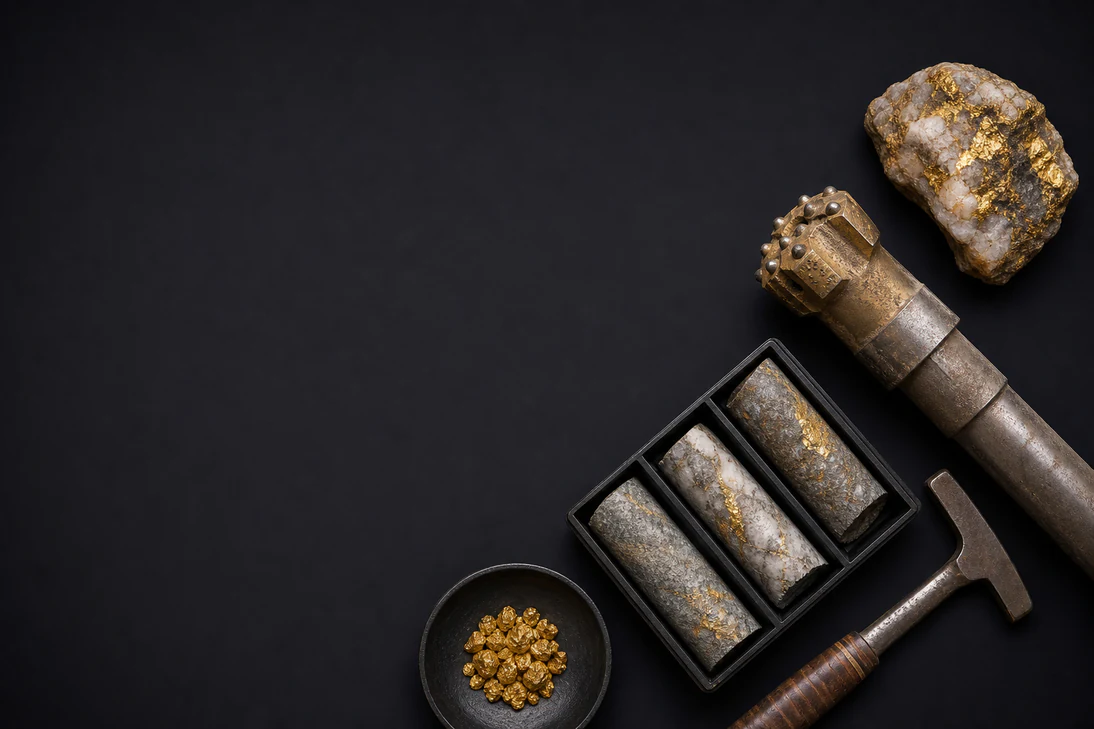

6,000-Metre Drilling Campaign Begins
Falcon Metals Limited (ASX:FAL) has moved the Errabiddy Gold Project from surface exploration to its first drill test, starting reverse circulation drilling at the Olsen Well target in Western Australia. The company plans approximately 50 holes for 6,000 metres, a substantial expansion from the previously announced 3,500-metre campaign after its recent capital raising.
The extra metres will broaden coverage of the central portion of Olsen Well’s geochemical footprint. Drilling is focused on a 2.5-kilometre zone carrying more than 50 parts per billion gold in soils, within a broader 5.8-kilometre anomaly defined by values above 10ppb. Some soil samples returned more than 1 gram per tonne gold.
Rock Chips Provide the First Drill Targets
Olsen Well is not being drilled solely on the back of a regional soil signal. Falcon says two closely spaced traverses identified a coherent bedrock anomaly about 30 metres wide, while four rock-chip samples returned more than 1g/t gold. The strongest reported sample assayed 6.42g/t, with other highlighted results of 2.27g/t and 0.34g/t.
The company interprets the results as evidence of structural and lithological control on the mineralisation. The anomalous samples occur mainly in sheared quartz-feldspar-biotite-mica gneiss containing quartz veinlets and leucosome bands, although those observations remain exploration indicators rather than a resource estimate or drilling result.
Errabiddy’s Craton-Margin Setting
Falcon is positioning Errabiddy within a geological setting associated with several large gold systems. The project lies on the Errabiddy Shear Zone, near the boundary between the Yilgarn Craton and the Glenburgh Terrane of the Capricorn Orogen, and about 35 kilometres southeast of Benz Mining’s Glenburgh Gold Project. Glenburgh has a stated exploration target of 10.1 million to 12.0 million ounces of gold, but that figure belongs to the neighbouring project and says nothing directly about Falcon’s own endowment.
Errabiddy comprises one exploration licence in which Falcon can earn a 70% interest, excluding graphite rights, from West Coast Silver, alongside an adjoining 100%-owned licence. The company says no gold exploration drilling has previously taken place within its project tenure, leaving the upcoming campaign as the first meaningful test of the Olsen Well anomaly.
Government Support Reduces Drilling Cost
The Western Australian Government’s Exploration Incentive Scheme is contributing a rebate equal to 50% of drilling costs, capped at $180,000. Falcon is also continuing drilling at its Blue Moon project in Victoria, giving the company two active gold exploration programs while it awaits results from Olsen Well.
The immediate question is whether the extensive surface anomaly translates into continuous gold mineralisation beneath cover and weathered material. Until assays arrive, the 6.42g/t rock chip and the long soil anomaly are useful targeting evidence, not proof of scale, grade continuity or economic potential.
Bottom Line?
Olsen Well now has a materially larger first-pass drill test, but the investment case still turns on whether drilling converts surface anomalies into coherent subsurface mineralisation.
Questions in the middle?
- Will RC drilling confirm gold mineralisation beneath the 5.8-kilometre soil anomaly?
- How continuous and thick will any mineralised zones prove across the central 2.5-kilometre target?
- When will assay results establish whether the rock-chip grades reflect a broader bedrock system?