Mt Malcolm Expands Copper-Gold Pipeline with Four Leonora Targets

Mt Malcolm Mines has identified four copper-gold exploration targets across its Malcolm Project, led by selective Braiser rock chips grading up to 1.37% copper. The broader target inventory is promising but remains early-stage, with no new drilling completed and most geochemical signals still awaiting laboratory verification.
- Braiser rock chips returned up to 1.37% Cu and 0.44 g/t Au
- Four targets identified across Malcolm South, Braiser, Harry’s and Wool Shed
- Malcolm South anomaly combines magnetic, structural and pathfinder signals
- pXRF results remain screening data, not certified laboratory assays
- Follow-up mapping, sampling and potential AC or RC drilling planned

Mt Malcolm Mines NL (ASX:M2M) has expanded its exploration pipeline near Leonora, Western Australia, after an integrated review identified four copper-gold targets across the Malcolm Project. The strongest result came from Braiser, where selective laboratory-tested rock chips returned up to 1.37% copper, although the company has not yet established the width, continuity or economic significance of the mineralisation.
Braiser Produces the Strongest Copper Signal
Braiser is the most advanced of the new targets. Two samples returned 1.37% and 1.34% copper, while other samples graded up to 0.46% and 0.14% copper. The highest gold result in the reported set was 0.44 grams per tonne, from a separate sample, and several of the stronger copper samples also carried elevated arsenic, cobalt and nickel.
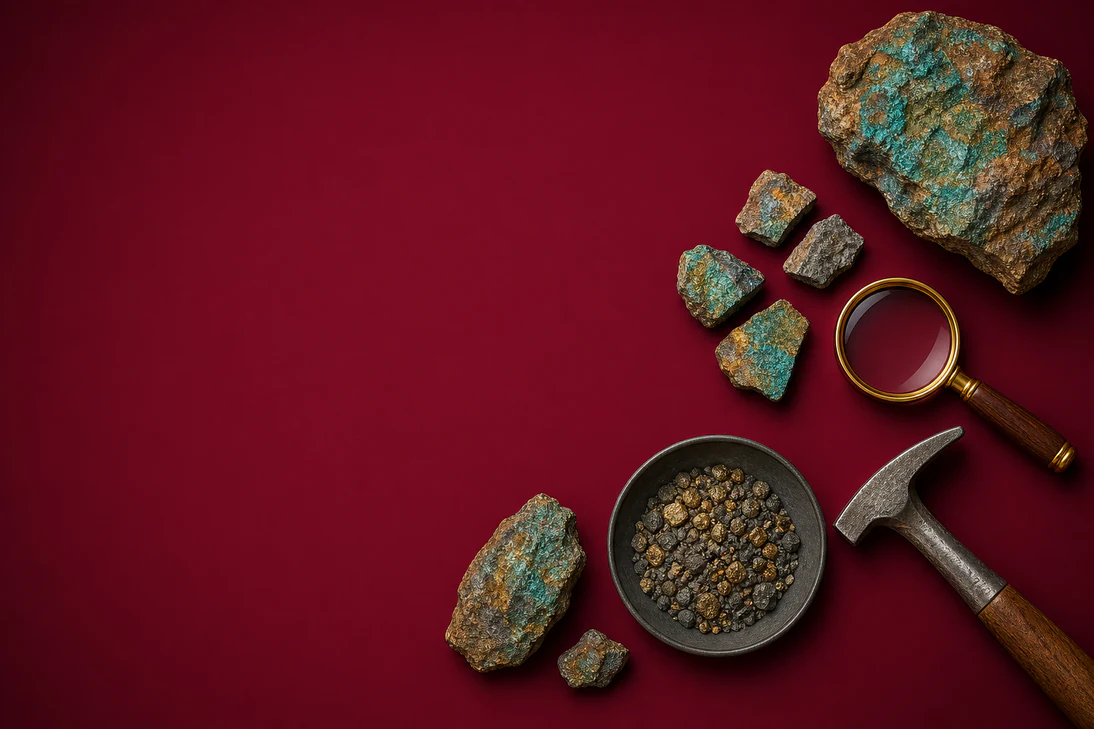
The results came from exposed, altered rock and historical workings along a mafic-schist and quartz-sericite stratigraphic corridor. Visible malachite was recorded in several samples. Mt Malcolm says the copper-arsenic-cobalt signature is consistent with a potential hydrothermal system, while also stressing that rock-chip sampling is selective and cannot be treated as representative of average grade or mineralised thickness. Historical Kennecott work provides geological support, but the company does not interpret those old results as proving continuity at depth.
Malcolm South Combines Magnetic and Geochemical Clues
At Malcolm South, a 230-sample pXRF soil survey outlined an arsenic-antimony-tungsten-bismuth-thallium response over or near a compact, high-amplitude magnetic feature. The anomaly also overlaps a historical 2-6 parts-per-billion gold zone and an interpreted shear structure, giving the company a multi-layered target for further work.
That target is still a geological hypothesis rather than a discovery. The source of the magnetic response has not been confirmed and could represent a mafic intrusive, iron-rich banded iron formation or chert, or magnetite-bearing alteration. Transported alluvial cover may also have shifted or weakened the surface geochemical response. Mt Malcolm plans laboratory checks, resampling of historical aircore spoil and refined drill geometry before considering aircore or reverse-circulation drilling.
Harry’s and Wool Shed Remain Earlier Stage
Harry’s produced an arsenic-tungsten-bismuth anomaly, with antimony also elevated, near a magnetic low and interpreted structural complexity. The company’s 210-sample pXRF program identified a central response within a broader shear corridor, but the reported values still require laboratory validation. Detailed mapping and possible drilling will depend on those results.
Wool Shed is the more difficult target to read. Its pXRF responses were generally subdued, and transported alluvial and colluvial cover can approach 100 metres. The company therefore does not consider the surface data sufficient to define bedrock mineralisation there, preferring aircore or other subsurface testing over a straightforward interpretation of soil anomalies.
The next meaningful test is not another attractive map or isolated surface assay, but whether laboratory confirmation and follow-up drilling can turn these indications into coherent mineralised zones. Until that happens, Braiser offers the clearest copper lead while Malcolm South, Harry’s and Wool Shed remain ranked exploration targets rather than defined deposits.
Bottom Line?
Braiser has supplied a credible copper lead, but the investment case still depends on continuity, laboratory validation and drilling across a project where most targets remain conceptual.
Questions in the middle?
- Will follow-up sampling show that the strongest Braiser rock chips form a continuous mineralised corridor?
- Can drilling identify the bedrock source of the magnetic and geochemical anomaly at Malcolm South?
- Will subsurface testing at Wool Shed overcome the limitations created by deep transported cover?