Western Mines Finds Near-Surface Nickel Targets at Mulga Tank

Western Mines Group has identified broad nickel sulphide mineralisation across six holes on the western margin of Mulga Tank, including a shallow 13m zone grading 0.41% nickel. The results also support a geological model that could guide follow-up drilling towards richer zones, ahead of a government-backed seismic survey.
- MTRC001 returned 442m at 0.26% nickel
- MTRC084 delivered 13m at 0.41% nickel from 98m
- Five western-margin RC holes confirmed broad disseminated mineralisation
- Results support an uplifted basal sequence model
- A $300,000 government co-funding package will support seismic work

Shallow Nickel Zone Emerges at Mulga Tank
Western Mines Group Ltd (ASX:WMG) has found what it interprets as a near-surface enriched nickel zone on the western margin of its Mulga Tank project, although the broader result is more about geological continuity than an immediate mining-grade discovery. Hole MTRC084 returned 24m at 0.35% nickel from 96m, including 13m at 0.41% nickel from 98m, with copper at 177 parts per million and platinum-palladium at 0.21 grams per tonne in the higher-grade interval.
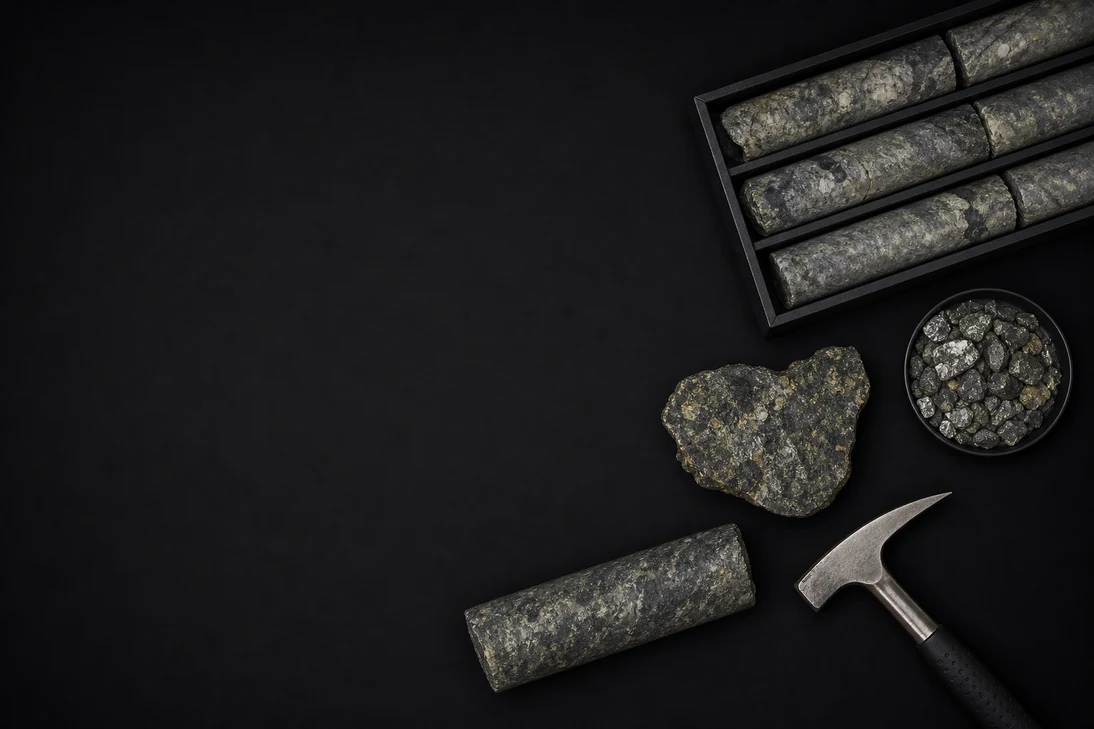
The company’s headline result came from the much deeper diamond tail of MTRC001, which produced a cumulative 442m at 0.26% nickel, 129ppm cobalt, 78ppm copper and 27ppb platinum-palladium. That hole intersected a roughly 410m thickness of high-magnesium adcumulate dunite containing disseminated magmatic sulphides, with sulphides locally forming interstitial blebs.
Six Holes Trace the Basal Mineralised Sequence
Results from RC holes MTRC083 to MTRC087 showed the same broad pattern: nickel-bearing intervals with elevated sulphur, copper and platinum-group elements separated by barren or weakly mineralised dunite. The cumulative results were 171m at 0.30% nickel in MTRC083, 79m at 0.29% in MTRC084, 169m at 0.26% in MTRC085, 124m at 0.29% in MTRC086 and 98m at 0.21% in MTRC087.
Western Mines says the pattern supports its interpretation that the southwestern portion of the Mulga Tank Ultramafic Complex is the most uplifted part of the system, bringing basal horizons that occur deeper in the complex closer to surface. The company has also identified a possible higher-nickel zone near the end of MTRC083 and believes follow-up drilling to the west-southwest could test it at shallower depth.
The geological model remains preliminary. Western Mines interprets the mineralised horizons as separate sulphur-saturated magma pulses or flows, with barren injections between them. The presence of sulphur, copper and platinum-palladium alongside nickel is being used as evidence that nickel is hosted in sulphides rather than being contained only within the dunite host rock, but these assay results do not establish mineability, recoveries or economic viability.
Seismic Survey Sets the Next Exploration Test
The next major targeting tool is an approximately 35 square kilometre active seismic survey across the Mulga Tank complex. The Western Australian government’s Exploration Incentive Scheme has increased its co-funding to $300,000, covering half the survey costs, and Western Mines expects mobilisation at the end of September with fieldwork planned for the first two to three weeks of October.
The survey is intended to image the architecture of the ultramafic complex and help locate basal contacts that could host Perseverance-style massive nickel sulphide deposits. That makes the near-surface MTRC084 interval useful as a targeting clue, but the harder question is whether follow-up drilling can convert these broad, mostly disseminated zones into consistently higher-grade mineralisation.
Bottom Line?
The western margin is becoming a clearer exploration target, but the investment case still depends on whether modelling, seismic data and follow-up drilling can locate thicker or materially richer sulphide zones.
Questions in the middle?
- Will follow-up drilling confirm that the MTRC084 zone broadens along strike to the north-northeast?
- Does the nickel zone near the end of MTRC083 continue into a shallower, higher-grade target?
- Can the seismic survey identify basal structures capable of hosting more concentrated massive sulphide mineralisation?