White Cliff finds bornite-rich copper system in first Bornite Hills drilling

White Cliff Minerals has reported broad, bornite-dominant mineralisation in the first-ever drilling at Bornite Hills, but laboratory assays are still weeks away. The discovery adds a new target to the Rae Copper Project, alongside a sediment-hosted copper horizon now traced across a much larger area.
- More than 32m of visually estimated bornite-dominant mineralisation reported in BNH26003
- Mineralisation extended more than 60m below a historic 3.66m trench grading 46.99% Cu
- Approximately 725m of Bornite Hills strike remains largely untested
- Sediment-hosted copper confirmed across a footprint exceeding 4.3km east-west and 2.1km north-south
- Bornite Hills assays expected in October 2026

First drilling opens a new Bornite Hills target
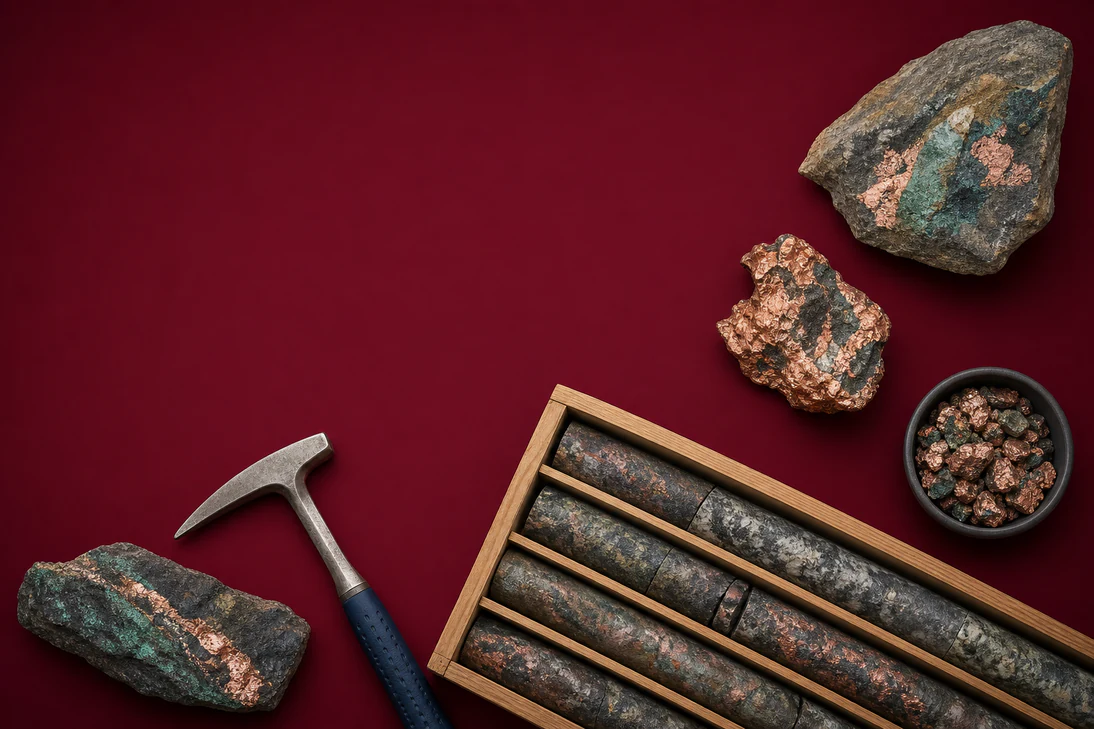
White Cliff Minerals Limited (ASX:WCN) has found what it describes as a major new copper discovery at Bornite Hills, where the first-ever diamond holes encountered broad zones of bornite-dominant mineralisation. Hole BNH26003 reportedly intersected more than 32 metres of mineralisation, including semi-massive bornite, while BNH26001A returned a reported 13.7-metre interval of bornite-chalcopyrite mineralisation in veins and breccias.
The geological significance is clear enough; the economic significance is not yet established. The Bornite Hills observations are based primarily on visual logging rather than laboratory assays, with results expected in October. The company’s detailed observation table lists a 22.06-metre sulphide interval in BNH26003 from 67.94 metres to 90 metres, rather than the more than 32 metres cited in the headline, so the final assays and reconciliation of the reported intervals will matter.
High-grade surface occurrence provides the geological clue
Bornite Hills sits on a NNW/SSE-trending fault structure interpreted to splay from the regional Herb Dixon Fault Zone. Historic trenching returned 3.66 metres at 46.99% copper at surface, and the new drilling confirms bornite mineralisation more than 60 metres vertically below that occurrence. The reported drill lengths are downhole intervals, not true widths, because the orientation of the host structure remains poorly constrained.
White Cliff says roughly 725 metres of prospective strike remains largely undrilled, including at depth. That gives the company an obvious follow-up program, but also leaves plenty of geological work between a striking outcrop result and any coherent deposit interpretation. Bornite Hills is approximately 32 kilometres from Danvers, adding another copper target to a Rae project that already contains several distinct mineralisation styles.
Sediment-hosted copper footprint expands across Rae
The release also reports copper mineralisation at the base of the Rae Group, where the company is testing a redox boundary with the underlying Husky Creek Formation. Eight additional diamond holes extended the confirmed footprint to more than 4.3 kilometres east-west and 2.1 kilometres north-south, although drill spacing is as wide as 2.6 kilometres in places.
The reported assay intervals from the sedimentary drilling are more concrete than the Bornite Hills results, though generally modest in grade: examples include 4.46 metres at 0.19% copper in SED26002, 5.58 metres at 0.12% in SED26005 and 3 metres at 0.11% in SED26008. The data establishes a prospective regional horizon, according to the company, but the wide spacing means continuity and the location of any higher-grade core remain unresolved.
Geophysical survey sets up 2027 targeting
White Cliff has commissioned Sander Geophysics to fly more than 70 kilometres of magnetic, gravity and radiometric survey coverage over the Rae Group-Husky Creek contact. The company plans to combine those results with earlier MobileMT data and 2025-2026 drilling to rank targets for 2027, while also applying the Danvers exploration model at the Thor and Rocket prospects.
The immediate catalyst is therefore not a resource estimate or development decision, but assay confirmation at Bornite Hills. Until those results arrive, the strongest part of the story is the combination of a high-grade surface vector, visible sulphides at depth and substantial untested strike; the weakest is that the headline discovery remains visual, downhole and not yet converted into grade data.
Bottom Line?
October assays will determine whether Bornite Hills is a genuine high-grade extension or an impressive-looking but narrower sulphide occurrence.
Questions in the middle?
- Will laboratory assays confirm the scale and copper grade implied by the visually logged bornite intervals?
- How close are the reported downhole widths to true geological thickness?
- Can follow-up drilling connect Bornite Hills mineralisation along the 725 metres of largely untested strike?