QMines Uncovers New Copper and Polymetallic Strength at Mt Chalmers

QMines has reported a broad 44-metre copper intersection and high-grade zinc-lead-gold-silver mineralisation from six holes at Mt Chalmers. The results support ongoing Definitive Feasibility Study work, while a hole ending in copper mineralisation and upcoming barge drilling add further exploration interest.
- 44m at 1.03% copper, including 2m at 5.52% copper
- 1.5m grading 11.73% zinc, 6.85% lead, 1.35% copper, 7.11g/t gold and 60.6g/t silver
- One hole abandoned in mineralisation at 150.5m
- 10,000m campaign supports Mt Chalmers DFS and resource modelling
- Barge drilling beneath the historic open pit is next in line
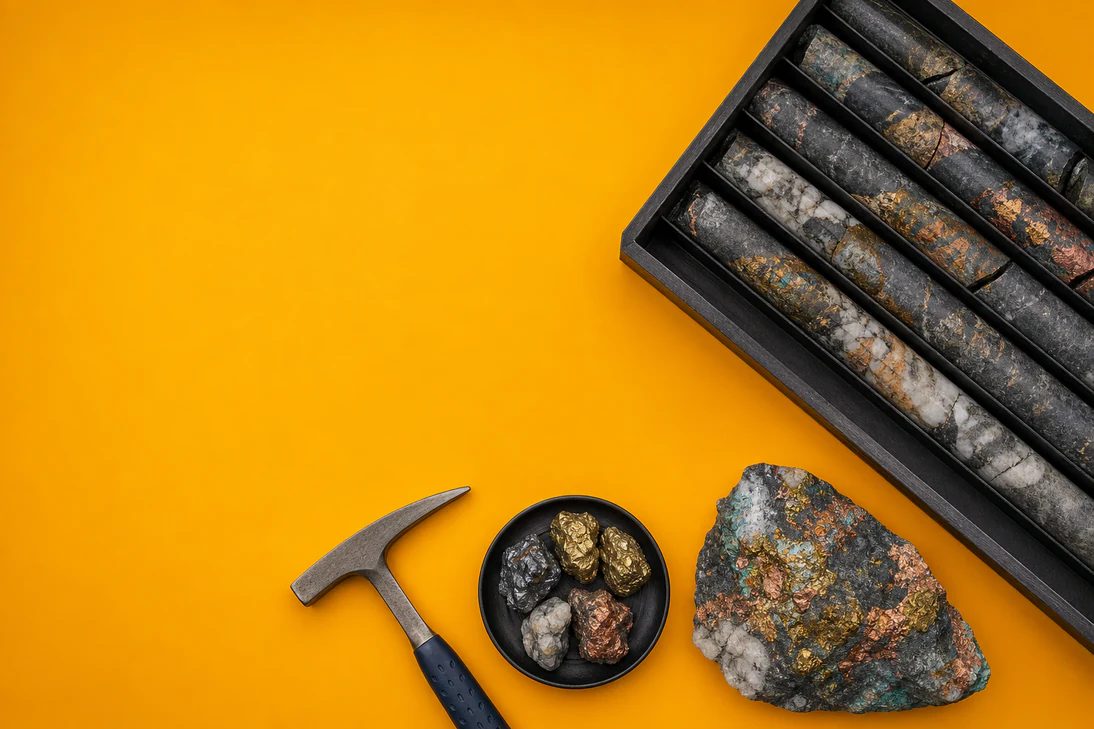

Broad Copper Intercept Strengthens Mt Chalmers Drilling Case
QMines Limited (ASX:QML) has struck a 44-metre copper zone on the eastern side of the historic Mt Chalmers open pit, with the interval grading 1.03% Cu, 0.15g/t Au and 2.3g/t Ag from 103 metres. Within it, a 10-metre section returned 2.20% Cu, including two metres at 5.52% Cu.
The result sits above Mt Chalmers’ current global Mineral Resource grade of 0.75% Cu, although the company reports the intersection as a downhole length rather than a true width. A second hole drilled about 57 metres to the south delivered 7 metres at 1.02% Cu and a further 24 metres at 0.46% Cu. It was abandoned at 150.5 metres when drill rods became stuck, with the final 0.5-metre sample grading 2.05% Cu, leaving mineralisation below the hole untested.
Polymetallic Sulphides Add Zinc, Lead, Gold and Silver
The batch also highlighted the deposit’s upper polymetallic sulphide horizons. Hole 26MCDD013 returned 1.5 metres at 11.73% Zn, 6.85% Pb, 1.35% Cu, 7.11g/t Au and 60.6g/t Ag from 53.9 metres. Nearby, 26MCDD012 intersected five metres at 0.99g/t Au, 55.5g/t Ag, 1.84% Zn and 1.09% Pb from 45 metres, including two metres at 1.91g/t Au and 118g/t Ag.
Those numbers are striking, but the technical qualifications matter. Core recovery through the 26MCDD013 sulphide interval was 43%, while recovery through the deeper zinc-lead zone in 26MCDD012 averaged 62%. QMines says preferential loss of friable sulphide or altered material cannot be excluded, so the reported grades and widths require confirmation through further drilling.
Drilling Feeds the DFS and Resource Model
The results come from a 10,000-metre, multi-rig drilling campaign designed primarily to support Mt Chalmers’ Definitive Feasibility Study, including geometallurgical, structural and resource-modelling work. The project currently has a 9.6-million-tonne Ore Reserve grading 0.65% Cu, 0.48g/t Au and 5.20g/t Ag, while its Mineral Resource stands at 11.3 million tonnes grading 0.75% Cu, 0.42g/t Au and 4.60g/t Ag.
Fresh core from selected holes will be used for mineralogical, comminution and flotation testing. The company also has assays pending from 19 holes covering 2,314 metres, with two rigs continuing to operate. The document says the next results are expected from barge drilling beneath the flooded historic open pit, an area that has not been drilled since 1982.
True Widths and Chronology Remain Important Caveats
For investors, the immediate question is whether these intersections translate into consistent, mineable geometry rather than isolated high-grade sections. The company has not yet constrained the local orientation of the mineralised zones sufficiently to calculate true widths, and some of the polymetallic intervals carry material recovery limitations. The announcement is also dated 23 September 2024 while referring to a 2026 drilling campaign, a chronology inconsistency that should be clarified in the company’s reporting.
The next evidence will come from the pending assays, follow-up drilling below 26MCDD011 and the barge program under the old pit. Those results should help determine whether the latest grades improve the geological and economic model, or remain attractive but narrowly defined drill intersections.
Bottom Line?
The drilling has added meaningful copper and polymetallic hits, but the DFS will depend on proving continuity, true widths and recoverable grades across the broader system.
Questions in the middle?
- Will follow-up drilling confirm copper continuity below the hole that ended in mineralisation?
- Can the high-grade polymetallic zones be shown to have reliable thickness despite poor core recovery?
- Will barge drilling beneath the historic open pit materially expand the resource or improve the DFS mine plan?