Accent Resources finds a credible dry route for Magnetite Range

3 min read
9:02am on Wednesday 30th of September, 2026 AEST ~9am, 30th Sept, 26
Popular on LinkedIn
Independent LONGi testwork has produced 66.3% to 68.0% Fe magnetite concentrates from four Magnetite Range samples using a bench-scale dry flowsheet. The results strengthen the case for a water-efficient route in Accent Resources' pre-feasibility study, but remain preliminary and untested at pilot scale.
- 66.3% to 68.0% Fe concentrates from dry magnetic separation
- Up to 98.21% magnetic iron recovery
- Three higher-grade samples returned 85.2% to 91.2% total iron recovery
- Wet polishing lifted concentrate grades to 69.7% to 70.3% Fe
- Pilot-scale engineering and economic validation still required

Dry Testwork Delivers High-Grade Magnetite Concentrate
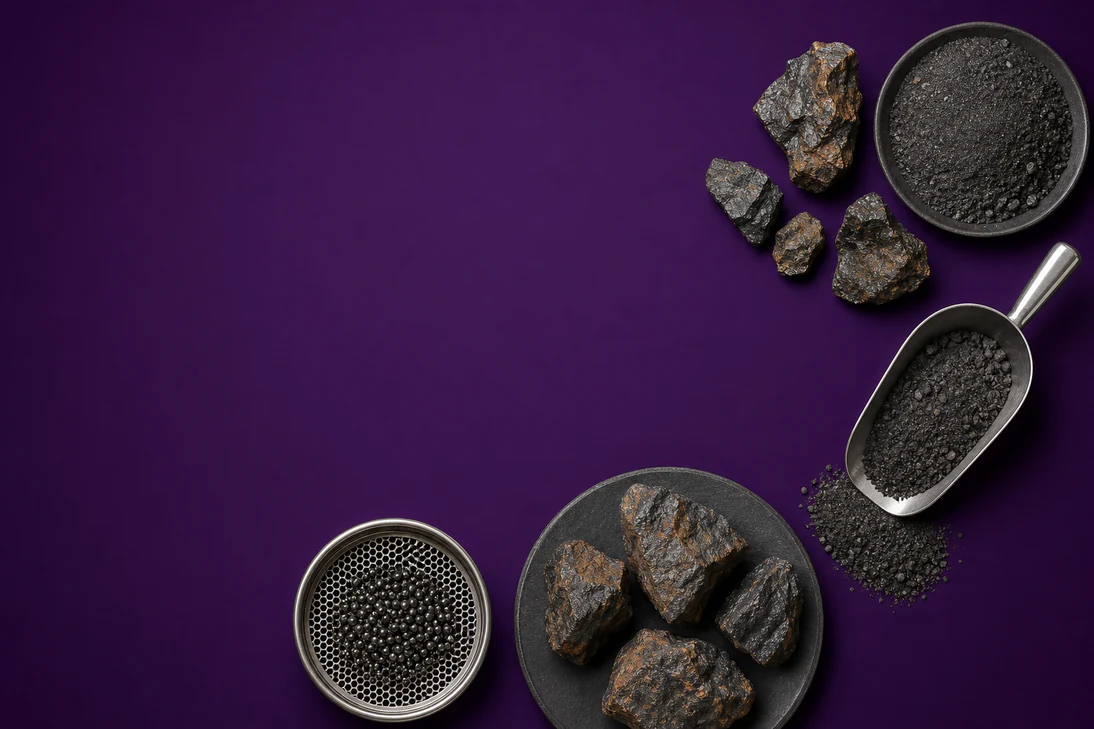
Accent Resources NL (ASX:ACS) has cleared an important technical hurdle at its Magnetite Range Project, with independent LONGi Magnet Co., Ltd. testwork producing high-grade magnetite concentrates through a fully dry processing route. Four representative samples from the Julia and Robb deposits returned final concentrates grading between 66.3% and 68.0% Fe after dry grinding to approximately P85 75 microns and passing through a two-stage drum separator.
The strongest results came from the three higher-grade magnetite samples, which produced 66.7% to 68.0% Fe concentrates at 85.2% to 91.2% total iron recovery. Magnetic iron recovery was higher still, ranging from 97.0% to 98.2% across those samples, with the company reporting a peak overall result of 98.21%.
Lower-Grade Sample Shows the Flowsheet's Limits
The results were not uniform, and that matters for any future plant design. The purpose-selected lower-grade R-LBIF-14 sample also produced a 66.3% Fe concentrate, but at only 21.1% mass yield, 56.2% total iron recovery and 88.3% magnetic iron recovery. Accent says the sample represents a non-primary process feed type, rather than the expected core feed for the circuit.
That distinction keeps the announcement encouraging without making it definitive. The testwork was conducted at bench scale on four composites, and the release expressly warns that the outcomes are not a production forecast or final process design. Energy consumption, equipment sizing, material handling, dust control, concentrate moisture and operating costs remain unresolved.
Wet Polishing Adds a Product Quality Option
LONGi also tested a wet magnetic cleaning stage on the dry concentrates. The LJC unit produced final grades of 69.7% to 70.3% Fe, although final total iron recovery varied considerably from 59.2% to 88.6%. Accent presents that route as a possible finishing step for a higher-specification product, including potential direct reduced iron feed, rather than as a replacement for the dry circuit.
Pre-Feasibility Study Must Convert Results Into Economics
The immediate significance for Accent is that dry magnetic separation can now be included in the Magnetite Range pre-feasibility study as a technically credible alternative to wet processing. A successful dry route could reduce process-water demand and potentially lessen reliance on conventional wet concentration and tailings storage infrastructure, but those benefits are described by the company as possibilities requiring further engineering, environmental and economic assessment.
Accent's next work programme is aimed at closing that gap: representative composite confirmation, flowsheet optimisation, coarse dry rejection, fine dry cleaning and comparison of wet and dry finishing options. The project has a 523.3 million tonne JORC 2012 Mineral Resource grading 31.3% Fe, but the size of that resource does not remove the central processing question. The next meaningful test will be whether laboratory-grade concentrate performance survives scale-up without making the water savings uneconomic.
Bottom Line?
The dry route has earned a place in the PFS, but pilot-scale recovery, energy and product-quality data will determine whether it can move beyond a promising laboratory result.
Questions in the middle?
- Will the concentrate grades and magnetic iron recoveries hold across larger, more representative composites?
- Can a dry circuit manage energy use, dust control and material handling at a commercially relevant scale?
- Will the potential value of a wet polishing stage justify its additional water demand and operating complexity?