Fulcrum finds a cleaner lithium route as Alkali Flats expands east

Fulcrum Lithium has staked 41 additional claims around its Alkali Flats project in Nevada and reported up to 79% lithium extraction from acid-free roast and water-leach tests. The results improve on earlier water-leach work, although they remain below the company’s 93% to 96% sulfuric-acid benchmark and come from scoping-level tests.
- 41 new claims take Alkali Flats to 698 claims
- 64% to 79% lithium extraction from three composite samples
- Up to 68% of lithium extracted within 24 hours
- More than 99% reductions in several impurities versus acid leaching
- Future drilling targets the 1.92Mt LCE higher-grade zone
Alkali Flats footprint extended eastward
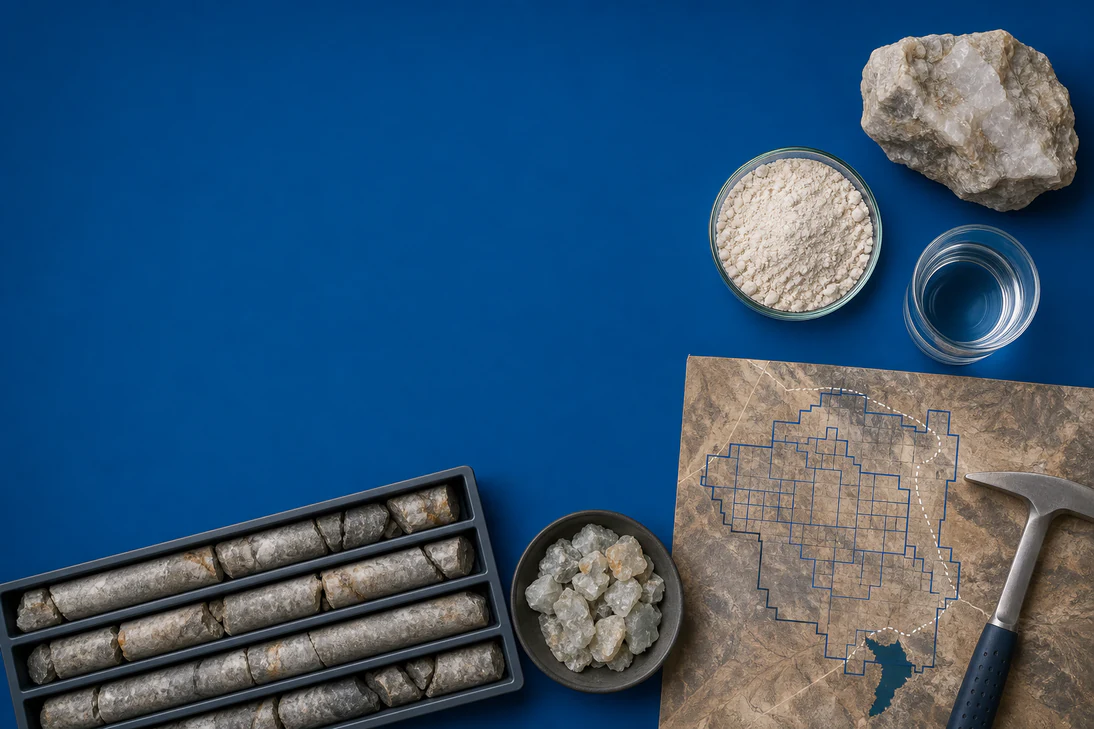
Fulcrum Lithium Ltd (ASX:FUL) is widening the exploration runway at Alkali Flats, staking 41 lode claims on the eastern side of its Nevada project where geological modelling points to a shallower, higher-grade lithium trend. The expansion takes the project to 698 claims covering roughly 58 square kilometres, although the new claims are still being filed with the US Bureau of Land Management and Esmeralda County.
The added ground is intended to support future drilling and bulk sampling rather than represent a new resource. Fulcrum has identified 1.92 million tonnes of lithium carbonate equivalent at an average grade of 775 parts per million above a 700ppm lithium cut-off within its existing resource. The company plans to focus expansion work on that higher-confidence, higher-grade portion of Alkali Flats.
Acid-free tests deliver rapid lithium extraction
Three composite samples from broad 30-metre zones in Phase 2 reverse-circulation holes returned lithium extraction of 64% to 79% in mini-column tests using roasted clay and water. Up to 68% of the lithium was extracted within the first 24 hours of the eight-day testing period.
The process involved pulverising and pelletising the clay with gypsum and limestone, roasting it at 1,000°C for one hour, then applying a recycled deionised-water leach. The results improved on Fulcrum’s previous roast-and-water test, which recorded 66% recovery, while the company says the strongest extraction came from the lowest reagent blend tested.
Lower impurities trade off against acid-leach recovery
The attraction is not simply the headline recovery. In the comparison supplied for one zone, the water-leach solution contained more than 99% less aluminium, iron, magnesium, manganese and titanium than the corresponding sulfuric-acid extraction. That points to a potentially cleaner leachate, though the test also produced a higher sodium concentration and a lower lithium concentration than the acid comparison.
There is a clear trade-off. Fulcrum’s earlier sulfuric-acid mini-column tests achieved 93% to 96% lithium recovery, above the 64% to 79% recorded in this acid-free series. The latest work therefore expands the range of possible processing routes, but does not yet establish which route would be technically or commercially preferable.
Further testing will determine whether the process scales
The tests used three composite samples assembled from drill cuttings taken at 1.5-metre intervals across zones averaging 592ppm to 674ppm lithium. They were scoping-level mini-column tests, not a demonstration of a commercial flowsheet. Fulcrum says the recovery curve showed little additional extraction after the first 24 hours under closed-circuit conditions, while the final water wash added a further 7% to 10%, indicating a possible benefit from open-circuit testing with fresh water.
The next work program is set to examine mineralogy, lithium distribution, beneficiation, reagent ratios, temperatures and extraction conditions using Phase 3 core and cuttings. In parallel, Fulcrum is defining drilling options across the eastern extension. The important test now is whether the rapid, lower-impurity extraction can be reproduced across a larger and more representative sample base without giving back too much recovery or adding processing complexity.
Bottom Line?
Fulcrum has added a useful processing option and more exploration ground, but the investment case still turns on whether the acid-free route can move from promising mini-columns to a scalable flowsheet.
Questions in the middle?
- Can open-circuit testing lift acid-free recovery consistently beyond the 79% result?
- Will the eastern claims convert the projected higher-grade trend into additional measured or indicated resources?
- How will reagent use, impurity handling and process scale affect the comparison with sulfuric-acid leaching?