Golden Deeps Takes Graceland's High-Grade Targets Deeper

Golden Deeps has reported high-grade polymetallic results at its Graceland prospect in Namibia while stepping up deeper drilling across an 800-metre target corridor. The explorer ended FY2026 with $4.218 million in cash, but remains dependent on exploration success and future funding.
- FY2026 net loss narrowed to $832,244
- $4.218 million cash balance at 30 June 2026
- High-grade copper, silver, zinc, lead, germanium and antimony at Graceland
- Initial 10-hole deeper drilling program underway
- 94.3 million options on issue at a $0.10 exercise price


Graceland Becomes Golden Deeps' Main Test
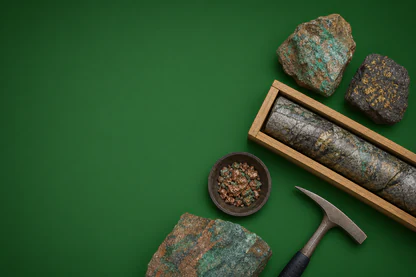
Golden Deeps Limited (ASX:GED) is putting its most valuable exploration question beneath the surface at Graceland, where exceptionally high-grade copper, silver, zinc, lead, germanium and antimony results have now led to a deeper 10-hole diamond drilling program. The company is testing an 800-metre Gossan 1 corridor in Namibia's Otavi Mountain Land, including three induced polarisation and low-resistivity anomalies interpreted as potential sulphide targets.
The surface results are striking, although they remain exploration results rather than an economic resource. Channel sampling included 3 metres at 11.2% copper, 294 grams per tonne silver and 8.7% zinc, including a 0.5-metre interval at 31.7% copper, 961 grams per tonne silver and 79 grams per tonne germanium. A separate channel at Gossan 1 East returned 3.5 metres at 12.6% copper, 79 grams per tonne silver and 403 grams per tonne antimony.
Shallow drilling produced similarly eye-catching grades. The company reported 1.82 metres at 16.6% copper equivalent from Gossan 1 East, including 0.66 metres at 44.7% copper equivalent, alongside 12.8% copper, 149 grams per tonne silver, 21.3 grams per tonne germanium and 491 grams per tonne antimony. Results from drilling completed after year-end included 8.2 metres at 3.5% copper equivalent below Gossan 1 and 4.48 metres at 4.0% copper equivalent below Gossan 1 East.
Ten-Hole Program Targets Depth and Continuity
Golden Deeps says the deeper program, which began in early September, will test down-plunge extensions of the known gossans as well as the key geophysical anomalies below Gossan 1 and Gossan 1 East. A second stage is planned to target extensions below 100 metres and the larger Gossan 1 Far East anomaly, which has no surface expression and remains open to the east and at depth.
The geological case rests partly on comparison with the nearby Tsumeb deposit, historically mined for copper, lead, zinc, silver and germanium. That analogy may help explain the exploration strategy, but it does not establish that Graceland has the same scale, continuity or economic characteristics. Golden Deeps' copper-equivalent figures also depend on assumed recoveries, payabilities and commodity prices, including market prices recorded on 1 March 2026.
Lower Loss, Larger Exploration Balance
The financial statements provide a more restrained backdrop. Golden Deeps reported an Australian-dollar net loss of $832,244 for FY2026, down from $1.137 million a year earlier, while operating cash outflow fell to $659,428 from $913,949. Exploration and evaluation expenditure rose to $11.343 million, including $9.326 million allocated to Namibia, and the company held $4.218 million in cash at 30 June.
The stronger cash position followed a $3.543 million share issue during the year, partly offset by $242,593 in capital-raising costs. Shares on issue increased to 228.0 million, while 94.3 million options exercisable at $0.10 remain outstanding until 31 October 2029. The capital structure therefore gives the company funding for continued work, but also leaves future dilution as a possibility if options are exercised or additional capital is required.
Golden Deeps has no operating mining revenue and disclosed that advancing its projects may require further equity or debt funding. It also faces five-year minimum tenement expenditure commitments of $7.878 million across Namibia, Australia and Canada, based on current holdings and assumptions that some tenements may later be reduced. The immediate financial question is not whether the company can keep drilling, but how far the current cash balance can carry a multi-project exploration portfolio before the next funding decision becomes unavoidable.
Bottom Line?
Graceland has supplied compelling high-grade intersections, but the next 10 holes must show whether those grades connect into a coherent, mineable system before the funding question takes centre stage.
Questions in the middle?
- Will deeper drilling confirm continuity and meaningful scale below the high-grade Graceland outcrops?
- How quickly will Golden Deeps need to raise capital as drilling and tenement commitments expand?
- Can the company convert its existing Otavi discoveries and resources into development studies rather than another cycle of exploration?