Charger Metals advances Medcalf toward a lithium development decision

Charger Metals has completed 4,390 metres of a 10,000 metre drilling campaign at its Medcalf lithium project, while test work lifted the composite product to 1.32% Li2O at 94.9% recovery. The Bynoe sale has also left the explorer with $4.23 million in cash to fund drilling and scoping work.
- 4,390m completed across RC and diamond drilling at Medcalf and Medcalf West
- Ore-sorting and fines combination produced 1.32% Li2O at 94.9% recovery
- Medcalf resource remains 10.6Mt at 1.0% Li2O, with 81% within 300m of surface
- Bynoe sale delivered $3.752 million cash and retained milestone and royalty exposure
- Cash balance rose to $4.229 million, equivalent to 5.2 quarters of reported funding
 Add us as a preferred source on Google
Medcalf drilling reaches 4,390 metres
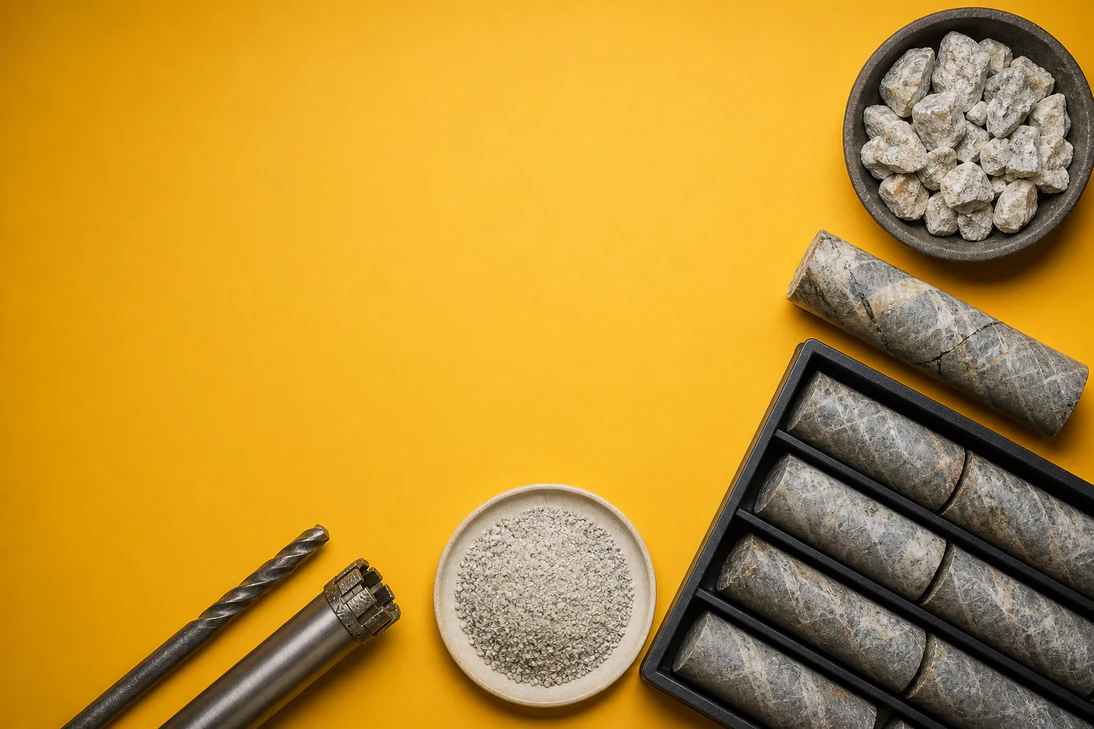
Charger Metals NL (ASX:CHR) has turned the proceeds from its Bynoe disposal into an active test of its Lake Johnston lithium strategy, completing 4,390 metres of a planned 10,000 metre campaign during the September quarter. One reverse-circulation rig and one diamond rig are targeting extensions and infill at the 10.6 million tonne Medcalf deposit, as well as the conceptual Medcalf West Exploration Target.
The programme is designed to test whether mineralisation that remains open along strike and down dip can support resource growth. Charger said first assays are expected shortly. The campaign follows the company's two-rig Medcalf drilling campaign, which targeted both greater geological confidence at Medcalf and the possibility of converting Medcalf West into a Mineral Resource.
Ore-sorting produces a higher-grade composite
The more immediate technical result came from metallurgical testing. When the coarse ore-sorted concentrate was combined with the unsorted fine fraction, the Master Composite produced 1.32% Li2O at 94.9% lithium recovery, alongside 147 parts per million tantalum pentoxide at 97.2% recovery.
The coarse concentrate alone reached 1.37% Li2O and 159ppm Ta2O5, while rejecting 78.3% of the iron in the feed. The combined product represented 72.5% of the sample mass. These are laboratory test results rather than commercial operating outcomes, and further heavy liquid separation and dense media separation work remains underway.
Shallow resource supports ongoing mine studies
Medcalf's current Inferred Mineral Resource remains 10.6Mt at 1.0% Li2O, containing about 106 kilotonnes of lithium oxide, with a separate 2.2Mt tantalum resource. Charger says 81% of the lithium resource sits within 300 metres of surface, a feature it is using in preliminary open-pit optimisation and mining studies.
The company is advancing a scoping study and permitting work, with mining concepts expected to combine open-pit extraction with underground methods for larger lodes. The potential 3Mt to 5Mt Medcalf West target, graded at a conceptual 1.0% to 1.4% Li2O, should not be treated as a resource: Charger explicitly states that more exploration is required and that conversion is uncertain.
Bynoe sale funds the next phase
Charger received $3.752 million in cash on 17 July from selling 100% of the Bynoe Lithium Project to Core Lithium's subsidiary. The transaction also preserves exposure to a further $1 million payment if an 8Mt resource grading at least 1.0% Li2O is delineated on the tenement, plus a 1% gross revenue royalty capped at $10 million.
That cash injection lifted the balance from $1.341 million at the end of June to $4.229 million at 30 September. Quarterly exploration and evaluation expenditure totalled $581,158, while the Appendix 5B reported total relevant outgoings of $813,000 and estimated funding of 5.2 quarters. No production or development activity was reported.
Assays and study results become the next test
Charger now has a funded work programme, but the value of the story depends on what the drilling and studies establish rather than on the headline resource alone. Pending assays could affect the size and confidence of Medcalf, while the outstanding DMS work and scoping study must determine whether the encouraging sorting results can translate into a credible processing and mining pathway.
Bottom Line?
The next meaningful inflection point is likely to come from drilling assays and the scoping study, which must turn a shallow resource and promising laboratory results into evidence of a workable development case.
Questions in the middle?
- Will the 10,000 metre campaign expand the Medcalf resource or convert any part of Medcalf West into a Mineral Resource?
- Can the ore-sorting, magnetic separation and DMS flowsheet support commercial recovery and product specifications?
- How much of the $4.23 million cash balance will remain after drilling, permitting and scoping study costs are incurred?
Sources
1-
Quarterly Activities/Appendix 5B Cash Flow Report (opens in a new tab)Official market announcement. Charger Metals NL · 22 Oct 2026 · chargermetals.com.au