Austin Metals Sharpens Two Gold Systems After Standout Brunswick Hill Assay

Austin Metals has sharpened its gold targets at Brunswick Hill and Mt Sandy after completing 4,215 metres of reverse circulation drilling, including a standout 12-metre intersection at 1.67 g/t gold. The exploration progress comes with a near-term funding question, as the company ended September with $1.091 million in cash and estimated funding of 1.11 quarters.
- 21-hole, 4,215m RC drilling programme completed at Austin Gold Project
- Brunswick Hill returns 12m at 1.67 g/t gold, including 1m at 12.70 g/t
- Mt Sandy model revised around a high-titanium dolerite sill and west-dipping shear
- $719,000 spent on exploration during the quarter
- $1.091m cash balance and 1.11 quarters of estimated funding remaining

 Add us as a preferred source on Google
Brunswick Hill delivers the quarter’s strongest gold intersection
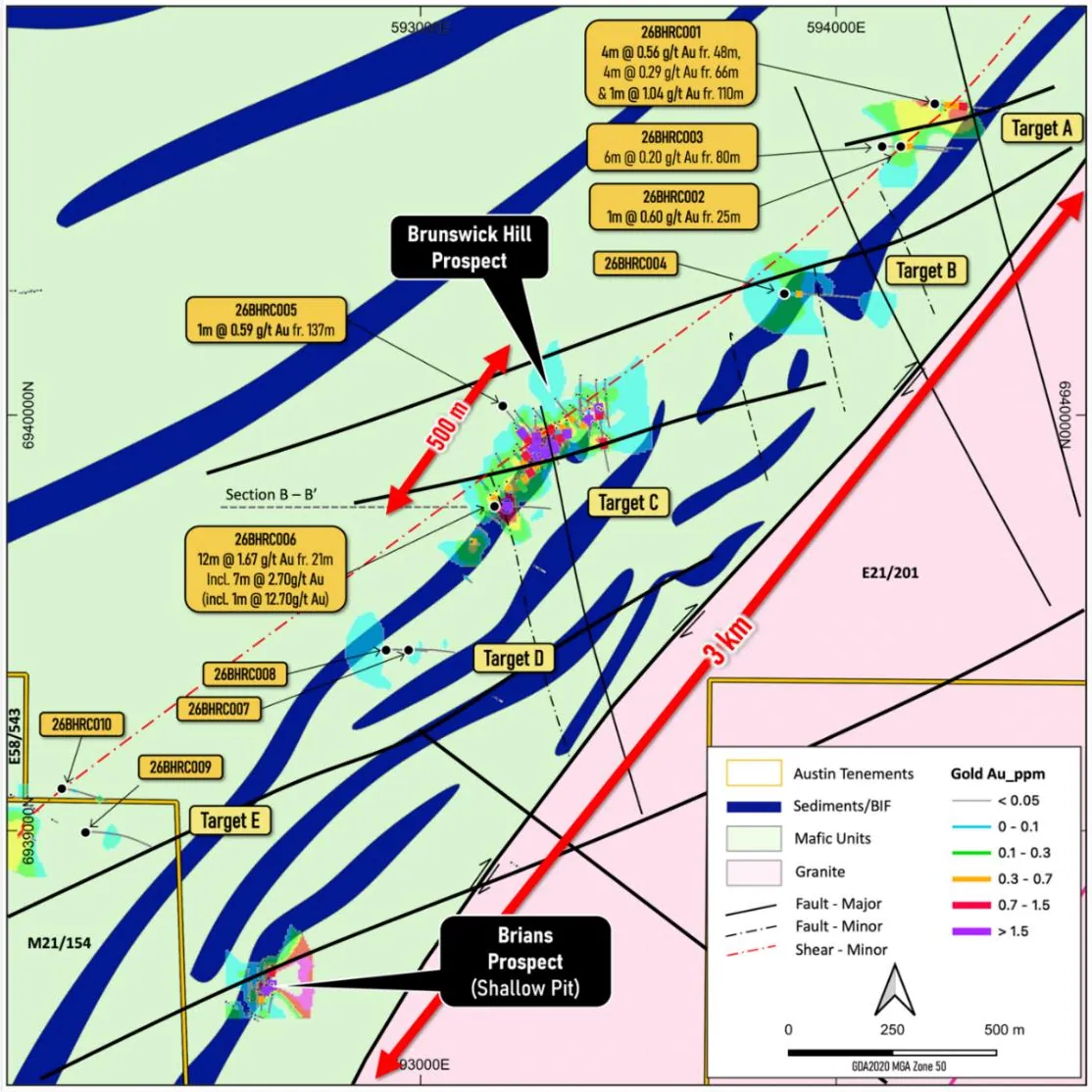
Austin Metals Limited (ASX:AYT) has finished a 21-hole, 4,215-metre reverse circulation drilling programme at its Austin Gold Project in Western Australia’s Murchison Goldfields, with the best result coming from Brunswick Hill. Hole 26BHRC006 returned 12 metres at 1.67 g/t gold from 21 metres, including 7 metres at 2.70 g/t and a peak one-metre assay of 12.70 g/t from 26 metres.
The result came from Target C, one of five areas tested along roughly three kilometres of prospective banded iron formation, or BIF, stratigraphy. Austin says the drilling validated its structural targeting model, with gold mineralisation associated with northeast- and northwest-trending structures intersecting BIF units. The company is now assessing whether the high-grade interval is controlled by the main mineralised trend or by cross-cutting structures.
The Brunswick Hill mineralisation remains open in both directions in the area tested, which extends for about 500 metres along strike and 140 metres down dip. That does not yet establish an economic deposit: the reported widths are down-hole lengths, and true widths remain unknown.
Mt Sandy model points to new structural targets
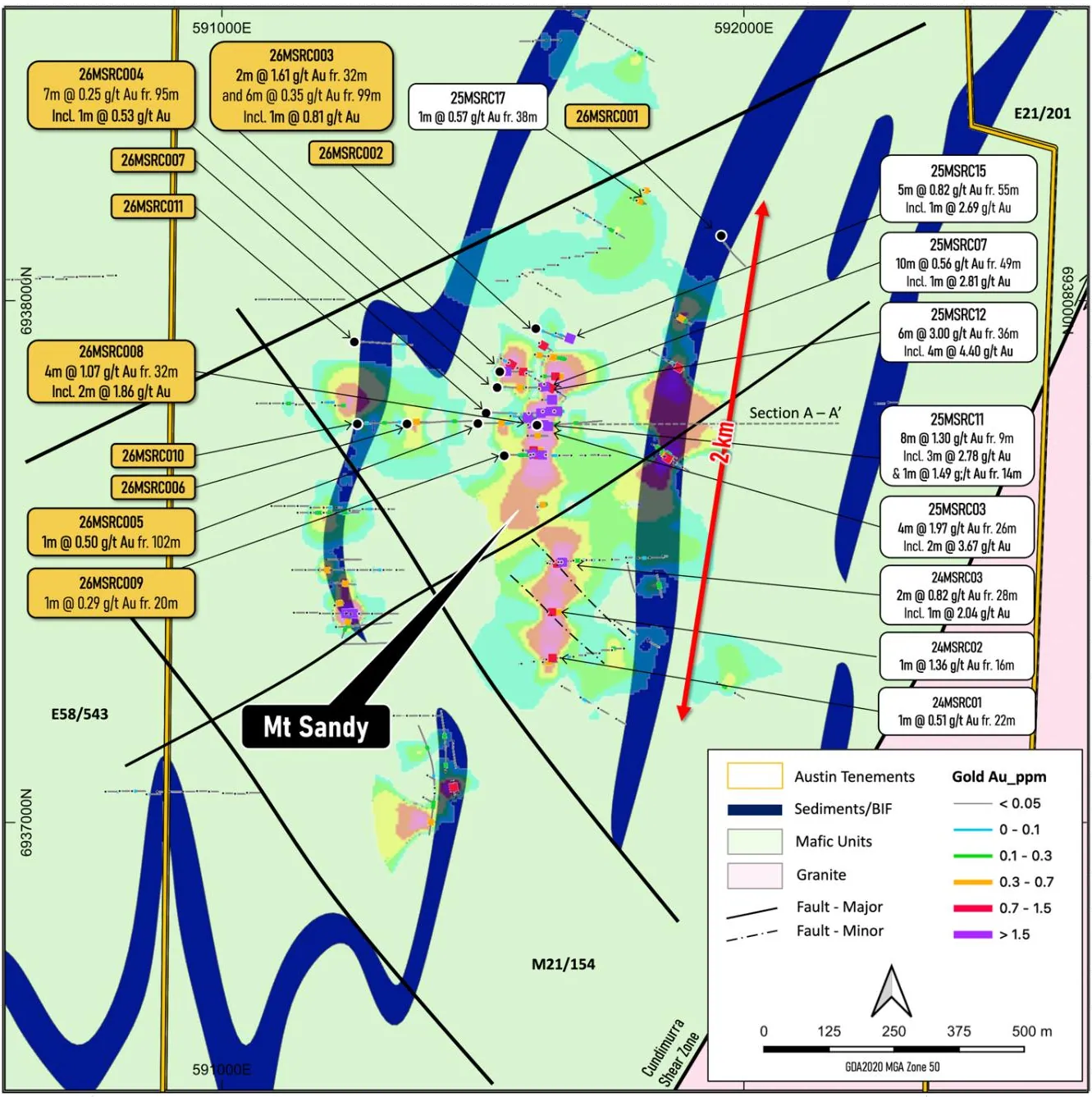
At Mt Sandy, 11 holes totalling 2,017 metres produced a more modest but potentially useful set of intersections. The strongest was 4 metres at 1.07 g/t gold from 32 metres in 26MSRC008, including 2 metres at 1.86 g/t and a one-metre peak of 3.03 g/t. Other results included 2 metres at 1.61 g/t from 32 metres in 26MSRC003.
New multi-element and mineralogy work has shifted the geological interpretation. Austin now identifies the host as a high-titanium dolerite sill, with mineralisation along its west-dipping sheared hanging-wall contact. The company believes higher-grade zones may occur where cross-cutting structures meet the sill and its sheared contact, creating targets for follow-up drilling along a broader trend interpreted to extend up to about two kilometres.
The revised model has similarities to the Great Fingall and Break of Day gold systems, but Austin explicitly describes those as conceptual analogues only. The company has not demonstrated equivalent grade, geometry, scale or continuity at Mt Sandy, so the comparison is a targeting aid rather than evidence of a comparable resource.
Follow-up drilling competes with a short funding runway
The next exploration phase is expected to focus on cross-cutting lode structures at Mt Sandy, the extent of the 26BHRC006 high-grade interval at Brunswick Hill, and additional BIF-hosted targets south along the Brunswick Hill trend. Austin also plans to progress target generation at the Teds and Shadow prospects, while the proposed UAV magnetic survey has been deferred.
That programme will need to be weighed against the balance sheet. Exploration expenditure totalled $719,000 during the quarter, while the Appendix 5B recorded $707,000 of exploration and evaluation cash outflows. Cash and cash equivalents fell from $2.075 million to $1.091 million, with total relevant quarterly outgoings of $984,000 and estimated funding of 1.11 quarters. Austin said it expects to maintain its current level of net operating cash flows, is considering options to support operations and exploration, and will prioritise activities according to available funding.
The company’s exploration campaign had already been framed around the September drilling results, which identified the same Brunswick Hill high-grade interval and revised the Mt Sandy model. Since quarter-end, John Ribbons has taken over as company secretary and CFO, while Sonu Cheema remains a non-executive director.
Bottom Line?
Austin has clearer drill targets, but the next value test may arrive alongside a capital-raising decision rather than a fresh assay result.
Questions in the middle?
- Will follow-up drilling show that the 12.70 g/t Brunswick Hill assay sits within a continuous, mineable structure?
- Can the revised Mt Sandy dolerite-sill model produce stronger or broader mineralisation at depth and along strike?
- What funding approach will Austin pursue before its current 1.11-quarter estimate is exhausted?
Sources
1-
Quarterly Activities/Appendix 5B Cash Flow Report (opens in a new tab)Verified company source. Austin Metals Limited · 26 Oct 2026 · investors.austinmetals.com.au