Monte Alto’s high-grade resource takes a major step forward

Brazilian Rare Earths has lifted Monte Alto’s Indicated ultra-high-grade resource by 41% to 3.54 million tonnes at 10.71% TREO, strengthening the geological base for mine planning. The company is now targeting a feasibility study for a staged concentrate-export operation by the end of 2026, although the updated resource is not yet an Ore Reserve or a new production forecast.
- Indicated resource rises 41% to 3.54 Mt at 10.71% TREO
- Monte Alto South Indicated tonnes increase approximately 200% to 1.9 Mt
- Total ultra-high-grade resource reaches 4.40 Mt at 9.87% TREO
- 8,100 metres of additional drilling incorporated into the estimate
- Concentrate sales feasibility study targeted for completion by end-2026
 Add us as a preferred source on Google
Monte Alto resource gains higher-confidence tonnes
Brazilian Rare Earths Limited (ASX:BRE) has expanded the higher-confidence portion of its flagship Monte Alto deposit by 41%, taking the Indicated ultra-high-grade resource to 3.54 million tonnes at 10.71% total rare earth oxides. The result gives the company a larger geological base from which to assess mine-life extension and staged development options in Bahia, Brazil.
The total ultra-high-grade resource, including 860,000 tonnes classified as Inferred, now stands at 4.40 million tonnes grading 9.87% TREO. Indicated material represents 87% of contained TREO, while the Inferred category accounts for 20% of tonnes and 13% of contained TREO. That distinction matters: Inferred resources carry lower geological confidence and cannot be treated as a proxy for mineable reserves.
Southern drilling drives the expansion
Monte Alto South supplied most of the growth. Its Indicated resource tonnes increased by approximately 200% to 1.9 million tonnes after step-out drilling repeatedly intersected thick, stacked mineralised horizons beyond the previous resource envelope. The deposit now extends across roughly 1,200 metres of strike and 300 metres of width, with mineralisation beginning at surface and remaining open along strike.
The new estimate incorporates 8,100 metres of additional drilling across 33 diamond holes, bringing the MRE database to 43,184 metres across 255 diamond drillholes. That work follows the Monte Alto drilling extensions, which previously identified ultra-high-grade mineralisation beyond the existing resource and a northern growth corridor.
Heavy rare earth inventory adds strategic appeal
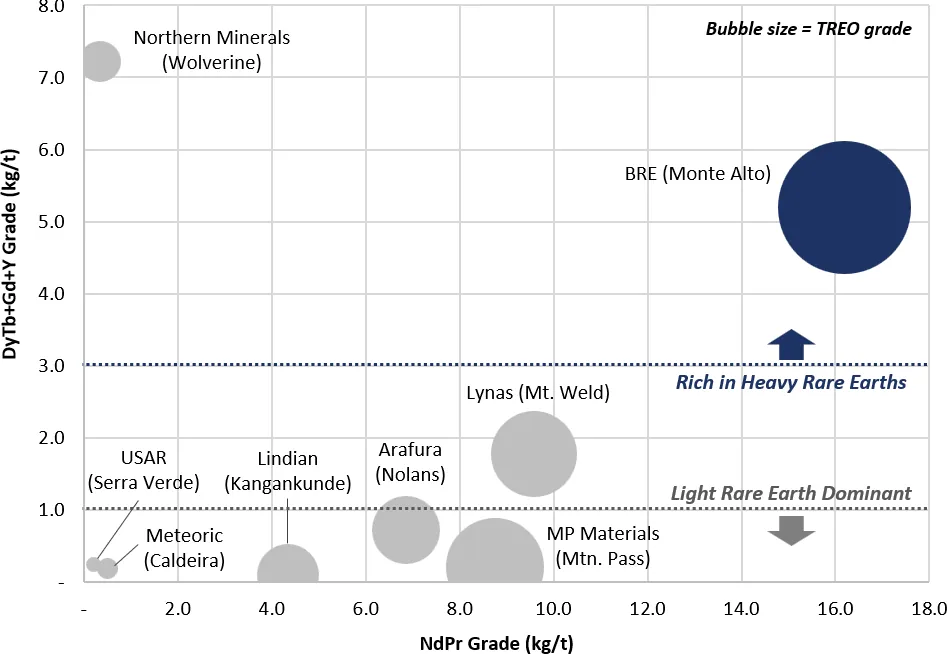
The resource is notable not only for its TREO grade but also for its mix of magnet and heavy rare earths. The updated estimate contains approximately 71.3 million kilograms of NdPr oxide, 3.12 million kilograms of dysprosium oxide and 572,000 kilograms of terbium oxide, alongside gadolinium and yttrium. It also includes niobium, scandium, tantalum and uranium, which BRE says could provide future co-product opportunities, subject to further processing and commercial work.
BRE’s earlier development narrative has centred on using Monte Alto’s high grades and ore-sorting potential to reduce the scale of mining and processing required per unit of payable product. The filing points to a possible initial concentrate-export business ahead of the planned Camaçari refinery, but describes that pathway as preliminary, indicative and subject to feasibility work, approvals and additional technical studies.
Feasibility study remains the next value test
The expanded MRE is intended to underpin the Monte Alto Concentrate Sales feasibility study, which BRE is targeting for completion by the end of 2026. The company says the study will examine a staged, low-capex operation using conventional mining and dry processing to produce a high-grade concentrate for export, potentially generating cash flow before downstream refining at Camaçari.
There is no new production target, forecast financial information or Ore Reserve in this announcement. The August 2026 scoping-study production target and financial forecasts were based on the previous resource and have not been updated. In addition, the company says metallurgical assumptions have not yet been fully validated at pilot scale across all material types, with further work required on ore sorting, flotation, acid curing, leaching and solvent extraction.
Drilling and density work still carry uncertainty
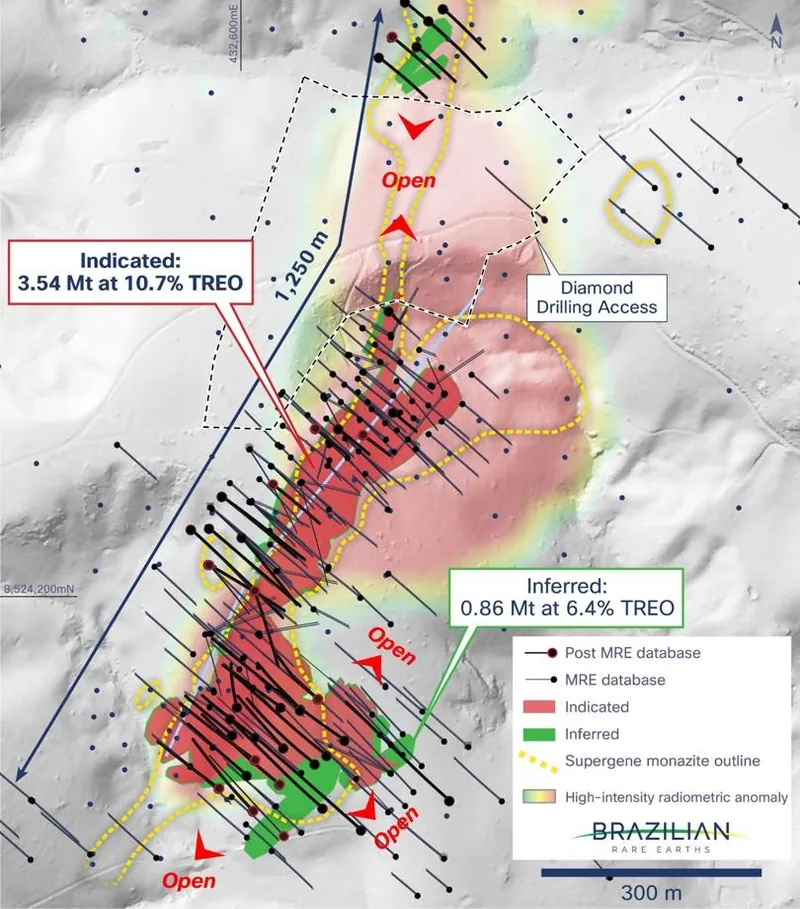
Mineralisation remains open to the south, north and east, and BRE has a further 5,000-metre step-out programme underway, alongside 900 metres of bridging drilling between Monte Alto Central and the northern extension. The company also plans infill drilling aimed at potentially converting parts of the Indicated resource to Measured status.
A separate caution sits within the updated estimate: changes to bulk-density assumptions reduced the weathered ultra-high-grade MIN resource to 360,000 tonnes at 13.23% TREO from 380,000 tonnes at 15.48% previously. BRE is developing a revised density model and says further work may lead to additional changes. The headline resource growth is substantial, but the feasibility study will have to convert geological scale and grade into recoverable product, capital requirements and an approved operating plan.
Bottom Line?
The resource upgrade strengthens BRE’s development platform, but the end-2026 feasibility study must now show how much of that geological advantage can become a financeable concentrate business.
Questions in the middle?
- Can the feasibility study support an economic Stage 1 concentrate operation without relying on Inferred resources?
- How will pilot-scale metallurgical work affect recoveries, product specifications and capital requirements?
- Will the next 5,000 metres of drilling extend the mine plan, or mainly increase resource confidence around existing zones?
Sources
1-
Monte Alto Indicated Ultra-High-Grade Resource Grows 41% (opens in a new tab)Verified source. Brazilian Rare Earths Limited · 26 Oct 2026