Cadoux finds shallow zircon extension along WIM 100 trend

Cadoux has extended WIM-style rare earth-zircon mineralisation onto its Wimmera joint venture ground, with Toolondo returning 20 metres at 0.86% in-situ zircon from just 8 metres. The result is promising but remains early-stage: rare earth chemistry is incomplete and no resource has been estimated.
- 20 m at 0.86% in-situ zircon from 8 m at Toolondo
- 3 m high-grade zone at 2.60% in-situ zircon
- Mineralisation spans about 1 km and remains open
- Echo East and Pimpinio also warrant follow-up
- Further drilling and rare earth analysis planned for Q4 2026
 Add us as a preferred source on Google
Toolondo extends WIM 100 onto Cadoux ground
Cadoux Limited (ASX:CCM) has found the most consequential result yet from its southern Wimmera exploration program: a shallow, sheet-like body of mineralised sand that the company interprets as the southern continuation of Iluka Resources’ WIM 100 trend. Drilling at Toolondo returned 20 metres at 0.86% in-situ zircon from 8 metres, including a three-metre interval at 2.60%.
The result was one of four consecutive holes across a traverse roughly one kilometre wide. The other intersections were 16 metres at 0.75% from 12 metres, 12 metres at 0.75% from 17 metres and nine metres at 0.68% from 18 metres. Cadoux said the mineralised layer is between nine and 20 metres thick, begins eight to 18 metres below surface and remains open to the west, south and at depth.
The ground sits about 2.5 kilometres south of Iluka’s WIM 100 Ore Reserve, although Cadoux cautions that mineralisation on neighbouring ground is not necessarily indicative of what lies within its own licence. The WMS JV’s earlier work at Danube had already put the WIM 150 trend on its map; the company’s maiden WMS drilling program completed 101 shallow aircore holes before these results were released.
Unassayed samples leave the Toolondo picture incomplete
The apparent continuity is encouraging, but the section is not yet a resource-ready dataset. Holes on the key traverse are spaced 250 to 400 metres apart, several samples remain held for assay and the upper 10 to 15 metres of three holes have not been tested. Cadoux also said one hole was assayed only from 17 to 26 metres, with its final assayed metre still returning 0.38% in-situ zircon.
The reported zircon and monazite figures are calculated from X-ray fluorescence chemistry rather than confirmed by mineralogy. Rare earth distributions, including xenotime content, have not yet been measured by ICP-MS. That distinction matters: an in-situ grade is an exploration measure, not a statement of recoverable product or project economics.
Echo East and Pimpinio add two follow-up targets
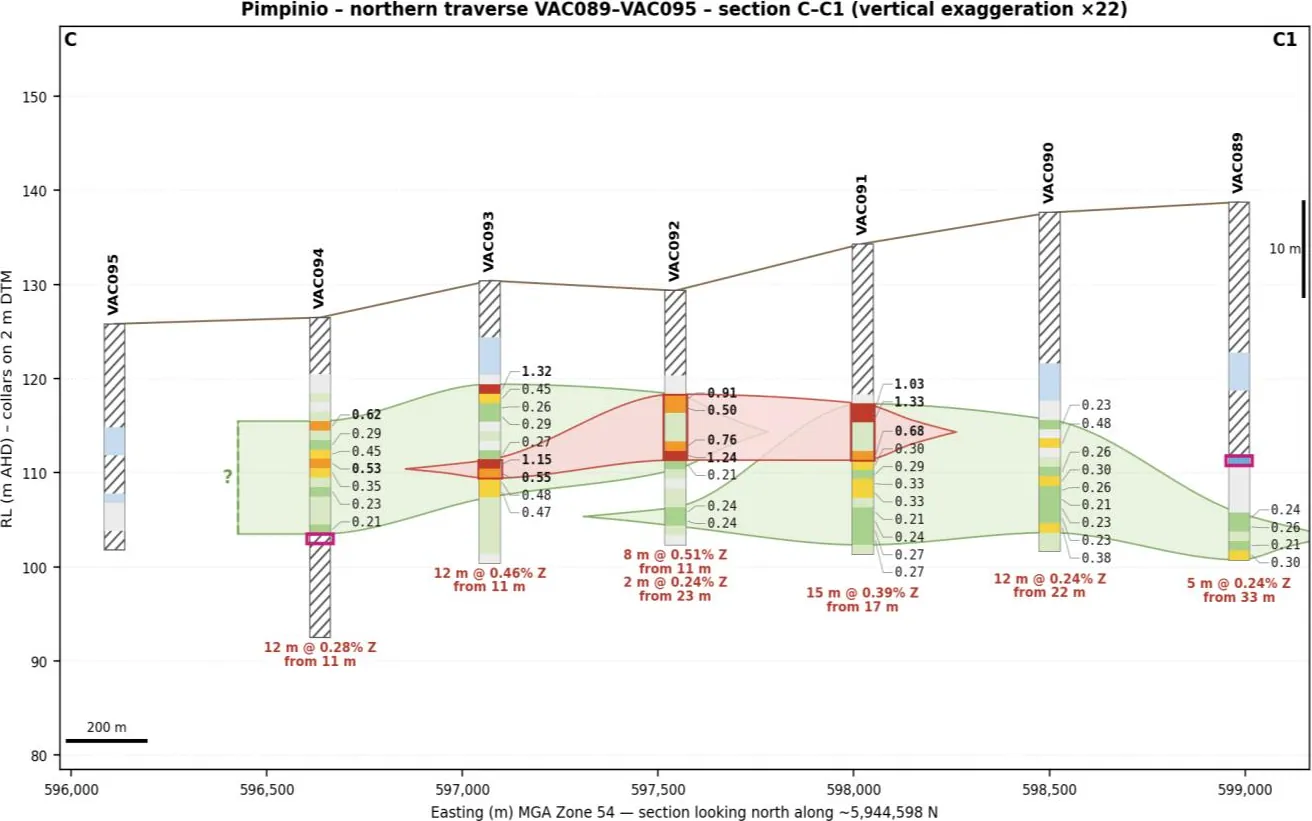
Toolondo was not the only target to produce WIM-style mineralisation. At Echo East, Cadoux reported several broad intersections, including 10 metres at 0.58% in-situ zircon and seven metres at 1.07% in one of the stronger holes. Pimpinio returned a 15-metre intersection at 0.39% from 17 metres, while the highest-grade result there was eight metres at 0.51% from 11 metres.
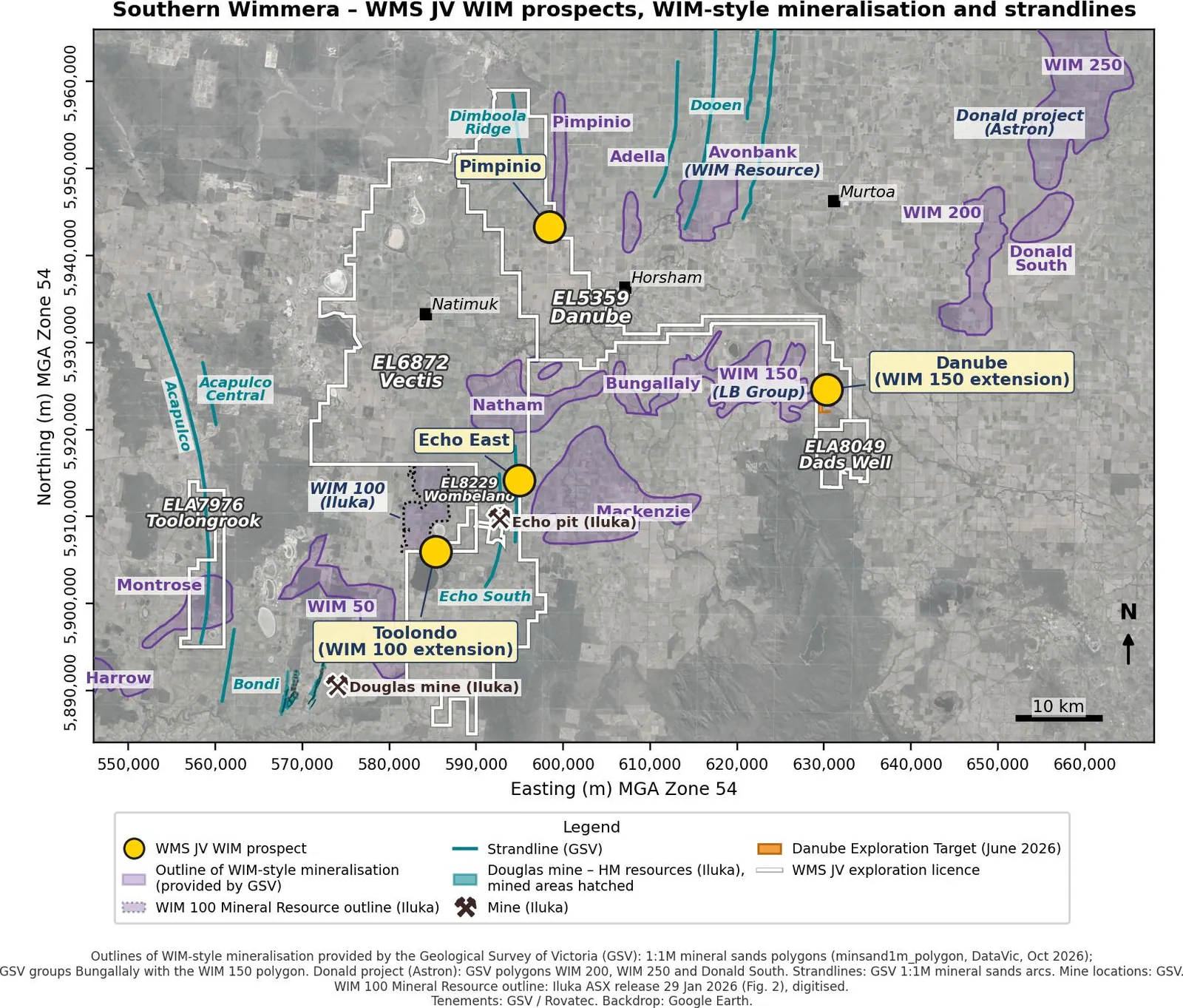
Those results are less striking than Toolondo’s best hit, but they extend the number of targets requiring follow-up across the roughly 1,400-square-kilometre WMS JV area. Cadoux is operator and can earn up to an 80% interest in the mineral sands rights, subject to the joint venture arrangements.
Rare earth assays and drilling are the next tests
The next phase will focus on assaying held samples, measuring rare earth chemistry and conducting metallurgical testwork on composite samples to produce a heavy mineral concentrate. Cadoux plans further drilling west and south of Toolondo, as well as follow-up work at Echo East and Pimpinio. The next drilling campaign is planned for the fourth quarter of 2026, subject to land access, approvals and funding.
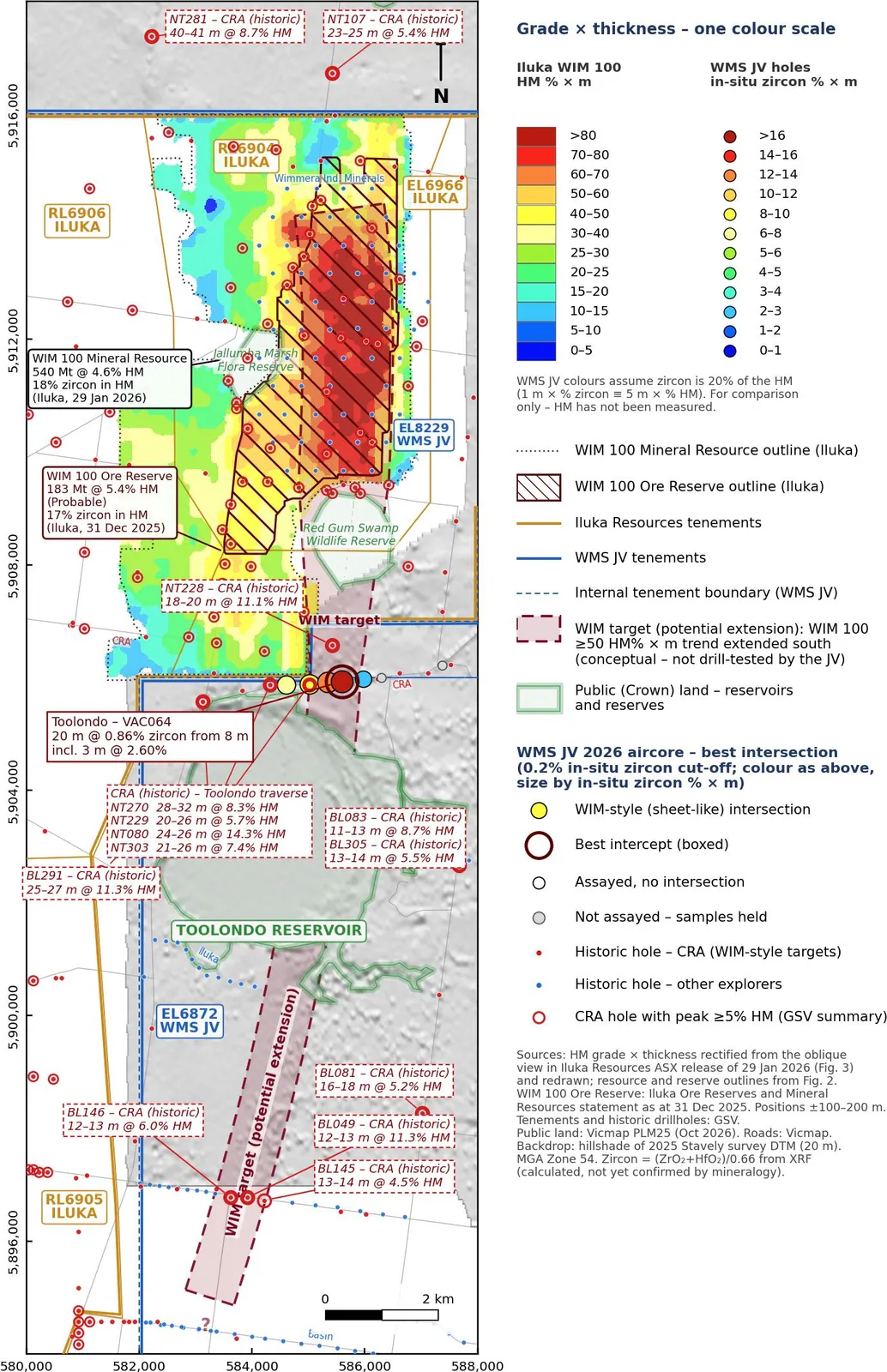
No Exploration Target or Mineral Resource has been estimated for Toolondo, Echo East or Pimpinio. The immediate question is therefore not whether Cadoux has discovered a deposit, but whether the shallow zircon intersections can be shown to carry a consistent rare earth assemblage and support recoverable products at meaningful scale.
Bottom Line?
Toolondo has improved Cadoux’s exploration profile, but the investment case still turns on held assays, ICP-MS rare earth results and metallurgical recovery rather than the headline zircon interval alone.
Questions in the middle?
- Will unassayed samples extend the shallow, one-kilometre Toolondo mineralised sheet?
- What rare earth minerals and grades will ICP-MS testing identify, particularly for xenotime and heavy rare earths?
- Can follow-up drilling and metallurgical work support an Exploration Target or eventual Mineral Resource?
Sources
1-
Drilling Extends WIM 100 REE/Zircon Trend to WMS JV Ground (opens in a new tab)Official market announcement. Cadoux Limited · 26 Oct 2026 · cadoux.com.au