Capricorn’s Mt Gibson drilling opens a deeper underground gold opportunity

Capricorn Metals has reported further high-grade gold intersections at Mt Gibson, with Lexington mineralisation extending beyond current pit and underground designs. The results support a planned maiden underground resource at Lexington later this quarter, but remain exploration results rather than an Ore Reserve.
- 6.0m at 57.38g/t gold and 29.5m at 6.65g/t at Lexington
- 3.0m at 89.88g/t gold at Hornet
- 21.83m at 9.54g/t at Orion South
- 26,668 metres drilled across 88 holes during the September quarter
- Lexington maiden Inferred underground resource targeted later this quarter

 Add us as a preferred source on Google
Lexington drilling extends beyond existing designs
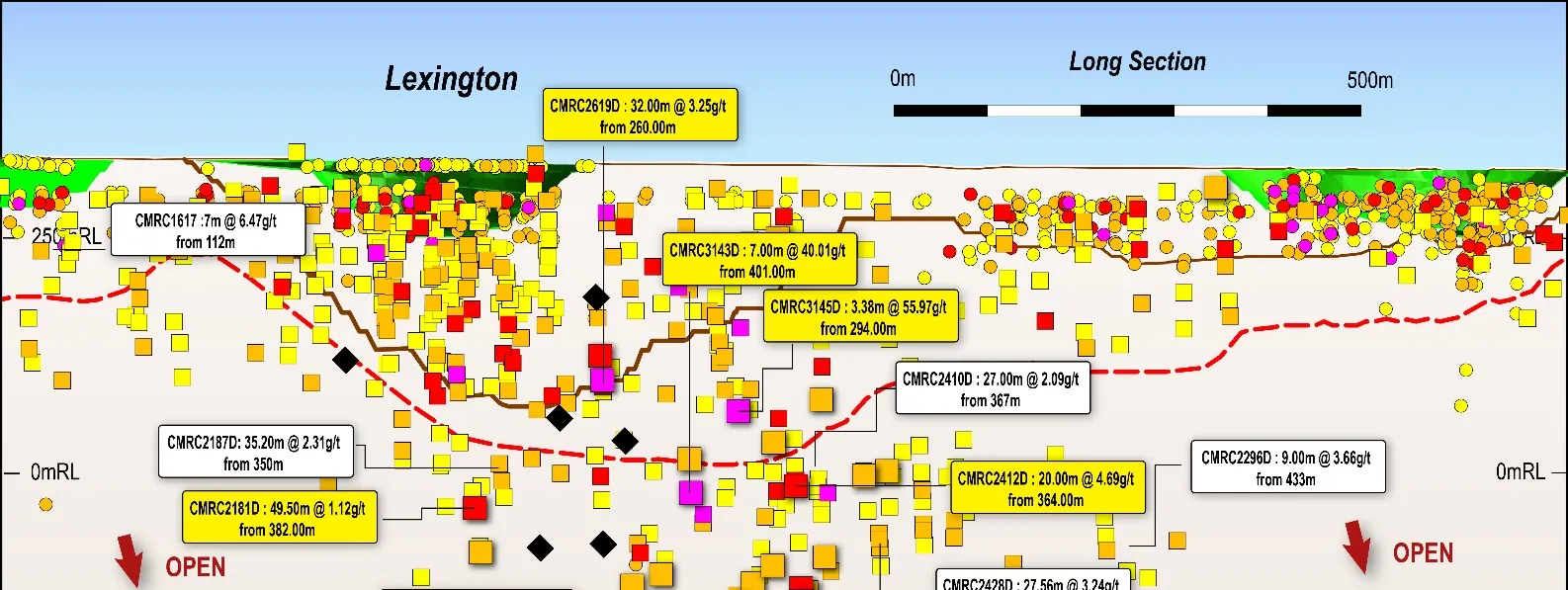
Capricorn Metals Limited (ASX:CMM) has delivered another set of high-grade gold results from its Mt Gibson Gold Project in Western Australia, with the strongest intersections sitting well below current open-pit and underground reserve designs. At Lexington, drilling returned 6.0 metres at 57.38 grams per tonne gold from 616 metres, 7.0 metres at 40.01g/t from 401 metres and 29.5 metres at 6.65g/t from 760.5 metres.
The company completed 26,668 metres across 88 diamond and reverse-circulation holes at Lexington and Hornet during the September 2026 quarter. Mineralisation was intersected from roughly 260 metres to more than 840 metres down-hole, and Capricorn said the system remains open along strike and at depth. The reported widths are down-hole intersections; true widths are not consistently provided in the announcement.
The results add to Capricorn’s earlier Mt Gibson drilling results, which had also highlighted high-grade exploration at the project, but today’s release is more specific about the resource-definition work now under way at Lexington.
Maiden Lexington resource remains the next test
Capricorn is using the drilling to define the geometry and grade distribution of Lexington’s north-plunging lodes ahead of a planned maiden Inferred underground Mineral Resource Estimate later this quarter. The company has not yet reported that resource, and the current intersections do not establish an Ore Reserve or an economic underground mine plan.
That distinction matters. The standout grades are encouraging exploration results, but their eventual value will depend on continuity, geological interpretation, mining widths, recoveries, costs and the resource estimate itself. Capricorn said the Lexington-Hornet mineralisation is hosted in an intrusion-related setting that generally produces thicker, higher-grade intercepts than the shear-hosted mineralisation at Orion South.
Hornet and Orion South add scale to the corridor
At Hornet, drilling intersected mineralisation beneath the current reserve pit outline, including 3.0 metres at 89.88g/t gold from 120 metres. Other results included 12.18 metres at 2.33g/t from 319 metres and 14.5 metres at 1.44g/t from 278 metres. Deeper Hornet drilling remains subject to pending assays, while historic drilling indicates mineralisation may continue at depth.
Orion South produced a separate 21.83-metre intersection at 9.54g/t gold from 371 metres, alongside 3.0 metres at 15.43g/t from 356 metres and 10.11 metres at 4.36g/t from 489.89 metres. Capricorn completed 10,575 metres across 45 holes at Orion South during the quarter, defining more than 1,600 metres of prospective strike and identifying a Western Lode outside the current pre-feasibility study stope design.
Processing capacity is being prepared for more drilling
Capricorn said the Lexington-Hornet and Orion South results sit within an eight-kilometre strike that hosts the existing Mt Gibson resource base, although the drill-tested portions remain only part of that broader corridor. Drilling will continue at Lexington and Hornet, while Orion South work will focus on infilling and extending the principal lodes and testing the Western Lode.
The on-site core processing facility at Mt Gibson is complete, with services, fit-out and equipment installation under way ahead of planned commissioning in November 2026. Further assays across the Mt Gibson deposits are expected in the second quarter of FY27. The immediate question is whether the coming Lexington resource can convert impressive individual intersections into a coherent, mineable underground inventory.
Bottom Line?
The drilling has strengthened the geological case for an underground corridor at Mt Gibson, but the planned Lexington resource will be the first real test of how much of that potential can be quantified.
Questions in the middle?
- How large and continuous will Lexington’s maiden Inferred underground Mineral Resource Estimate be?
- Will pending Hornet assays extend the high-grade system sufficiently to influence future mine design?
- How will the new Orion South and Lexington results affect subsequent resource, reserve and economic studies?
Sources
1-
Further High-Grade Results at Lexington (opens in a new tab)Official market announcement. Capricorn Metals Ltd · 26 Oct 2026 · capmetals.com.au