Firebird strengthens LMR precursor platform ahead of Australian replication

Firebird Metals has improved the packing density, particle morphology and impurity profile of its lithium-manganese-rich precursor material, with tap density reaching 1.35 g/cm³ and sulphur falling 46% to 610 ppm. The results strengthen the technical case for the platform, but downstream cathode testing and larger-scale validation remain ahead.
- Tap density rises to 1.35 g/cm³, 35% above Firebird’s previous result
- Sulphur falls 46% to 610 ppm
- Improved particle morphology reported across three batches
- Perth demonstration plant replication proposed as the next scale-up step
- Commercialisation still depends on cathode testing, reproducibility and customer qualification
 Add us as a preferred source on Google
Firebird improves the LMR precursor recipe
Firebird Metals Limited (ASX:FRB) has produced a denser and cleaner lithium-manganese-rich precursor, giving its emerging battery-materials platform a more credible bridge from laboratory work to scale-up. Tap density reached 1.35 g/cm³, 35% above the company’s previously reported result and 11% above a commercial reference, while sulphur content fell by approximately 46% to 610 ppm.
Tap density measures how tightly powder packs into a given volume. If that improvement carries through to finished electrodes without compromising electrochemical performance, more active material could fit within the same electrode space. That is a useful engineering result, but it is not yet evidence of higher cell energy density or better battery economics.
Particle formation and impurity control show progress
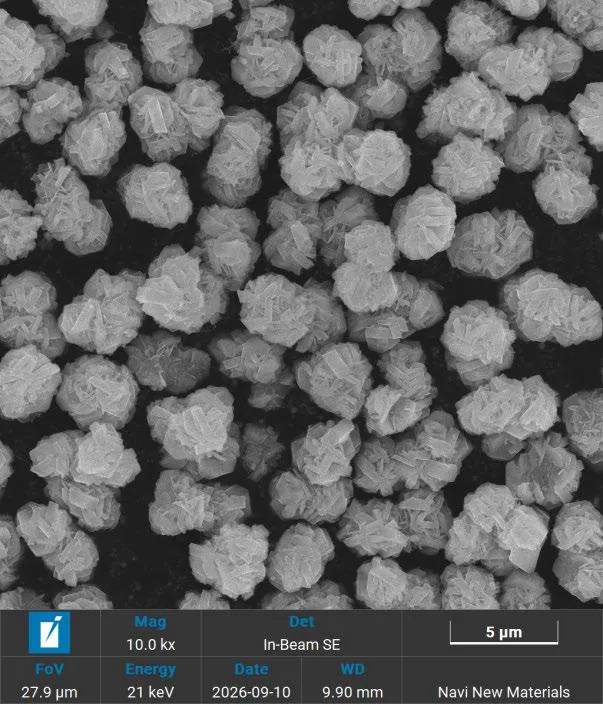
The Hunan research and development team refined its ammonia-based co-precipitation process, including reaction conditions and the temperature, frequency and duration of washing. Firebird reported predominantly rounded secondary particles with structured surfaces, a particle-size span of 0.742 and a median particle size of 4.193 micrometres.
The company said key indicators were consistent across three batches, an encouraging signal for repeatability. However, the detailed independent results in the announcement relate to one sample, so they do not independently establish that the full set of measurements was reproduced across all three batches. Firebird also cautioned that controlled comparative trials are still needed to determine how manganese sulphate purity affects precursor characteristics and later cathode performance.
From precursor quality to cathode validation
The result advances the next technical stage: lithiation and calcination followed by testing of cathode structure and electrochemical performance. It builds on Firebird’s earlier LMR cathode testing, which reported discharge capacity comparable with commercial reference materials, but the current announcement does not establish that the improved precursor will translate into superior finished-cathode performance.
Firebird’s strategy links the LMR program with its ultra-high-purity manganese sulphate capability. The company says the combination could support an integrated pathway from manganese feedstock to advanced cathode materials, although the announcement does not prove that feedstock purity caused the latest precursor improvements.
Perth demonstration plant is the next test
Firebird proposes to replicate the process at its Perth Australian Demonstration Plant, assessing production consistency, reagent efficiency, material yields and product quality at a larger scale. That work would sit alongside the plant’s broader development, after Perth plant progress was supported by a A$2 million ARENA grant and major equipment orders.
The commercial hurdle is therefore becoming more specific rather than disappearing. Firebird still needs to demonstrate reproducibility at scale, complete downstream electrochemical testing and progress customer qualification before commercial application can be established. The proposed Perth replication will show whether the encouraging Hunan results can survive the less forgiving conditions of demonstration-scale manufacturing.
Bottom Line?
The technical metrics have improved, but the decisive evidence will come from cathode performance, Perth-scale reproducibility and customer qualification rather than precursor data alone.
Questions in the middle?
- Will the higher tap density translate into stronger finished-cathode energy density without compromising cycle life or safety?
- Can Firebird reproduce the reported impurity and particle-size results consistently at the Perth demonstration plant?
- When will customer qualification or commercial partnering provide external evidence of demand for the LMR material?
Sources
1-
Firebird Significantly Improves LMR Precursor Quality (opens in a new tab)Verified company source. Firebird Metals Limited · 26 Oct 2026 · firebirdmetals.com.au