Peregrine Gold builds a funded Pilbara drilling pipeline from multiple gold targets

Peregrine Gold has advanced a portfolio of Pilbara gold targets, from a 4km auriferous palaeogravel zone at Capricorn to high-grade rock-chip results at Pilgangoora North. A $2.25 million placement strengthens the near-term exploration program, although quarter-end cash covered less than one quarter of reported outgoings before the raising.
- Capricorn palaeogravels extended across approximately 4km, with assays up to 13.52g/t Au
- Bulk samples near Peninsula recovered visible gold, but the material was not laboratory-assayed
- RC drilling is planned at Carneys, Coopers and Mallina subject to approvals
- $2.25 million placement priced at $0.135 a share, with part of the issue subject to shareholder approval
- Quarter-end cash of $1.096 million equated to 0.76 quarters of funding on the Appendix 5B calculation
 Add us as a preferred source on Google
Capricorn palaeogravels drive the quarter
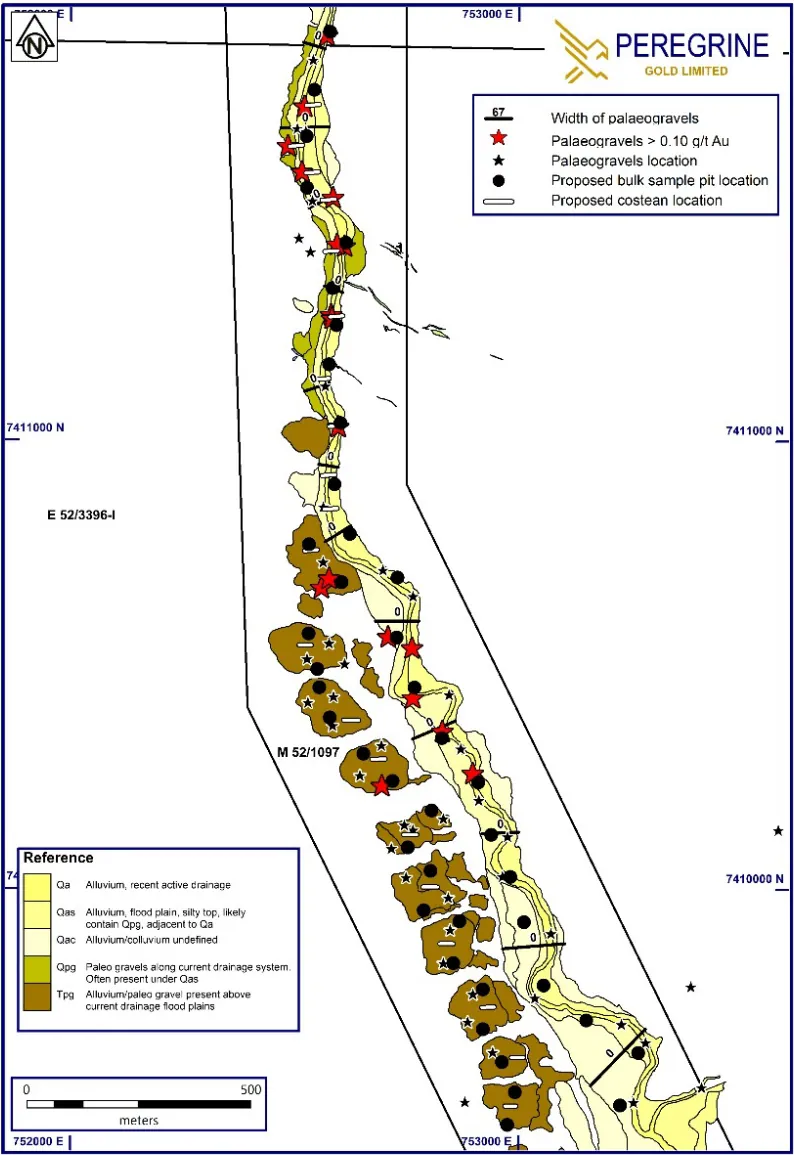
Peregrine Gold Limited (ASX:PGD) has put its most tangible exploration momentum behind the Capricorn Prospect, where gold-bearing palaeogravels now extend across approximately 4 kilometres within the Newman Gold and Iron Ore Project. Sampling returned results as high as 13.52g/t Au, while a separate older palaeogravel unit returned up to 0.5g/t Au from small channel samples.
The company lodged a mining lease application covering about 202 hectares after the initial results, and now plans a 500-kilogram bulk sampling program over the older Tpg unit. That work matters because the unit may exceed 2 metres in thickness, while only seven of 22 channel samples reached basement. Peregrine says the small, constrained samples did not adequately test grade distribution and that bulk sampling should provide a more reliable assessment.
The Capricorn work builds on the 4km palaeogravel extension reported earlier, but the geological encouragement comes with an important qualification: individual samples weighed only 3 to 4 kilograms and gold results varied sharply from the visible colours observed in pan samples. The proposed bulk program remains subject to a heritage survey and Programme of Works approval.
Visible gold supports dry-blowing trials, not a grade estimate
Two orientation bulk samples collected near the Peninsula Prospect produced visible gold after dry blowing and panning. Pit 1 yielded an estimated 5.3 grams of recovered gold, including a 48-gram ironstone-quartz-gold specimen, while Pit 2 produced approximately 7 grams in smaller pieces.
Those figures are field observations rather than laboratory grades. Peregrine has said it does not intend to submit the recovered specimens for assay, meaning the results cannot establish continuity, economic potential or a reportable mineralised grade. They do, however, support the company’s decision to expand bulk sampling at Capricorn and its view that dry-blowing techniques can help assess the palaeogravels.
Multiple drilling programs await approvals
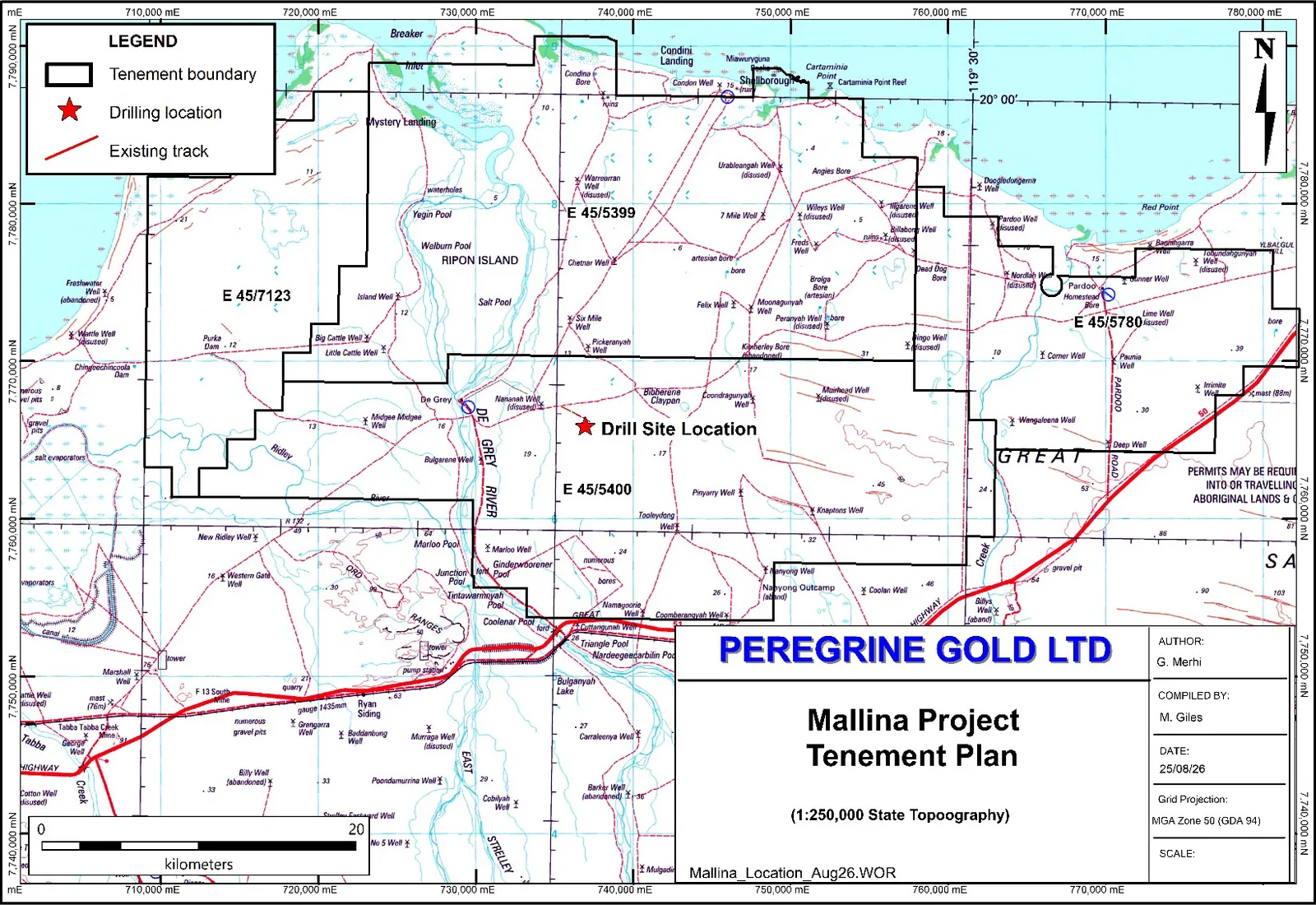
Exploration is broadening beyond the palaeogravels. Ethnographic surveys have been completed at the Carneys and Coopers Channel Iron Deposit prospects, with archaeological surveys scheduled before planned RC drilling of up to 100 holes at each prospect. At Mallina, a heritage survey has cleared proposed drill locations and access routes over geophysical targets, with targeted drilling anticipated in the December quarter subject to approvals.
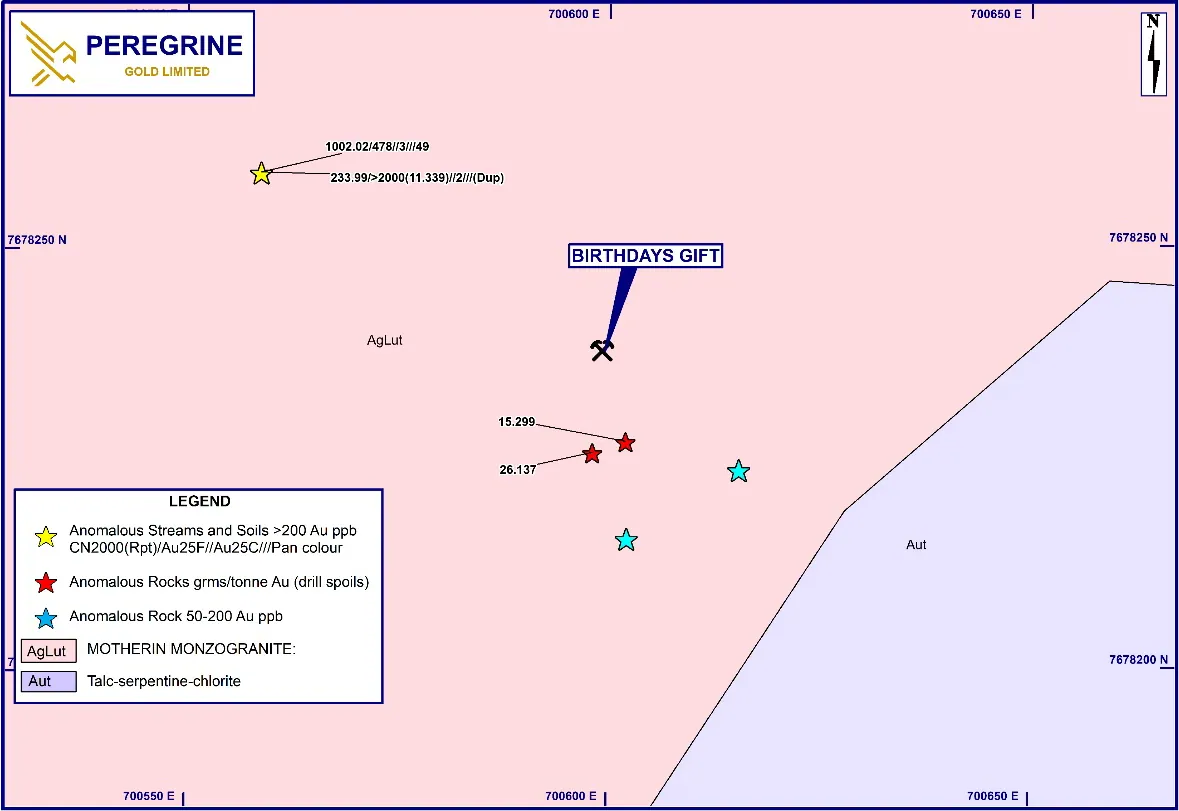
Pilgangoora North produced the sharpest isolated assay of the quarter: two rock-chip samples from the Birthday Gift occurrence returned 26.1g/t Au and 15.3g/t Au. The broader program outlined an approximately 800-metre by 1,000-metre gold-anomalous zone, which Peregrine plans to investigate with detailed soil sampling and mapping. Rocklea also returned stream-sediment results up to 318ppb Au, but those results remain early-stage indicators requiring further reconnaissance work.
Placement eases funding pressure but does not remove it
Post-quarter end, Peregrine secured firm commitments for a $2.25 million placement at $0.135 a share, issuing 16.67 million shares and 8.33 million free-attaching listed options exercisable at $0.25 by December 2027. The raising was supported by the company’s largest shareholder, Lion Selection Group and institutional investors, while director participation remains subject to shareholder approval at the 27 November annual meeting. The $2.25m September placement is intended to fund drilling and broader exploration across the Pilbara portfolio.
The timing is significant. Peregrine ended September with $1.096 million in cash after spending approximately $599,000 on exploration, while total net operating cash outflow was $837,000. On the Appendix 5B calculation, that represented 0.76 quarters of funding, before taking the subsequent placement into account. The company said approximately $2.0 million of the raising had been completed, with the balance tied to director participation and shareholder approval.
The next test is execution rather than another long list of targets: heritage and regulatory approvals must convert Capricorn’s sampling case into bulk results, while drilling at Carneys, Coopers and Mallina must turn geological promise into comparable, assay-backed evidence. Until then, the portfolio offers breadth, but its economic story still rests on a sequence of pending approvals and future field programs.
Bottom Line?
The placement gives Peregrine room to pursue several programs, but the investment case now depends on approvals and whether bulk sampling and drilling convert anomalies into repeatable grades.
Questions in the middle?
- Will the Capricorn bulk samples confirm that the older Tpg palaeogravel unit contains commercially meaningful and repeatable gold distribution?
- When will heritage and Programme of Works approvals allow drilling at Carneys, Coopers and Mallina to begin?
- Will shareholder approval of the remaining director-related placement shares be secured at the November annual meeting?
Sources
1-
Quarterly Activities/Appendix 5B Cash Flow Report (opens in a new tab)Verified source. Peregrine Gold Ltd · 26 Oct 2026