Amplia lines up next narmafotinib trial with $25.6 million pro forma cash

4 min read
8:22am on Wednesday 28th of October, 2026 AEDT ~8am, 28th Oct, 26
Amplia Therapeutics is preparing the next stage of narmafotinib’s pancreatic cancer development as its ACCENT trial nears completion and a Lilly collaboration broadens the drug’s potential into lung cancer. The biotech ended September with $20.8 million in cash, rising to $25.6 million pro forma after an October R&D tax refund.
- ACCENT pancreatic cancer trial nears completion with one patient still on study after 19 months
- ACCENT data included a 36% overall response rate and 11.1-month median overall survival
- ACCENT-MINI site start-up is under way, with ethics approval expected imminently
- Eli Lilly collaboration will test narmafotinib with olomorasib in KRAS G12C lung cancer
- September-quarter operating cash outflow was $3.1 million, implying 6.7 quarters of funding
 Add us as a preferred source on Google
Narmafotinib approaches its next pancreatic cancer test
Amplia Therapeutics Limited (ASX:ATX) is moving narmafotinib towards a registration-focused study in pancreatic cancer, with the ACCENT trial nearing completion and three Australian sites preparing for its successor, ACCENT-MINI. The company says ethics approval for the new study is expected imminently, although the trial design remains at an early planning stage.
The mature ACCENT data presented by Amplia include a 36% overall response rate, or 42% when unconfirmed responses are included, alongside a reported median overall survival of 11.1 months. The company says median progression-free and overall survival were two to three months better than chemotherapy alone, while the complete response rate reached 7.8% without significant worsening of chemotherapy tolerability. These are company-reported results from the existing study, rather than a new topline dataset in this quarterly report. The update builds on the mature ACCENT data reported earlier in the year.
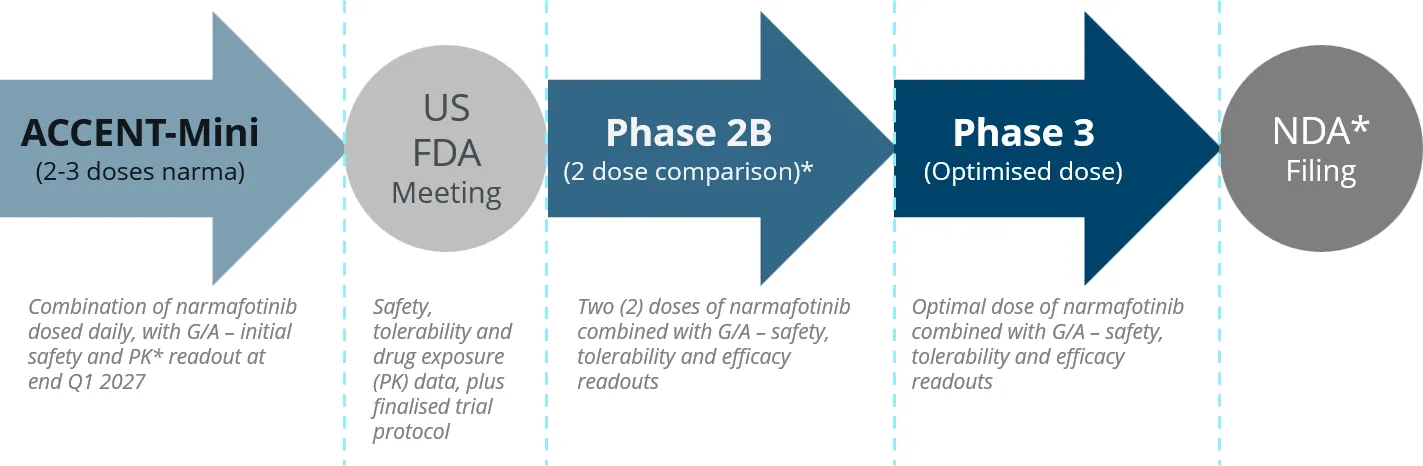
One patient remained on study after 19 months, while two others had completed 24 months and moved to narmafotinib under a compassionate access scheme. ACCENT-MINI will examine daily narmafotinib alongside gemcitabine and Abraxane across two or three dose levels, focusing on safety, tolerability and pharmacokinetics. Its findings are intended to guide dose selection for the next stage, with Amplia planning a meeting with the US Food and Drug Administration in the second quarter of 2027 to agree the final registrational design.
Lilly partnership tests the KRAS resistance thesis
Amplia is also trying to establish whether narmafotinib can strengthen a newer class of cancer medicines. Its collaboration with Eli Lilly will study narmafotinib alongside Lilly’s experimental KRAS G12C inhibitor olomorasib in non-small cell lung cancer. The partnership, announced in August, gives Amplia a route to generate what it describes as the first clinical evidence for narmafotinib’s ability to enhance a KRAS inhibitor. The earlier Lilly lung cancer collaboration had been framed as an expansion beyond Amplia’s pancreatic and ovarian cancer focus.
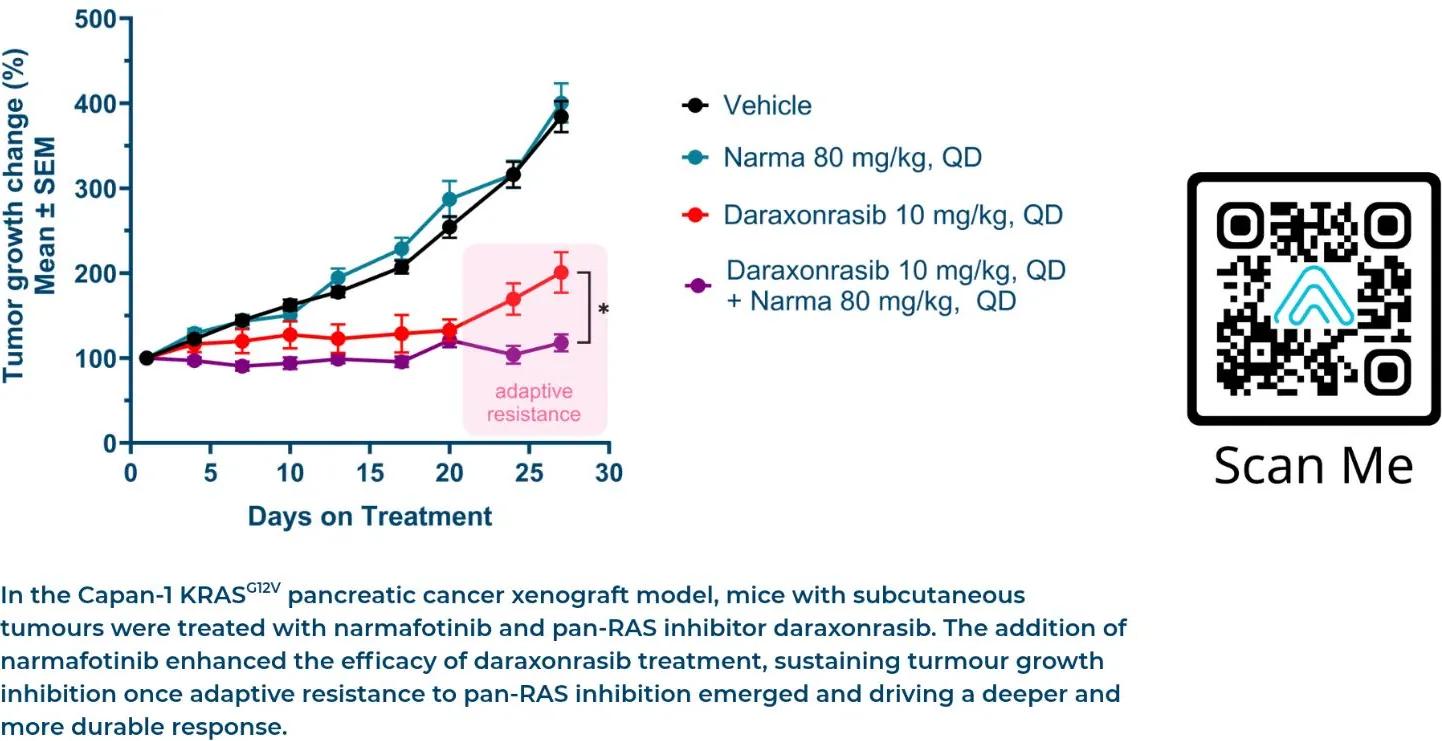
The rationale rests on preclinical work suggesting that FAK inhibition may block signalling pathways cancer cells use to survive KRAS inhibition. Amplia says resistance to KRAS inhibitors can emerge within two to four months in some cases, while KRAS mutations occur in about 30% of non-small cell lung cancers and 85% of pancreatic cancers. The company is continuing research with the Garvan Institute and has reported additional pancreatic cancer model work through an online scientific repository. None of that preclinical evidence establishes clinical benefit, making results from the Lilly-linked study a more consequential test of the strategy.
Cash runway extends after October tax refund
Amplia finished the September quarter with $20.8 million in cash after a net operating outflow of $3.1 million. Research and development accounted for $2.1 million of that operating spend, mainly covering ACCENT trial costs, contract research, manufacturing and related chemistry, manufacturing and controls work. Staff, administration and corporate costs totalled a further $1.2 million.
Using the quarter-end balance and operating cash use, the Appendix 4C reports an estimated 6.7 quarters of funding. Amplia subsequently received a $4.8 million R&D tax incentive refund in October, taking pro forma cash to $25.6 million. The company’s R&D tax rebate was reported separately before this quarterly update, but the new filing provides the clearer picture of cash burn and stated runway.
Get ASX:ATX news the moment it breaks
 iPhone & iPad
 Android
Bottom Line?
The next inflection points are practical rather than promotional: ethics approval, ACCENT-MINI dosing and the eventual FDA discussion will determine how quickly the promising but mature ACCENT data can be converted into a registration pathway.
Questions in the middle?
- How quickly will ethics approval translate into first-patient dosing for ACCENT-MINI?
- Will the Lilly combination produce clinical evidence that supports the preclinical KRAS-resistance thesis?
- Can the reported 6.7-quarter runway hold as the registrational program and collaboration studies expand?
Sources
1-
Quarterly Activities/Appendix 4C Cash Flow Report (opens in a new tab)Verified company source. Amplia Therapeutics Limited · 28 Oct 2026 · ampliatx.com