Boss Energy’s wide-spaced Honeymoon plan reaches its first major operating test

Boss Energy has maintained FY27 production and cost guidance after a weather-disrupted quarter, while its new wide-spaced wellfield design points to production at Honeymoon through at least FY34. The next test is whether early operating data can validate the study’s assumptions and support a larger regional uranium hub.
- 359,335 pounds of drummed U3O8 produced at Honeymoon in Q1 FY27
- A$47/lb C1 cost and A$79/lb AISC remain within full-year guidance
- New Feasibility Study forecasts 13.8 million pounds over nine years
- Uranium inventory rose to 1.64 million pounds as realised pricing improved
- Alta Mesa production fell sharply after permitting delays in Texas

 Add us as a preferred source on Google
Honeymoon holds guidance through a weather-disrupted quarter
Boss Energy Limited (ASX:BOE; OTCQX:BQSSF) has kept its FY27 production and cost guidance intact after Honeymoon produced 359,335 pounds of drummed U3O8 in the September quarter, despite 19 days of lost production following heavy rain. Production was broadly flat against the previous quarter, while C1 costs of A$47 per pound and AISC of A$79 per pound remained below the full-year guidance ranges of A$51-A$56 and A$83-A$92 respectively.
The operation generated record flows, but falling average solution tenor reduced ion-exchange production by 9.2% to 337,093 pounds. Boss said the decline was expected as older wellfields remain online and their tenor falls. It also pulled forward some planned shutdown activity after the weather interruption, helping it deliver production broadly in line with its initial expectations.
Wide-spaced wellfield design moves from study to operating test
The quarter’s more consequential development was the transition to the wide-spaced wellfield design underpinning the Honeymoon New Feasibility Study. Boss completed its first full quarter from B6, the last wellfield using the previous 30-metre injector-to-extractor spacing, and recovered about half of its resource after 12.1 pore-volume exchanges, with average leach solution tenor of 102 parts per million.
Flushing has now begun at EKT1, the first wellfield using the newer 58-metre spacing. Boss described the early flushing performance as supportive of the design’s viability, but the more meaningful evidence is still to come: final flushing data and initial leaching results are expected in the December quarter. The transition was anticipated in wide-spaced wellfield study, after the company began reshaping its mining strategy around the design earlier this year.
New feasibility study extends Honeymoon’s operating runway
The completed study forecasts approximately 13.8 million pounds of drummed U3O8 over a nine-year operating period, with economic production at Honeymoon extending until at least FY34. Boss says the design could reduce life-of-mine AISC by about A$30 per pound on a like-for-like basis against applying the original spacing to the updated resource estimate.
That forecast is not without qualifications. The production target is based on 65% Indicated and 35% Inferred Mineral Resources over the mine life, although the first four years are supported by 89% Indicated Resources. The wide-spaced design is also still being tested in commercial operations, making EKT1’s results a particularly important near-term operating marker.
Inventory builds as uranium prices improve
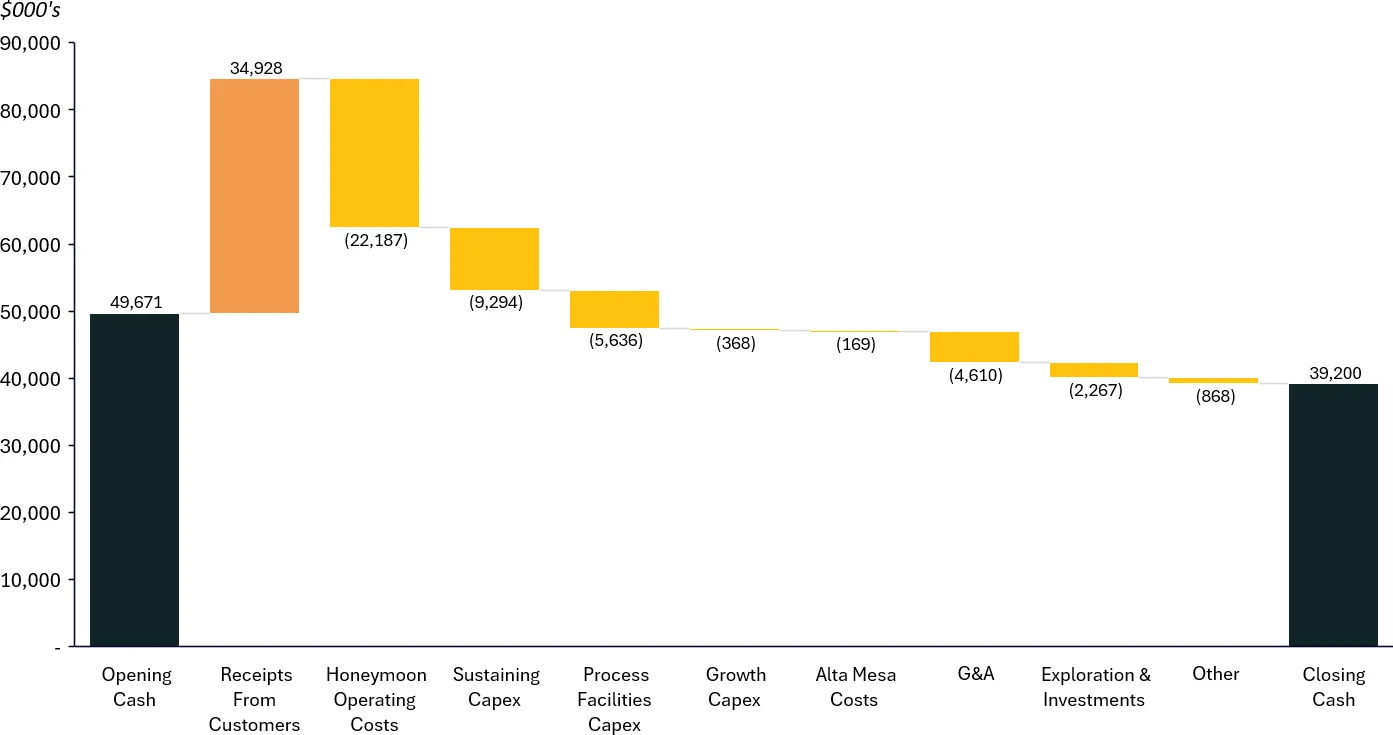
Boss sold 300,621 pounds during the quarter at an average realised price of US$81.8 per pound, up from US$75.1 per pound in the previous quarter. It accumulated a further 60,000 pounds, taking inventory to 1.641 million pounds, while cash fell A$10.5 million to A$39.2 million. Including investments and uranium inventory, liquid assets stood at A$194.9 million, and the company reported no debt.
Management expects a Q2 realised price of about US$87-US$89 per pound. That expectation sits alongside a strategically under-contracted position, which gives Boss exposure to uranium pricing but also leaves realised revenue sensitive to future contract deliveries and market conditions. A legacy contract is expected to account for 124,000 pounds per quarter in Q3 and Q4 at a realised price typically equivalent to 65%-70% of the prevailing spot price before delivery.
Regional hub ambition remains aspirational
Boss is advancing a plan to process uranium from Honeymoon, Jason’s Deposit and Gould’s Dam through existing infrastructure, with an aspiration to produce 2.5 million pounds annually at an AISC of about A$65 per pound by the early 2030s. The company has submitted the EPBC referral for the Honeymoon Mine Extension, with a decision expected in the December quarter, while technical and environmental work continues at Jason’s and Gould’s Dam. Earlier resource updates reported increases at both satellite deposits, but the new regional output figure is not a production target and has not been supported by feasibility studies for either project.
New wellfields EKT2, EKT3 and HMT1 are under construction and are expected to begin production in Q4 FY27, Q1 FY28 and Q3 FY27 respectively. Water treatment plant upgrades are also progressing, with Stage 1 targeted for Q4 FY27 and Stage 2 for Q3 FY28. Planned drilling at Jason’s Deposit and across priority targets in the Honeymoon catchment should add geological and operating information, but the projects remain subject to further drilling, approvals, infrastructure work and successful wellfield performance.
Alta Mesa interruption adds a separate execution risk
The quarter was less encouraging at Alta Mesa, the 30%-owned Texas joint venture with enCore Energy. Production on a 100% basis fell to 10,000 pounds from 45,000 pounds in the previous quarter, and Boss received no product. State permitting delays meant new wellfields were not brought online in time to offset declines in existing fields, forcing the plant to stop until replacement wellfields are available. Permits for PAA3 Extension and PAA8 are expected in Q2 FY27 and Q3 FY27 respectively.
Boss has also changed its leadership structure, with Peter Botten becoming chair on 30 September while Wyatt Buck remains a non-executive director. The immediate operational focus, however, is less ceremonial: EKT1’s leaching results, the timing of new wellfield start-ups and the pace of water-treatment upgrades will determine how quickly the study’s lower-cost, longer-life proposition becomes visible in production data.
Get ASX:BOE news the moment it breaks
 iPhone & iPad
 Android
Bottom Line?
Boss has preserved its FY27 targets and strengthened its uranium inventory, but the investment case now depends on EKT1 validating the wide-spaced design rather than merely supporting it on early flushing data.
Questions in the middle?
- Will EKT1’s first leaching results in the December quarter match the New Feasibility Study assumptions?
- Can EKT2, EKT3 and HMT1 enter production on schedule despite the earlier rainfall delays?
- When will Alta Mesa’s permitting issues be resolved, and can production recover once the new wellfields are online?
Sources
1-
Quarterly Activities Report - September 2026 (opens in a new tab)Official market announcement. Boss Energy Ltd · 28 Oct 2026 · bossenergy.com