White Cliff’s Rae copper footprint grows as Hancock funding accelerates drilling

White Cliff Minerals has expanded copper mineralisation at Danvers to 4.75km, added a new Bornite Hills discovery and secured A$8.77 million from Hancock Prospecting. The funding improves the immediate exploration position, but the project remains at the drilling and assay stage.
- Danvers mineralisation extended across 4.75km of the Teshierpi corridor
- Bornite Hills returned assays of up to 11.5m at 2.00% copper
- Hulk drilling expanded the sediment-hosted copper target, though the filing cites conflicting footprint figures
- Hancock Prospecting invested A$8.77 million for approximately 13.5% of White Cliff
- Quarter-end cash was A$1.32 million before the post-quarter placement proceeds
 Add us as a preferred source on Google
Danvers copper corridor reaches 4.75km
White Cliff Minerals Limited (ASX:WCN) has used its September quarter report to put a larger number around the Rae Copper Project story: drilling has now confirmed copper mineralisation over 4.75km of the Teshierpi structural corridor at Danvers, compared with approximately 820m tested in 2025. The company also says visual copper sulphides have been observed across more than 6km to 7km of the broader Teshierpi Fault Zone, although those visual observations still require laboratory confirmation.
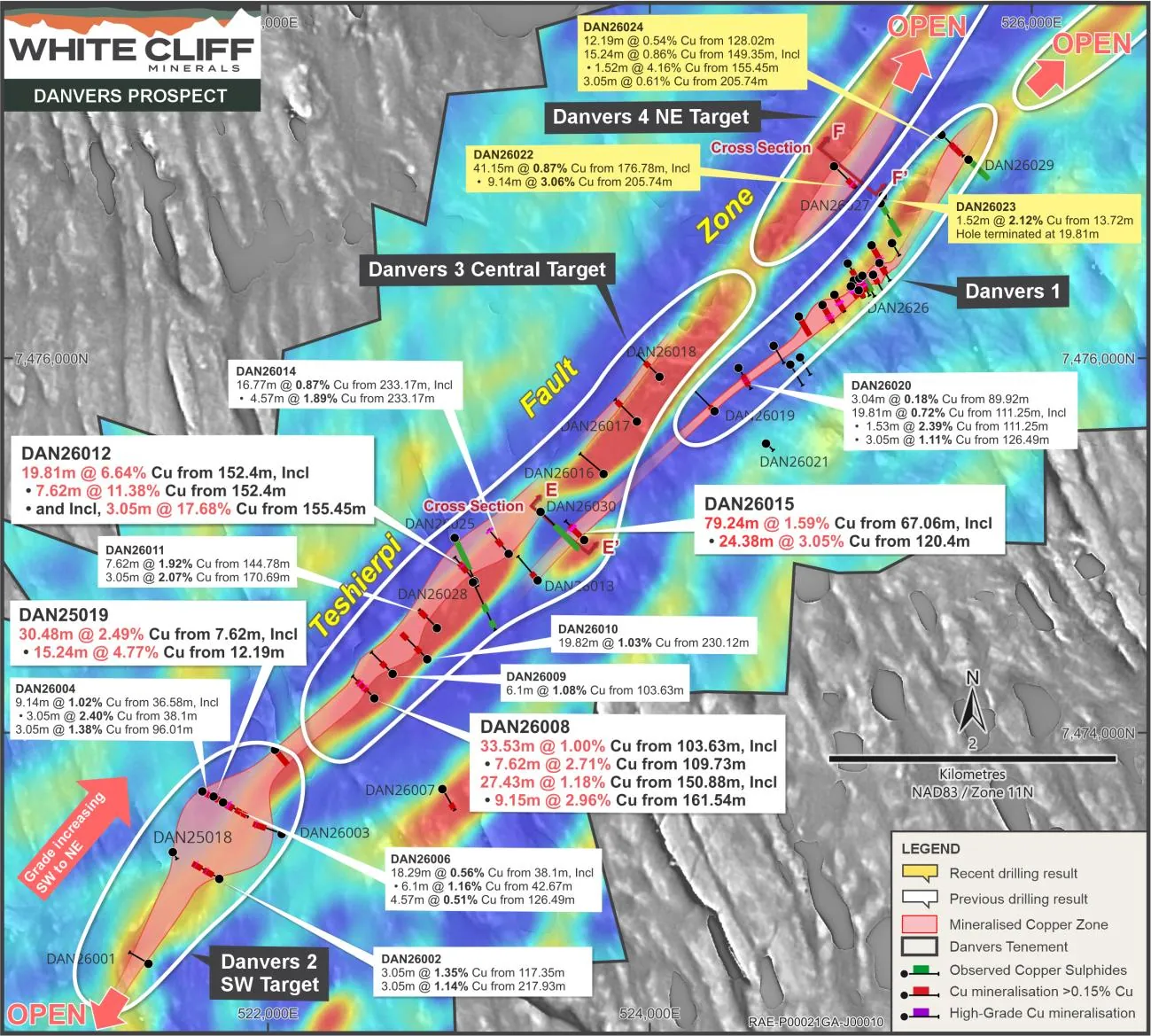
The strongest reported quarter results include 23m at 6.18% copper and 13g/t silver from 161m in hole DAN26036, including 3.90m at 16.45% copper, and 50.9m at 2.81% copper and 7.66g/t silver from 39.7m in DAN26026. Earlier drilling also produced a 19.81m interval at 6.64% copper, including 1.52m at 21.1% copper. These are exploration intersections, not a resource estimate, but the accumulating results have extended both the apparent footprint and the high-grade core.
The latest Danvers activity also connects with the company’s 76.5m Danvers copper intercept, reported earlier in October. That result returned 76.5m at 2.01% copper from 49.5m, including 4m at 11.19% copper, while the current report says drilling is continuing across Danvers 1, 2 and 3.
Bornite Hills adds a second copper front
Bornite Hills has moved from surface evidence to an early drilling discovery. First-pass drilling intersected more than 32m of bornite-dominant mineralisation below a historic trench that returned 3.66m at 46.99% copper. Assays received after the quarter included 15m at 1.62% copper from 57m in BNH26001A and 11.5m at 2.00% copper from 75.5m in BNH26003, with a peak 0.56m interval grading 16.3% copper.
The mineralised system remains open along a 1.3km host structure. The company’s Bornite Hills drilling results had already placed the assays beneath the historic surface trench on the market’s radar, but geometry and true thickness remain unresolved. Further drilling will need to establish whether the high-grade observations form a coherent body rather than a series of isolated intersections.
Hulk expands sediment-hosted copper target
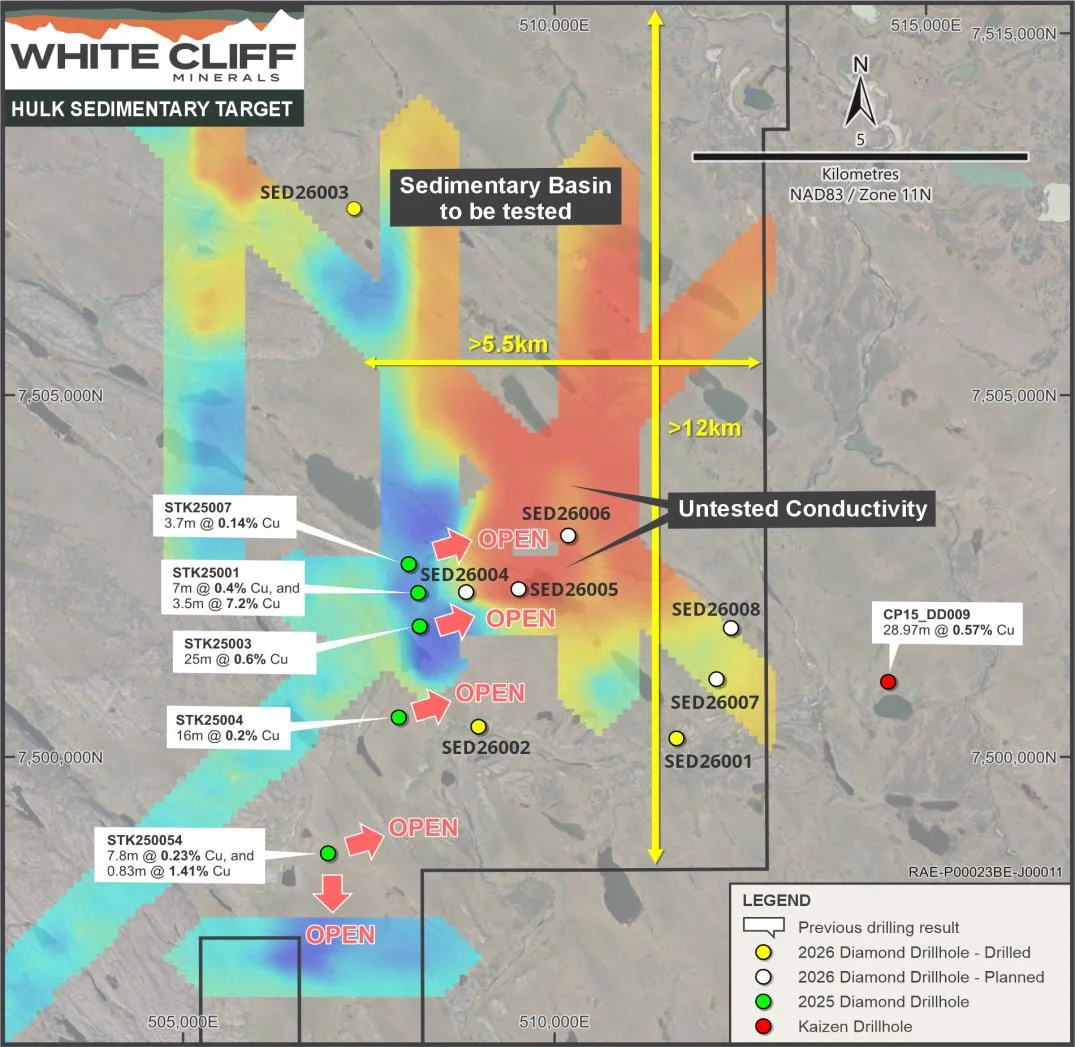
At Hulk, all three 2026 diamond holes intersected visible chalcopyrite at the Rae Group-Husky Creek Formation redox boundary. White Cliff says mineralisation has been confirmed more than 3.7km east of the earlier STK25004 hole, with the detailed project section placing the interpreted prospective area at approximately 6.3km². High-priority electromagnetic conductors east of the existing drilling remain untested.
There is, however, a data point investors should not glide past: the announcement’s headline highlights describe the known sediment-hosted copper footprint as greater than 10km², while the detailed Hulk discussion refers to an approximately 6.3km² prospective area. The filing does not reconcile the two figures. More importantly, the Hulk results are based on visible sulphides; laboratory assays are needed to determine grade and reported widths.
Hancock placement changes the drilling equation
Hancock Prospecting has provided White Cliff with A$8.77 million through a placement of 515,791,601 shares at A$0.017, representing approximately 13.5% of the company after shareholder approval on 19 October and issue of the shares on 22 October. The proceeds are earmarked to expand and accelerate drilling at Rae.
The capital arrived after White Cliff received approximately A$6.5 million from the underwritten conversion of WCNO options during the quarter. That funding matters because the company ended September with only A$1.32 million in cash and reported net operating cash outflow of A$6.67 million for the quarter, including A$5.80 million on exploration and evaluation. The Appendix 5B calculated just 0.20 quarters of funding at quarter-end and recorded no available financing facilities; the post-quarter Hancock proceeds materially changed that immediate position, without removing the need to fund an aggressive exploration program.
RC drilling has recommenced at Danvers, while assays remain pending from the new 2.8km parallel structure less than 200m east of Danvers 1. The first hole there, DAN26053, recorded visual copper sulphides from 16m across multiple chalcocite- and chalcopyrite-bearing veins and breccias, but the company cautions that visual estimates are not a substitute for laboratory analysis. The next meaningful test of the story is therefore not another map of prospective ground, but whether the pending assays convert the visual expansion into repeatable, reportable copper grades.
Bottom Line?
Hancock’s A$8.77 million investment gives White Cliff room to drill harder, but the investment case now depends on assays converting a large exploration footprint into coherent, resource-quality mineralisation.
Questions in the middle?
- Will assays from the 2.8km parallel structure east of Danvers 1 confirm a second mineralised system or only isolated sulphide zones?
- Can Bornite Hills establish continuity and true thickness beneath the high-grade historic trench?
- Which Hulk footprint is correct, and will laboratory assays support the scale suggested by the visible chalcopyrite intersections?
Sources
1-
Quarterly Activities and Cashflow Report (opens in a new tab)Official market announcement. White Cliff Minerals Limited · 28 Oct 2026 · relait.wcminerals.com.au