$15 million placement follows $27.3 million statutory profit at White Energy

White Energy has pivoted towards thermal and metallurgical coal, completed two acquisitions and raised $15 million after year end. But its FY2026 report records a $3.6 million normalised EBITDA loss, just $0.4 million in unrestricted cash and an auditor-highlighted material uncertainty over going concern.
- $27.3 million statutory profit driven largely by a $32.1 million debt-extinguishment gain
- $3.6 million normalised EBITDA loss and $3.3 million operating cash outflow
- Lolley No. 1 and Tin Hut Creek acquisitions completed after year end
- $15 million placement at $0.06 a share funded the acquisition push
- Auditor flags material uncertainty over White Energy’s ability to continue as a going concern

 Add us as a preferred source on Google
Profit headline masks White Energy’s operating loss
White Energy Company Limited (ASX:WEC) reported a $27.3 million profit before tax for FY2026, but the number is largely an accounting artefact rather than evidence of an operating turnaround. The result included a $32.1 million gain from the extinguishment of shareholder liabilities, while adjusted normalised EBITDA remained a $3.6 million loss, wider than the $3.1 million loss recorded a year earlier.
The company generated only $370,000 of total revenue and recorded a $3.3 million net cash outflow from operations. At 30 June, unrestricted cash had fallen to $414,000 from $3.1 million, while the group remained in a net liability position of $11.0 million. The auditor issued an unmodified opinion, but highlighted a material uncertainty that may cast significant doubt on White Energy’s ability to continue as a going concern.
Coal acquisitions create a larger development pipeline
White Energy’s strategic reset is now centred on building a coal development portfolio rather than relying primarily on its Binderless Coal Briquetting technology. After the reporting date, it completed the acquisition of the Lolley No. 1 underground metallurgical coal project in Alabama and the Tin Hut Creek thermal coal project in Queensland, following the transactions outlined in the September coal acquisitions.
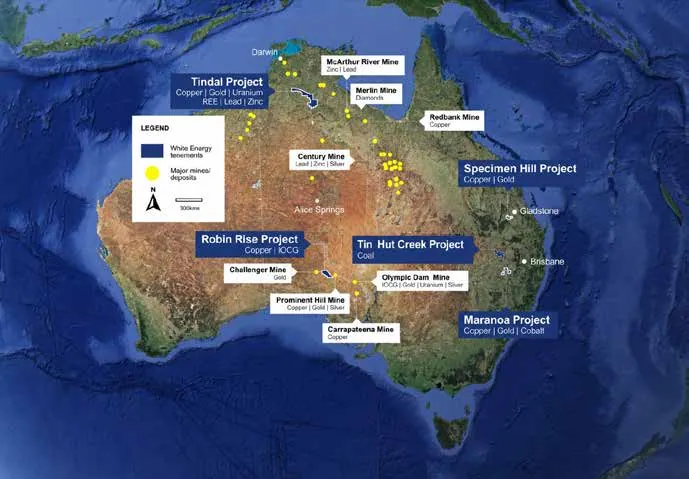
Lolley No. 1 is on care and maintenance and includes an on-site 350-tonne-per-hour coal handling and preparation plant, mine portals and access to rail and barge infrastructure. White Energy says initial Phase 1 production could begin about 12 months after recommissioning, but only subject to financing, approvals and restart activities. Tin Hut Creek covers about 896 square kilometres in Queensland’s Surat Basin, where the company plans to review historical data before drilling and evaluating coal resources.
Funding has bought time, not removed the capital question
The post-year-end transactions were supported by a $15 million placement at $0.06 a share, alongside 83.33 million escrowed shares issued as consideration for the Alabama project. The capital is intended to fund the acquisitions, project development, working capital and corporate costs. Nathan Tinkler became executive chairman and managing director on completion, with a shareholder-approved plan allowing him to subscribe for up to 100 million additional shares through interest-free, loan-funded arrangements at $0.10 and $0.15.
That financing materially changes the company’s scale, but the annual report makes clear that further funding is still part of the plan. Directors’ cash-flow forecasts through September 2027 indicated a need for additional funds, with potential sources including asset sales, equity, project debt and shareholder loans. The proposed sale of the former Mountainside Coal wash plant remains unresolved after a buyer failed to complete a US$3.8 million transaction, leaving White Energy pursuing other interested parties.
Specimen Hill supplies exploration momentum
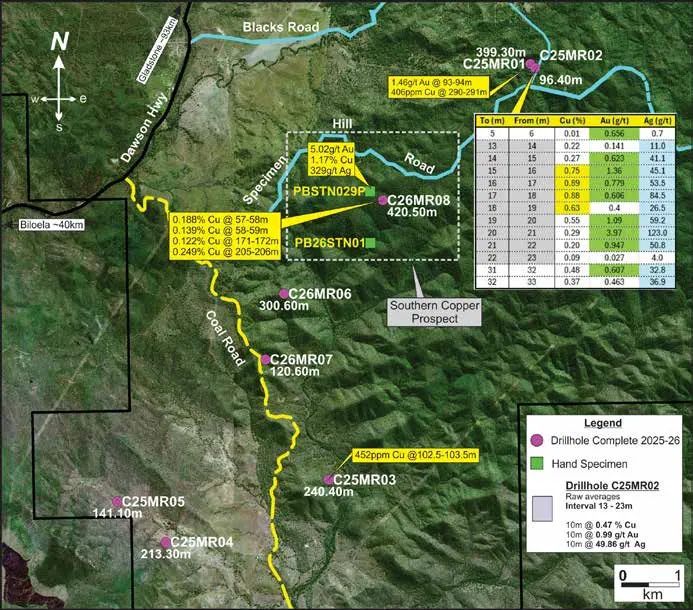
Exploration remains the other active leg of the strategy. At the 51%-owned Specimen Hill copper-gold project in Central Queensland, eight reconnaissance diamond holes encountered alteration consistent with a complex MIAC mineral system, while selective assays identified copper-gold-silver hydrothermal vectors. A surface gossan sample returned 11.7% copper, 5.0 grams per tonne gold and 329 grams per tonne silver, although the company is using the results to refine targets rather than claiming a defined resource. The drilling program and its implications were also detailed in the Specimen Hill drilling results.
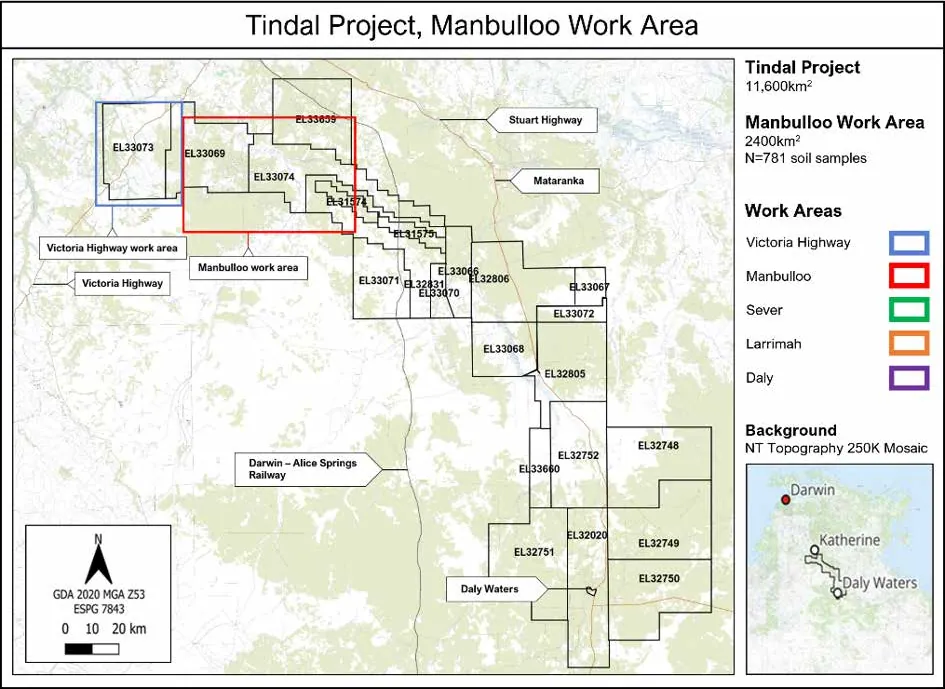
White Energy also holds the large Tindal exploration position in the Northern Territory, where ionic soil anomalies have been aligned with interpreted basement structures. The work remains at the target-generation stage, with further geophysics and sampling planned before potential drilling. In South Australia, the company supported surrender of the Lora Creek tenement after concluding that magnetic basement was likely deeper than 1,000 metres, while its Lake Phillipson coal resource remains recorded at 1.13 billion tonnes based on a 2011 JORC estimate.
BCB technology faces a commercial test
White Energy’s briquetting business continues through its 51%-owned River Energy joint venture, including pilot and proposed demonstration work in South Africa. The underlying BCB patent and worldwide licence expired in January 2026, and the company has instead entered an exclusive worldwide agency arrangement with K.R. Komarek to market briquetting machines for BCB applications and earn sales commissions. The shift preserves a route to commercialisation, but the annual report does not disclose operating revenue from the technology segment.
White Energy is therefore moving from a low-cash exploration and technology model towards a capital-intensive coal development strategy. The immediate test is not the ambition to reach scale, but whether the placement proceeds, asset realisations and future funding can carry the company through approvals, mine recommissioning and resource definition before the cash position again becomes the central story.
Bottom Line?
White Energy has expanded its asset base and secured near-term acquisition funding, but the auditor’s going concern warning keeps financing and project execution at the centre of the investment case.
Questions in the middle?
- How much additional capital will White Energy need before Lolley No. 1 can reach recommissioning?
- Can the company convert Tin Hut Creek’s historical coal data into a JORC resource and a financeable development plan?
- Will the Mountainside wash plant be sold soon enough to provide the asset realisation assumed in the funding plan?
Sources
1-
Annual Report to shareholders (opens in a new tab)Verified source. White Energy Company Limited · 27 Oct 2026