Cann Group’s Mildura export engine starts to turn

Cann Group’s September quarter delivered a sharp increase in revenue and exports as its Mildura GMP facility gained traction in Europe. But with just $49,000 in cash, $626,000 of undrawn debt capacity and an estimated 0.9 quarters of funding, the recovery still depends on collections and further financing.
- Unaudited revenue of $3.45 million, up about 70% on the second-half FY2026 quarterly average
- Exports contributed around 40% of quarterly revenue, versus 16% for FY2026
- Operating cash outflow of $733,000 followed a $900,000 increase in receivables
- Inventory fell 23% to $4.16 million as sales broadened
- Cash and undrawn funding totalled $675,000 at quarter end, equivalent to 0.9 quarters of funding

 Add us as a preferred source on Google
Export revenue accelerates from Mildura
Cann Group Limited (ASX:CAN) has started FY2027 with its strongest revenue quarter in the company’s reset, reporting unaudited September-quarter revenue of $3.45 million. That was roughly 70% above the $2.0 million quarterly average in the second half of FY2026, and represented about 40% of the whole of last financial year’s revenue.
Exports supplied around 40% of the quarter’s revenue, up from 16% across FY2026, with further orders in hand for the December quarter. Cann said European demand is increasingly favouring GMP-certified flower, particularly in Germany, while its Mildura site holds a TGA-GMP licence and was rated “A1 - good compliance” at its latest inspection. The company also continues to sell through domestic bulk B2B customers, distributor and pharmacy channels, white-label supply and contract packing.
The export push builds on the UK and Germany export expansion, which had been identified in the company’s June-quarter update as a route towards higher-value regulated markets. Cann says about half of Mildura’s commissioned capacity was used in FY2026, leaving room to increase production without adding an entirely new facility, although the filing makes clear that capacity only creates value when it converts into shipped product, cash receipts and sustainable margins.
Receivables timing obscures improved cash trend
Operating cash flow remained negative in the quarter, with $733,000 used in operations. Cann attributes that result mainly to a $900,000 increase in trade receivables, which reached about $1.32 million after invoicing was weighted towards September. Management expects those amounts to be collected in the December quarter, but that remains an expectation rather than cash already received.
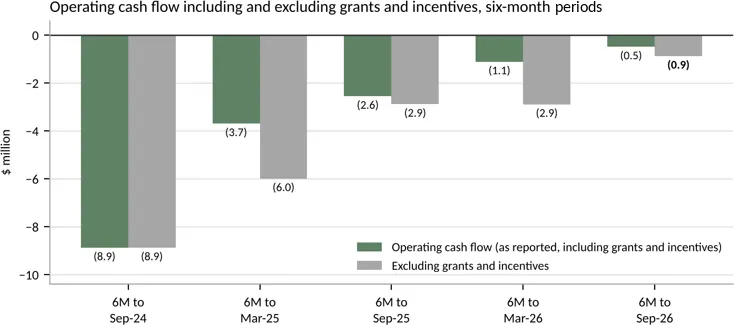
The underlying six-month trend is more encouraging: operating cash outflow excluding grants and incentives fell to $900,000, compared with $2.9 million in each of the two preceding six-month periods. Customer receipts rose 18.4% from the June quarter to $3.02 million, while staff and administration payments were broadly steady at $2.05 million. Inventory also dropped by $1.2 million, or 23%, to $4.16 million.
Liquidity remains the recovery’s hard constraint
The headline cash figures are less forgiving. Cann ended September with only $49,000 in cash and $626,000 of unused capacity under its private credit facility, giving total available funding of $675,000. Under the Appendix 4C calculation, that equates to 0.9 quarters of funding based on the quarter’s operating cash outflow.
The company says it does not expect September’s cash burn to continue at the same level, pointing to receivables collection, export growth, inventory conversion and an expected FY2026 research and development tax incentive refund. It also says the directors expect these measures to meet funding requirements, while acknowledging that the going-concern matters disclosed in the FY2026 annual report remain relevant. The private credit facility had $16.73 million drawn at quarter end, carries a 9.5% cash interest rate plus 3% capitalised interest, and is subject to a formal waiver covering minimum shareholder equity and minimum cash reserve covenant breaches.
Debt structure simplified as consolidation talks continue
Cann completed the redemption of its Obsidian convertible notes on 3 July for US$363,704, or about A$525,000, leaving no convertible notes on issue. The private credit commitment was increased by $2 million, although $1.19 million was drawn and $200,000 repaid during the quarter. The company is also engaging with industry participants about potential consolidation, but reported no binding agreement and gave no assurance that a transaction will proceed.
For Cann, the December quarter is therefore a practical test rather than a ceremonial milestone. The key evidence will be whether the $1.32 million receivables balance turns into cash, whether export orders become repeatable revenue and whether the additional sales arrive with enough margin to reduce reliance on a nearly exhausted funding buffer.
Get ASX:CAN news the moment it breaks
 iPhone & iPad
 Android
Bottom Line?
Cann has produced a more convincing revenue and export start to FY2027, but the recovery now depends on converting receivables and export demand into cash before its limited liquidity headroom runs out.
Questions in the middle?
- How much of the $1.32 million receivables balance will be collected in the December quarter, and when?
- Will higher European export volumes generate operating cash flow after production, interest and logistics costs?
- Can Cann secure additional funding or a value-accretive consolidation outcome before its remaining $626,000 facility headroom is consumed?
Sources
1-
Quarterly Activities/Appendix 4C Cash Flow Report (opens in a new tab)Verified source. Cann Group Limited · 30 Oct 2026 · wcsecure.weblink.com.au