Osmond’s Orión economics clear an early hurdle as funding pressure intensifies

Osmond Resources has advanced its Spanish critical minerals project through a maiden resource, a striking but preliminary scoping study and a maximum government grant. Yet with A$3.15 million in cash against a development concept requiring US$299 million, financing remains the project’s defining test.
- 60.0Mt maiden JORC resource across monazite, zircon, titanium and hafnium
- Scoping study estimates US$2.31bn post-tax NPV8 and 145% IRR on a 100% project basis
- Production target includes 29% Inferred Mineral Resources and carries approximately ±35% accuracy
- Expanded drilling campaign targets resource growth and higher confidence ahead of an updated study
- A$3.153m cash at quarter-end represents about 1.17 quarters of reported funding
 Add us as a preferred source on Google
Orión’s headline economics meet the funding constraint
Osmond Resources Limited (ASX:OSM) has a compelling project model on paper, but a short financial runway in practice. Its Orión project in southern Spain carries a preliminary post-tax NPV8 of US$2.309 billion and an ungeared IRR of 145% on a 100% project basis, against initial capital of US$299 million. Osmond held A$3.153 million in cash at 30 September, equivalent to 1.17 quarters of funding at the reported expenditure rate.
The figures come from the scoping study released after quarter-end and are not a development decision. The study has an estimated accuracy of about ±35%, does not establish an Ore Reserve, and relies on a production target containing 10% Measured, 61% Indicated and 29% Inferred Mineral Resources. The company says the supporting assumptions remain materially unchanged, but also states that approximately US$299 million in pre-production funding is required and that funding is not assured.
That gap is the central investment question. Osmond says it expects to rely on existing cash and future debt or equity raisings, including placements under its available ASX capacity, to fund current activities. The quarterly report records A$1.886 million of exploration and evaluation spending and A$802,000 of net operating cash outflow, while no financing facility was reported.
A 60Mt resource anchors the Spanish project
The quarter included the maiden JORC 2012 Mineral Resource Estimate that underpins the study. Orión contains 60.0 million tonnes at 9.39% TiO2, 3.06% ZrO2, 624 parts per million HfO2 and 6,274ppm TREO, with estimated grades of 0.9% monazite, 4.5% zircon, 7.8% rutile and 3.0% ilmenite. Only 15.3Mt, or about 26%, is classified as Measured and Indicated.
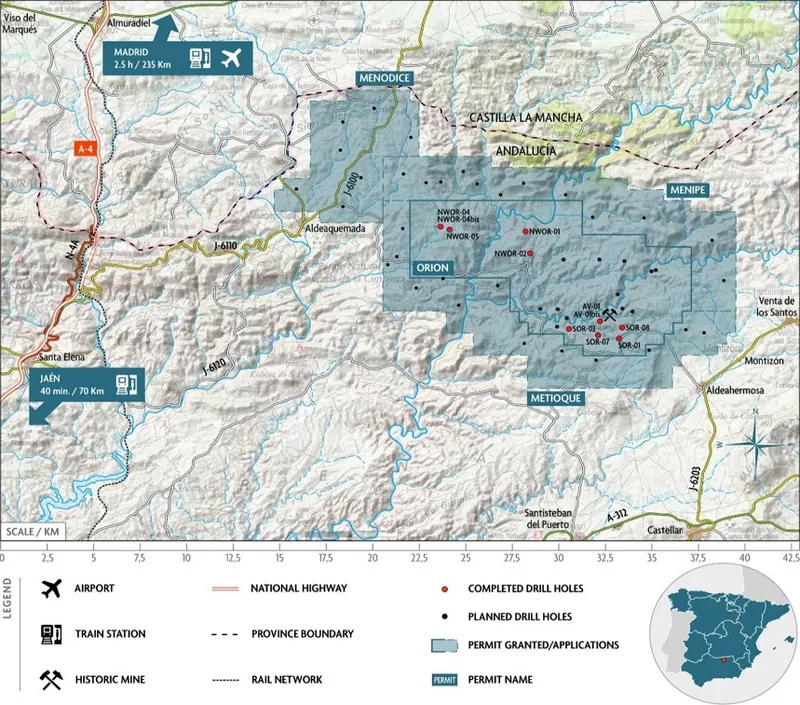
The resource covers roughly 3.4% of the company’s 232 square kilometres of Spanish tenure, leaving room for exploration but not guaranteeing that further drilling will produce an economic expansion. The study focuses on the higher-grade Main Seam and envisages a 2Mtpa underground room-and-pillar mine feeding conventional gravity, magnetic, electrostatic and flotation circuits. Planned annual output includes 42kt of monazite concentrate, 68kt of zircon concentrate and 109kt of titanium concentrate over an initial nine-year mine life.
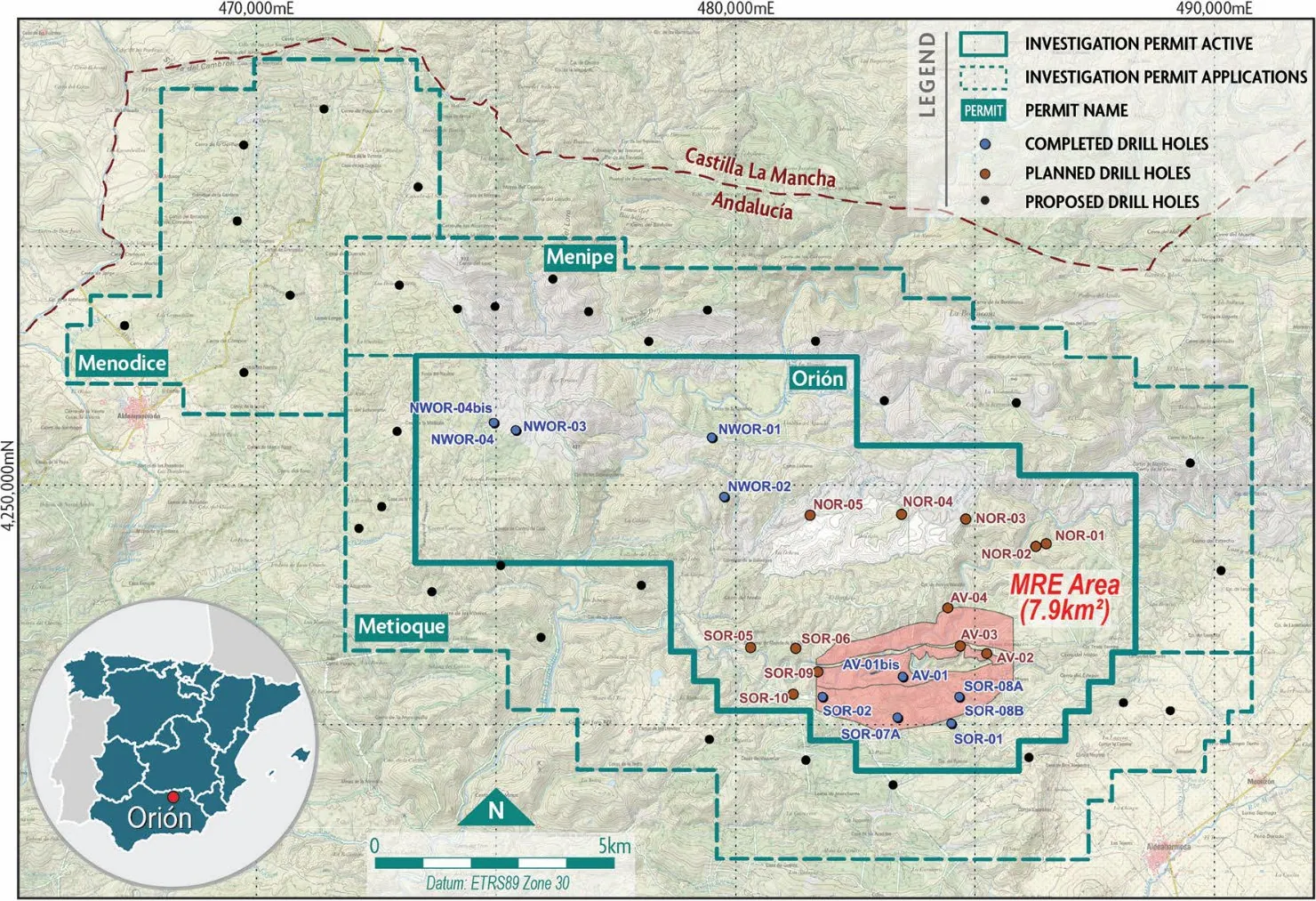
Osmond’s maiden 60Mt resource was previously identified as predominantly Inferred, and the new quarter’s drilling plan is intended to address that confidence issue. The campaign has expanded from 13 holes to between 15 and 20, with two rigs operating and a third expected in November. The stated objective is to expand the resource, upgrade confidence, assess a longer mine life and potentially support higher throughput in an updated scoping study.
Drilling, metallurgy and approvals now carry the story
The next technical milestone is not simply more tonnes. Osmond has commenced pre-feasibility-level processing testwork targeting premium-grade zircon, a near-pure rutile stream and an upgraded monazite concentrate. It is also progressing studies for mixed rare earth carbonate and rare earth oxide products with Técnicas Reunidas, while listing possible longer-term opportunities in rare earth oxides and titanium, zirconium, hafnium and silicon metal powders.
The project also sits within a more complicated permitting setting. Orión lies almost entirely within a Special Area of Conservation, and the association of rare earth elements with thorium and uranium will need to be addressed in processing, radiation management, residue and waste design. The company is targeting a mining licence application in the first half of calendar 2027, supported by an upgraded resource and scoping study, subject to drilling and further technical and economic work.
A provisional €250,000 grant from Spain’s national mineral exploration programme provides useful support for exploration, although it is modest beside the proposed construction capital. Osmond has also completed the issue of 85 million shares to retain its 80% interest in Iberian Critical Minerals, which owns 95% of the project vehicle. That leaves Osmond with a 76% beneficial interest in Orión, while adding a visible equity component to the project’s development history.
The next test is whether confidence catches up with valuation
The company’s planned Madrid secondary listing, European project-recognition applications and downstream workstreams may broaden access to capital and potential partners, but none removes the need to prove the mine technically and finance it commercially. The updated resource, metallurgical results, environmental pathway and eventual feasibility work will determine how much of the scoping study survives contact with engineering and permitting.
For now, Orión has moved beyond a purely exploratory concept, but it remains far from a funded mine. The next drilling results must do more than add scale: they need to convert geological confidence into a stronger production case before the financing requirement becomes the market’s dominant measure of progress.
Get ASX:OSM news the moment it breaks
 iPhone & iPad
 Android
Bottom Line?
Orión’s preliminary economics are substantial, but the immediate catalyst is higher-confidence drilling and the immediate constraint is funding a project that needs US$299 million before construction.
Questions in the middle?
- Will the expanded 15-to-20-hole programme materially lift the Measured and Indicated portion of the resource?
- Can pre-feasibility metallurgical work validate the product grades, recoveries and potential by-product credits assumed in the scoping study?
- How will Osmond fund the proposed development while preserving shareholder value and navigating conservation-area approvals?
Sources
1-
Quarterly Activities and Cashflow Report (opens in a new tab)Verified source. Osmond Resources Limited · 30 Oct 2026