Tennant Minerals tests Bluebird’s next high-grade extension

Tennant Minerals has begun the next phase of diamond drilling at its high-grade Bluebird copper-gold-bismuth discovery, targeting extensions and possible repetitions west of the existing resource. The company ended September with $1.91 million in cash, equivalent to about 2.7 quarters of funding on its reported spending rate.
- Four priority diamond-drilling targets across an 800m Bluebird corridor
- Earlier hole returned 18m at 10.0g/t AuEq, including 4.55m at 34.3g/t AuEq
- Up to 3,000m of aircore and slimline RC drilling at Kamran West and Perseverance North
- $1.07 million raised in the second tranche of a $2.8 million capital raising
- $1.91 million cash at quarter end and no debt facilities reported

 Add us as a preferred source on Google
Bluebird drilling moves from target generation to testing
Tennant Minerals Limited (ASX:TMS) has moved its Bluebird copper-gold-bismuth story into its next testing phase, with diamond drilling now underway on a structural corridor that extends at least 800 metres west of the existing resource. The target sits within a broader interpreted 1.5-kilometre corridor running towards the Perseverance magnetic complex, where Tennant has identified four priority diamond-drilling targets.
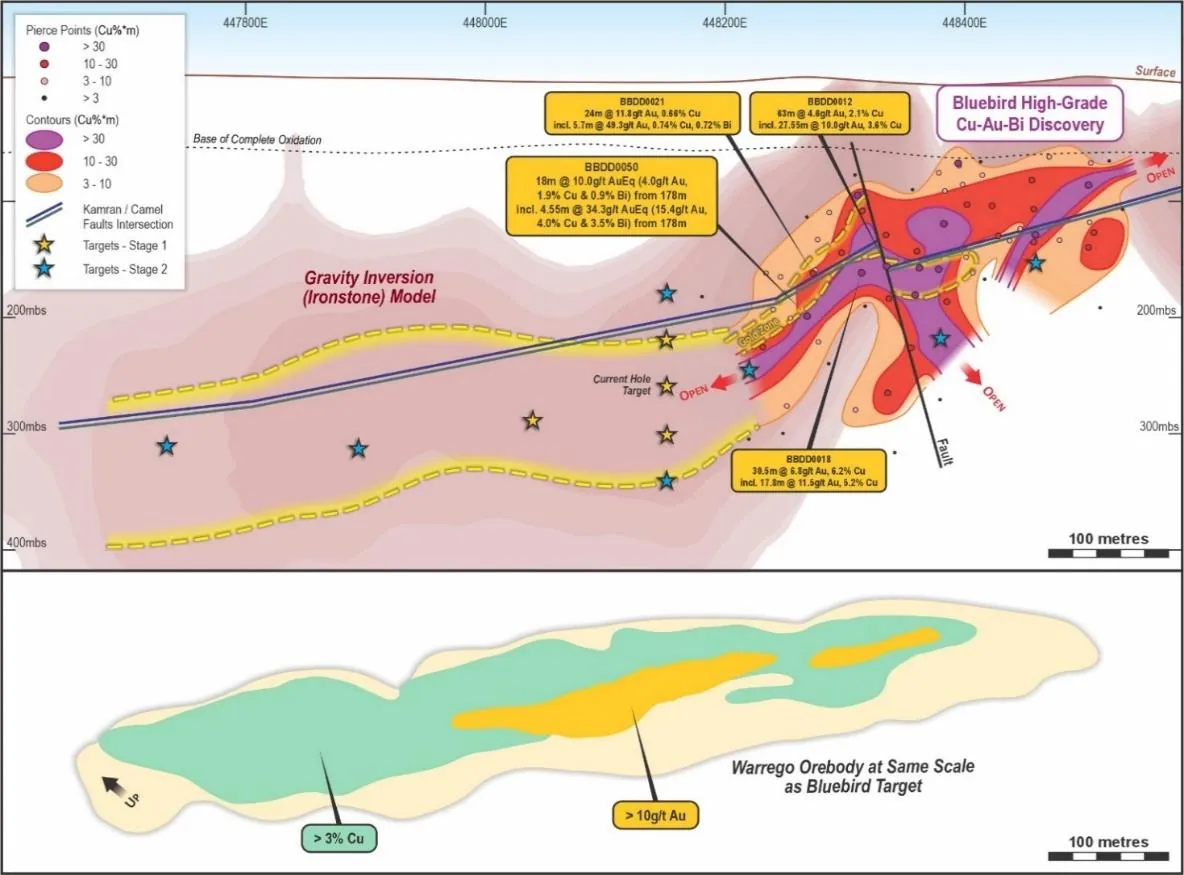
The first Stage 1 hole is testing a 60-metre step-out section west and down-plunge of the drilled Bluebird zone. Further holes are planned above or below the initial intersection before the program steps another 120 metres west. The campaign described in the filing follows the Bluebird drilling campaign, which earlier coverage said had begun with four priority targets across an 800-metre corridor.
High-grade results provide the exploration case
The geological thesis is supported by several strong historical intersections. Earlier drilling in hole BBDD0050 returned 18 metres at 10.0g/t gold equivalent, including 4.55 metres at 34.3g/t gold equivalent, based on 15.4g/t gold, 4.0% copper and 3.5% bismuth. Other intersections along the westerly plunging zone included 24 metres at 11.8g/t gold and 30.5 metres at 6.8g/t gold with 6.2% copper.
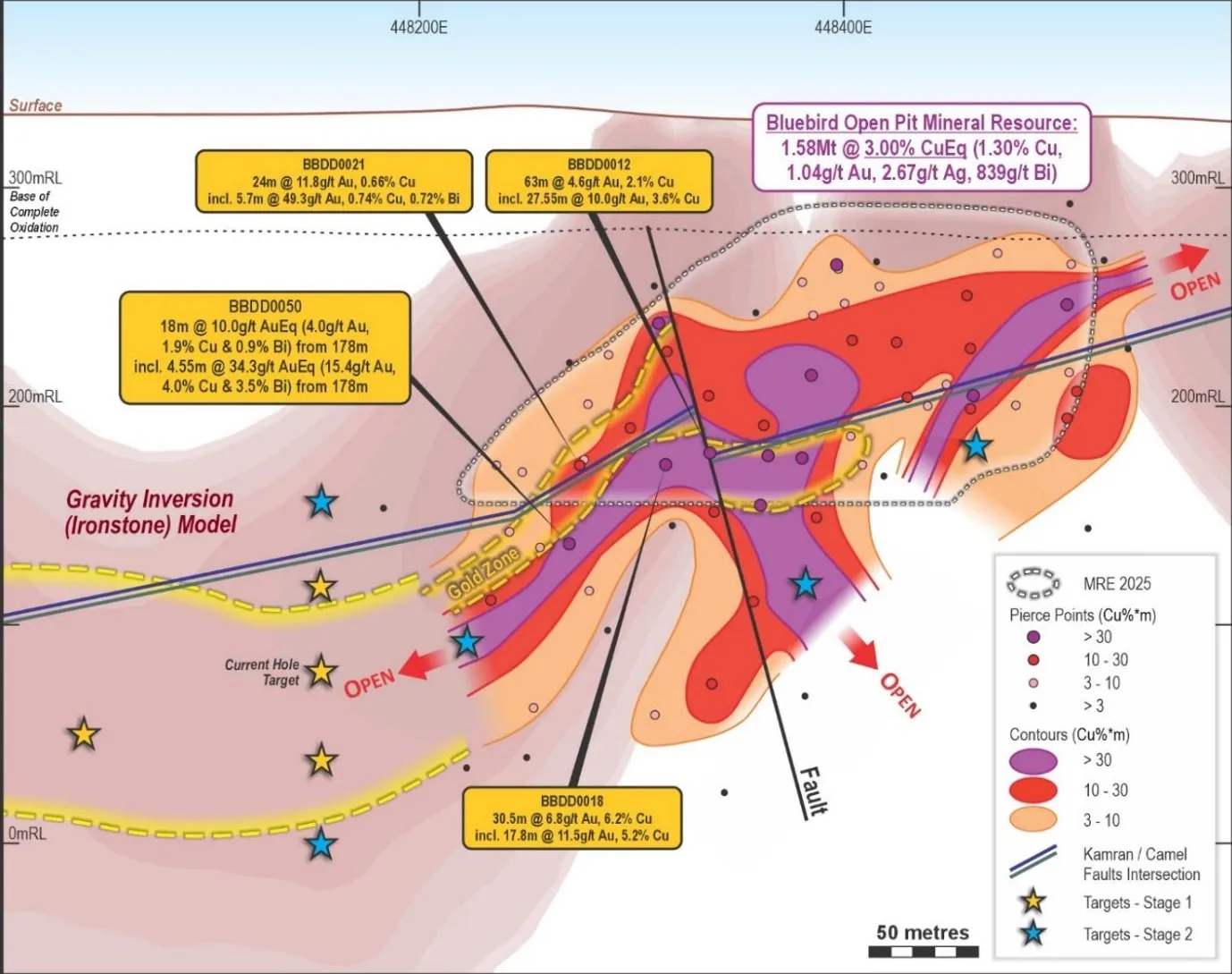
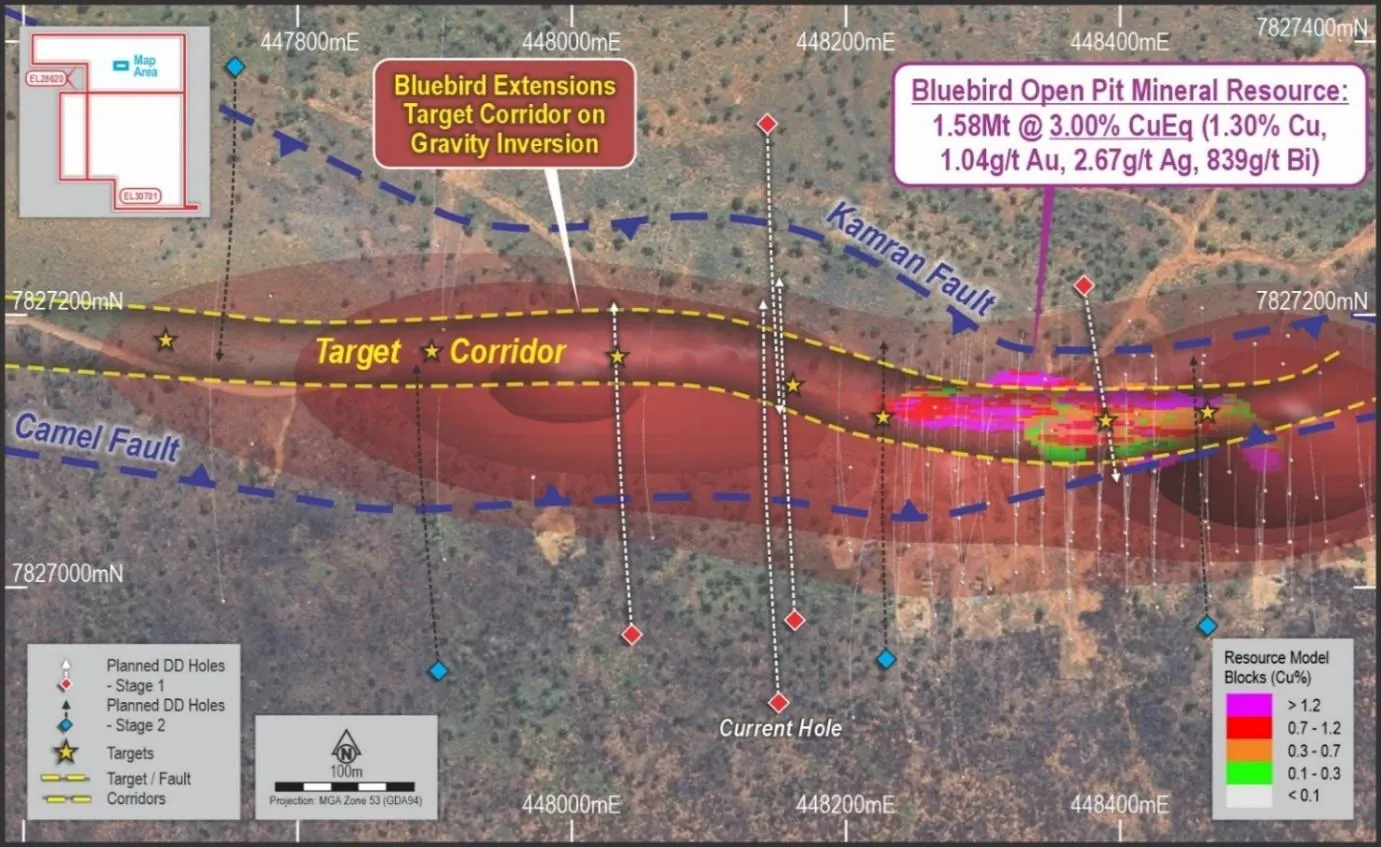
Tennant’s structural interpretation links the mineralised zones to the intersection of the Camel and Kamran faults, while gravity and magnetic modelling identifies a matching geophysical corridor. The company compares the scale of the target with the historical Warrego gold-copper deposit, but that comparison describes an exploration concept, not an estimate of mineralisation at Bluebird. Results from the current drilling were not available when the quarterly report was prepared.
Funding supports the campaign but leaves a short runway
Tennant completed the second tranche of its $2.8 million capital raising during the quarter, receiving approximately $1.07 million before costs through the issue of 164.3 million shares. The July capital raise had been described as funding accelerated Bluebird exploration and development activities.
Cash stood at $1.91 million on 30 September, after quarterly outflows of $708,000, including $427,000 on exploration and evaluation. The Appendix 5B calculation gives the company about 2.7 quarters of funding at that reported spending rate, with no financing facilities available. That makes the timing and quality of drilling results important not only for the geological case, but also for the next funding decision.
Regional drilling and processing study add two development tests
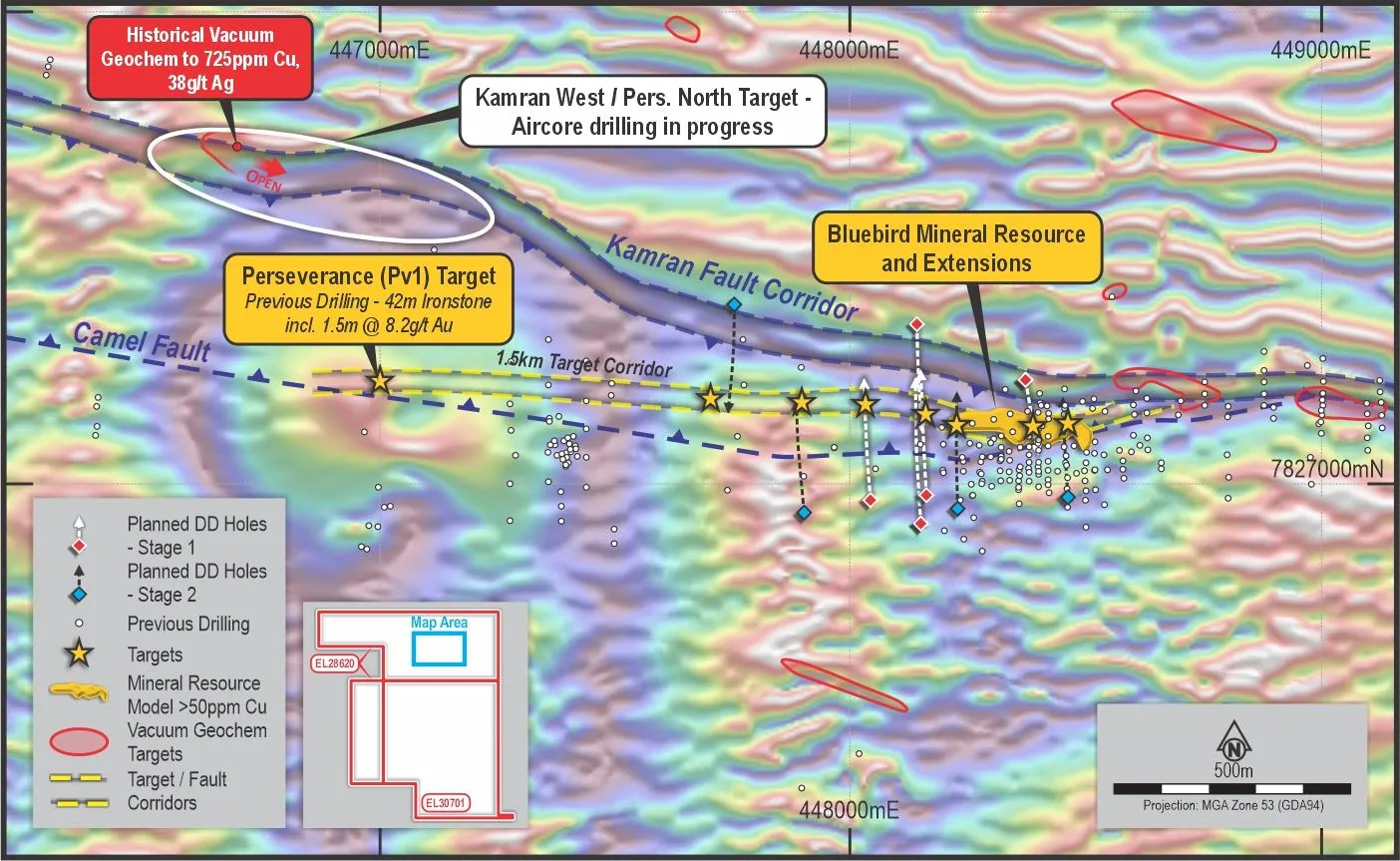
Alongside the Bluebird diamond drilling, an aircore and slimline RC program of up to 3,000 metres is testing the Kamran West and Perseverance North target. Previous vacuum drilling returned 725 parts per million copper and 34.6g/t silver in bottom-hole sampling, although the anomaly remains an exploration target under cover.
Tennant is also continuing its work with the Tennant Creek Copper Alliance on a feasibility study for a shared critical-minerals processing facility. The study is assessing plant configuration, available feedstocks, products including copper, gold, cobalt and bismuth, and the capital, operating, infrastructure and approvals requirements. For Tennant, the proposed shared facility could become relevant to future development planning, but the study has not yet established that the project is commercially viable.
Get ASX:TMS news the moment it breaks
 iPhone & iPad
 Android
Bottom Line?
The next material test is not another target map but the first drilling results from the western Bluebird corridor, which will determine whether the exploration thesis can justify further drilling and funding.
Questions in the middle?
- Will Stage 1 drilling confirm mineralisation west and down-plunge of the existing Bluebird resource?
- How much additional drilling and capital will be required before Tennant can consider a resource upgrade or mining study?
- Can the Tennant Creek Copper Alliance define a processing solution that materially improves Bluebird’s development pathway?
Sources
1-
Quarterly Activities/Appendix 5B Cash Flow Report (opens in a new tab)Official market announcement. Tennant Minerals Limited · 30 Oct 2026 · tennantminerals.com