Wrkr’s Payday Super platform clears a larger revenue hurdle

Wrkr’s platform activity accelerated sharply in the first quarter of Payday Super, with contributing TFNs nearly tripling and estimated ARR reaching A$17 million. The next test is converting that adoption into transaction revenue while bringing cash costs down.
- Active organisations more than doubled to 67,000 in Q1 FY27
- Contributing TFNs rose 193% to 1.23 million
- Estimated ARR increased to A$17 million, unaudited
- A$4.1 million net operating cash outflow and A$14.6 million cash balance
- STN processing expected to begin in November and complete by February 2027

 Add us as a preferred source on Google
Payday Super drives a sharp rise in platform activity
Wrkr Ltd (ASX:WRK) has reported a marked step-up in platform usage during the first quarter of Payday Super, with active organisations rising 111% from 31,800 at 30 June to 67,000 at 30 September. Registered tax file numbers increased to 2.43 million, while contributing TFNs climbed 193% to 1.23 million.
The more important figure may be activation, which rose from 26.1% to 50.7% over the quarter and reached 53.4% by 21 October. Because Wrkr invoices SaaS and transaction revenue when employers make contributions rather than when they onboard, the company identifies activation as its lead indicator for revenue. More than A$4 billion has now been processed since the new platform went live.
The scale-up follows the July capital raise, which raised A$12 million to support employer onboarding, product development and growth capacity ahead of the new superannuation regime. Estimated annual recurring revenue rose from A$13.4 million to A$17 million across the quarter, although the 30 September figure is unaudited and represents an annualisation of one month’s recurring revenue.
Cash remains negative while the revenue model changes gear
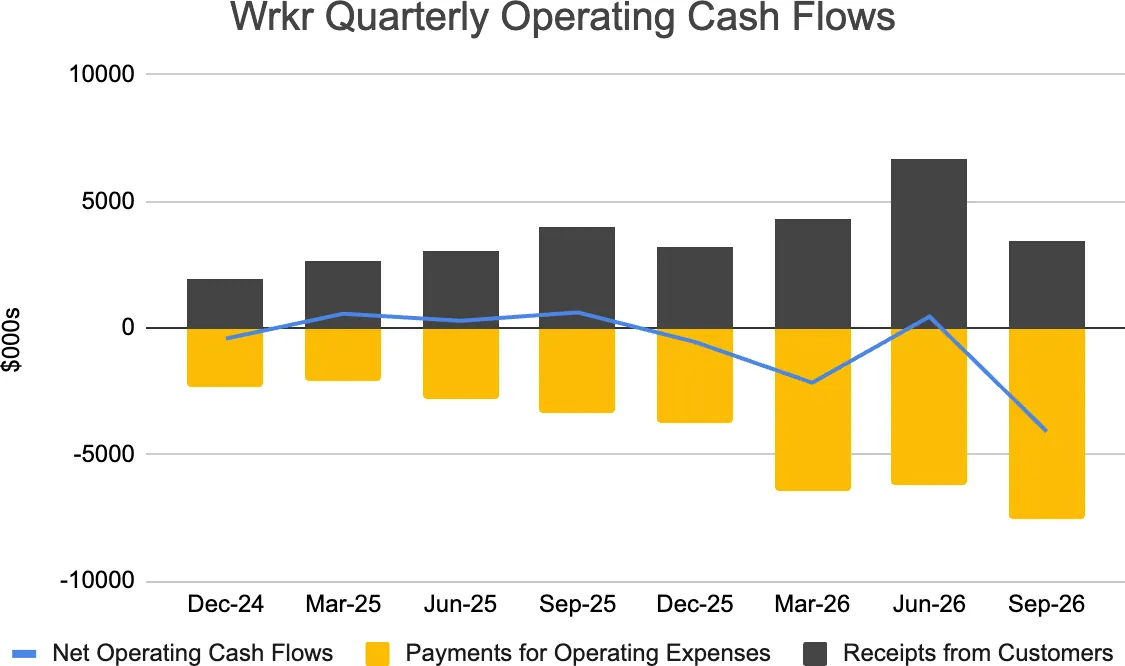
Wrkr recorded A$3.4 million in customer cash receipts and a A$4.1 million net operating cash outflow for the quarter. Cash receipts were down from A$6.7 million in the previous quarter, which included final MUFG implementation and migration payments as well as A$700,000 of annual licence fees paid early.
The company said no cash was received during the quarter for MUFG clearing-house transactions because of invoicing timing. It also reported A$1.03 million of overdue invoices, which management said were moving through large providers’ internal approval processes and were not considered at risk. Operating payments rose to A$7.5 million, partly reflecting annual remuneration adjustments, new engineering and product hires, and higher banking fees associated with PayID.
Wrkr ended September with A$14.6 million in cash and no unused financing facilities. On the reported quarterly operating burn, the Appendix 4C indicates roughly four quarters of funding; management says the business is funded to cash-flow break-even on current contracts and forecast transaction volumes, supported by planned cost reductions, expected R&D tax offsets and higher future transaction activity.
STN rollout becomes the next material revenue catalyst
From November, Wrkr expects to begin processing contribution messages from the SuperStream Transaction Network into MUFG funds. The company says this phase represents more than 50% of expected transactional revenue and is expected to be completed by February 2027. That is a forecast, not reported revenue, and depends on the timing of the rollout and underlying transaction volumes.
Wrkr plans to reduce costs in the second quarter by winding down subcontractors used for hypercare and data migration and rationalising development and testing environments. It also expects activation to continue rising as MUFG funds move legacy systems to read-only status and contributions are processed solely through the Wrkr platform, which previously expanded through major fund launches ahead of the Payday Super deadline.
PaidRight, enterprise integrations and the pipeline associated with MUFG’s acquisition of Grow Inc. provide additional avenues for growth, but the filing is careful to describe those opportunities as pipeline rather than forecasts. The near-term investment case therefore turns on a fairly specific hand-off: whether the sharp increase in contributing members and organisations becomes recurring gateway revenue quickly enough to offset the costs of operating at scale.
Get ASX:WRK news the moment it breaks
 iPhone & iPad
 Android
Bottom Line?
Wrkr has built substantial Payday Super volume, but the next quarters must show that activation and STN processing translate into cash receipts while the promised cost reductions arrive.
Questions in the middle?
- How quickly will STN processing contribute to reported revenue after its expected November commencement?
- Can activation continue rising as MUFG funds decommission legacy systems and move fully onto Wrkr’s platform?
- Will subcontractor reductions and R&D tax offset receipts be sufficient to carry the business to cash-flow break-even without another capital raise?
Sources
1-
Quarterly Activity Report and Appendix 4C (opens in a new tab)Verified company source. Wrkr Ltd · 30 Oct 2026 · investorhub.wrkr.com.au