A$539,000 RPM revenue and A$3.499 million operating cash outflow

Adherium delivered a fifth consecutive quarterly record for remote patient monitoring revenue, but ended September with only A$120,000 in cash after a A$3.499 million operating outflow. Post-quarter loans and an AstraZeneca milestone payment have improved near-term liquidity, although further funding remains central to the company’s plans.
- RPM recurring subscription revenue rose 12.5% quarter-on-quarter to A$539,000
- Customer receipts increased 33% to A$544,000
- Cumulative device shipments reached 6,392 and activations 4,732
- Quarter-end cash fell to A$120,000 against a A$3.499 million operating outflow
- A$1.45 million of post-quarter Barvest loans and A$257,917 from AstraZeneca received

 Add us as a preferred source on Google
Record RPM revenue meets severe liquidity pressure
Adherium Limited (ASX:ADR) extended its commercial run in the September quarter, recording A$539,000 of recurring remote patient monitoring subscription revenue, up 12.5% from the June quarter and marking the fifth consecutive quarterly record. The more immediate investor issue, however, was the balance sheet: cash fell to A$120,000 at 30 September after operating activities consumed A$3.499 million.
Customer cash receipts rose 33% quarter-on-quarter to A$544,000, helped by the expanding Hailie platform. The figure remains well below quarterly operating payments, which included A$2.087 million for staff and contractors, A$1.472 million for administration and corporate costs, and A$376,000 for research and development. The Appendix 4C calculates just 0.03 quarters of funding from quarter-end cash and reported no unused financing facilities.
Device activations build the recurring revenue base
Adherium added 1,033 device shipments and 900 activations during the quarter, taking cumulative totals to 6,392 and 4,732 respectively. The company says shipments lead revenue, with billable subscription revenue recognised as patients are activated. It also reported that cumulative shipments rose from 765 a year earlier, while activations increased 66% on a compound quarterly growth-rate basis over the same period.
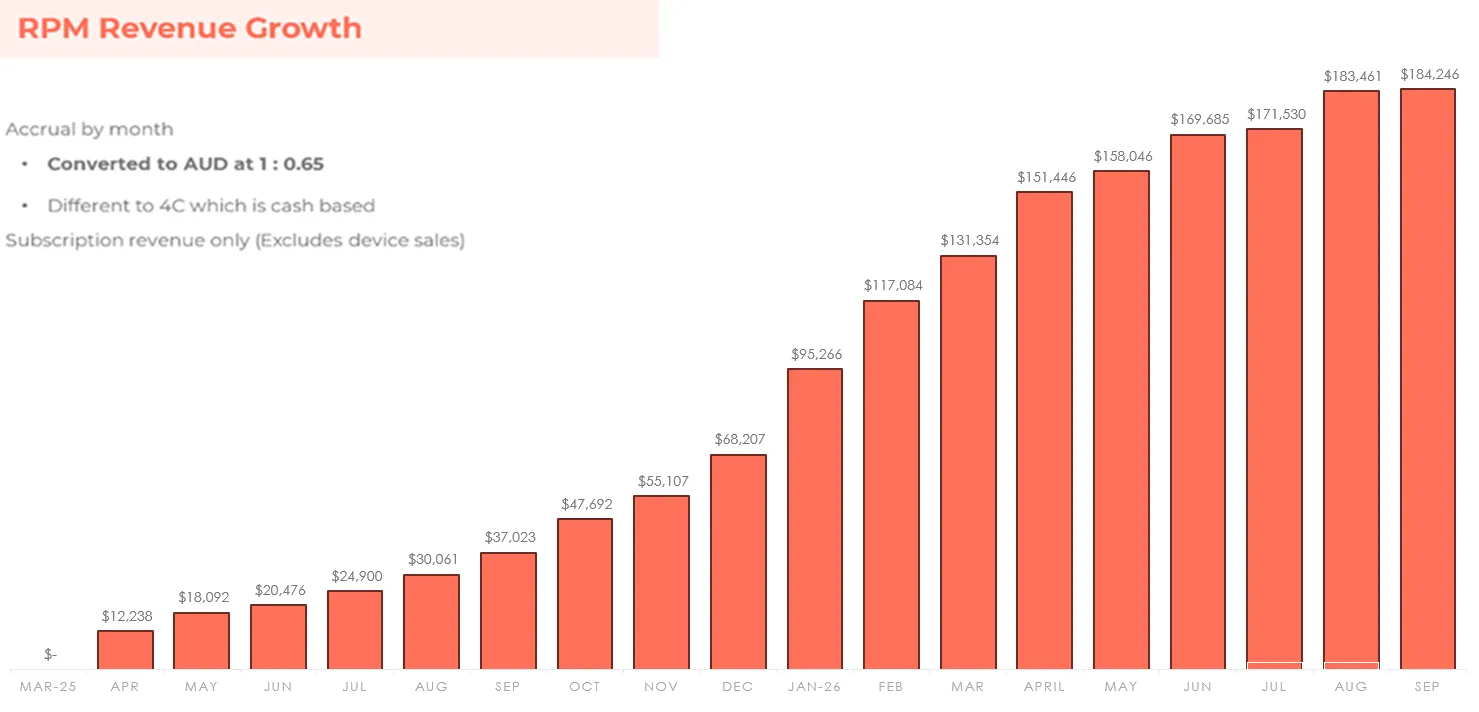
The result builds on the fourth record RPM quarter, when recurring subscription revenue reached A$479,000 and the company highlighted the potential to move from fee-for-service monitoring into larger US value-based care arrangements. In the latest quarter, Adherium said it was using retention analytics, patient-risk segmentation and additional clinical support during the first seven days of onboarding to improve the quality and durability of patient growth.
Post-quarter funding buys time, not financial independence
Adherium received a A$700,000 Barvest Ventures loan on 7 October, a A$257,917 milestone payment from AstraZeneca Pharmaceuticals on 9 October, and a further A$750,000 Barvest facility on 30 October. Those receipts came after the quarter-end cash calculation and therefore do not alter the 0.03-quarter funding figure reported in the 4C, but they provide additional liquidity after the reporting date.
The company’s existing Trudell loan facility stood at A$4.671 million at quarter end, with A$82,501 of accrued interest. The facility combines earlier short-term borrowings into a term loan due on 31 August 2027. Adherium said it expects to raise sufficient funds to support operations, while the scale and timing of any further funding remain unresolved in the filing.
Value-based care expansion faces reimbursement and execution tests
Adherium is positioning its patient data, clinical team and Hailie sensor infrastructure for value-based care contracts with US insurers, health systems and accountable care organisations. It also expanded its US commercial footprint during and after the quarter, including a partnership with Florida Lung, Asthma & Sleep Specialists in Central Florida and further participation across Allergy Partners’ clinic network.
The strategy carries several dependencies. CMS is due to finalise its proposed CY2027 physician fee schedule in November, with potential changes to RPM and remote therapeutic monitoring eligibility, payment rates and service requirements. Adherium is assessing the proposal’s effect on its current delivery model. The company is also continuing a 20-person feasibility study at Lurie Children’s Hospital and further analysis of the Intermountain Health iCARE dataset, with clinical evidence described as preliminary and still under evaluation.
Get ASX:ADR news the moment it breaks
 iPhone & iPad
 Android
Bottom Line?
RPM growth is becoming more visible, but the next quarter must show whether post-quarter funding and patient expansion can narrow the gap between recurring revenue and cash burn.
Questions in the middle?
- How long will the Barvest and AstraZeneca receipts support operations at the current cash-burn rate?
- Can rising activations and retention convert into materially higher recurring cash receipts rather than only accrual revenue?
- What will the final CY2027 CMS reimbursement rules mean for Adherium’s existing RPM model and value-based care transition?
Sources
1-
Quarterly Activities/Appendix 4C Cash Flow Report (opens in a new tab)Official market announcement. Adherium Limited · 30 Oct 2026 · adherium.com