Alligator finds more room for Samphire uranium growth

Alligator Energy has extended uranium mineralisation south of its Blackbush resource at Samphire while field recovery results feed into the project feasibility study. A $17.1 million capital raising and other receipts lifted quarter-end cash to $25.4 million.
- Samphire mineralisation extended to approximately 1.3km south of Blackbush
- 30 Mlb combined Indicated and Inferred Samphire resource
- Field trial leached, captured and eluted uranium under field conditions
- $17.1m capital raising completed at 4.5 cents per share
- $25.4m cash balance and estimated four quarters of funding
 Add us as a preferred source on Google
Samphire drilling extends uranium trend beyond current resource
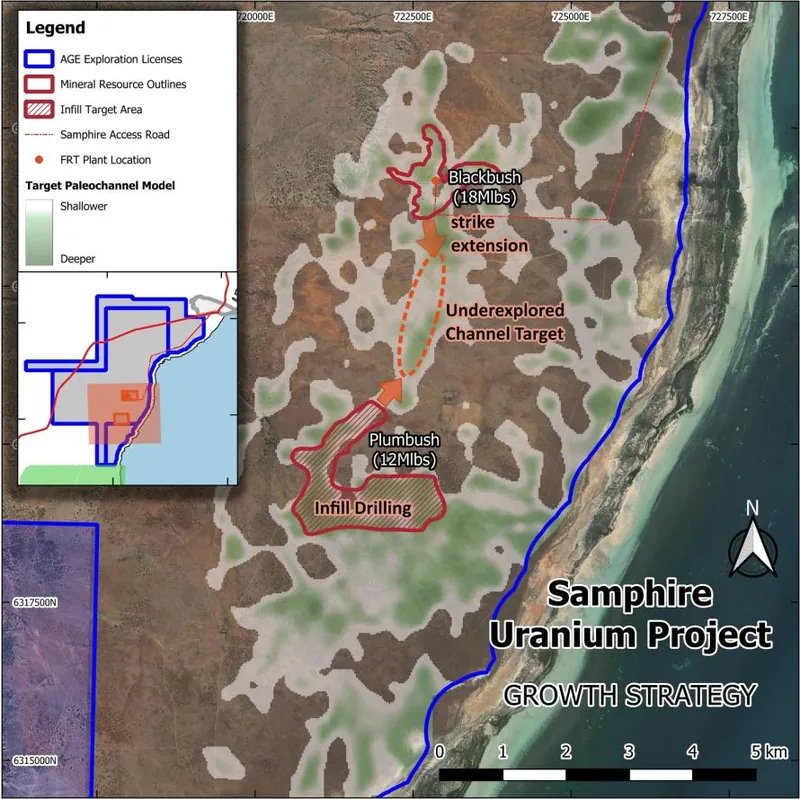
Alligator Energy Limited (ASX:AGE) has pushed the known Samphire uranium system well beyond the existing Blackbush resource footprint, with drilling now tracing mineralisation for approximately 1.3 kilometres south. The extension emerged from a roughly 250-hole campaign on the Mullaquana Crown Lease, where drilling began in July and reached mineralised sand units further south than previous work.
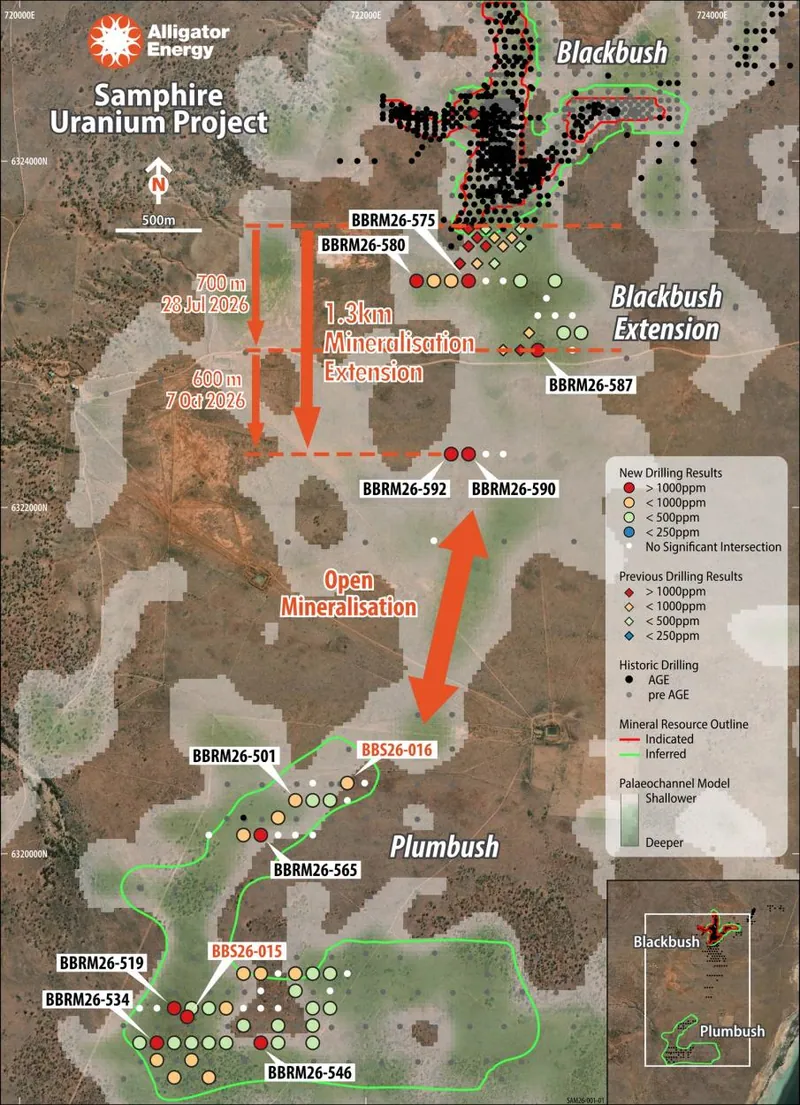
The latest results included 5.0 metres at 1,299 parts per million eU3O8, 2.4 metres at 2,025 ppm, 5.2 metres at 1,498 ppm and 6.6 metres at 1,245 ppm. These are downhole widths and equivalent uranium grades derived from calibrated gamma logging, rather than chemical assays. The company said the results demonstrate continuation of the mineralised system beyond the current Mineral Resource footprint, although any eventual resource increase remains subject to further drilling and estimation.
The campaign also included 108 Blackbush delineation holes and 62 holes at Plumbush, the first drilling at that deposit since 2011. Results from both areas correlated with existing models, with the Plumbush work intended to support a potential upgrade from Inferred to Indicated resources. The earlier Blackbush southern extension had already pushed mineralisation 600 metres south and formed part of the broader drilling effort now reaching the 1.3-kilometre mark.
Field recovery results move into feasibility engineering
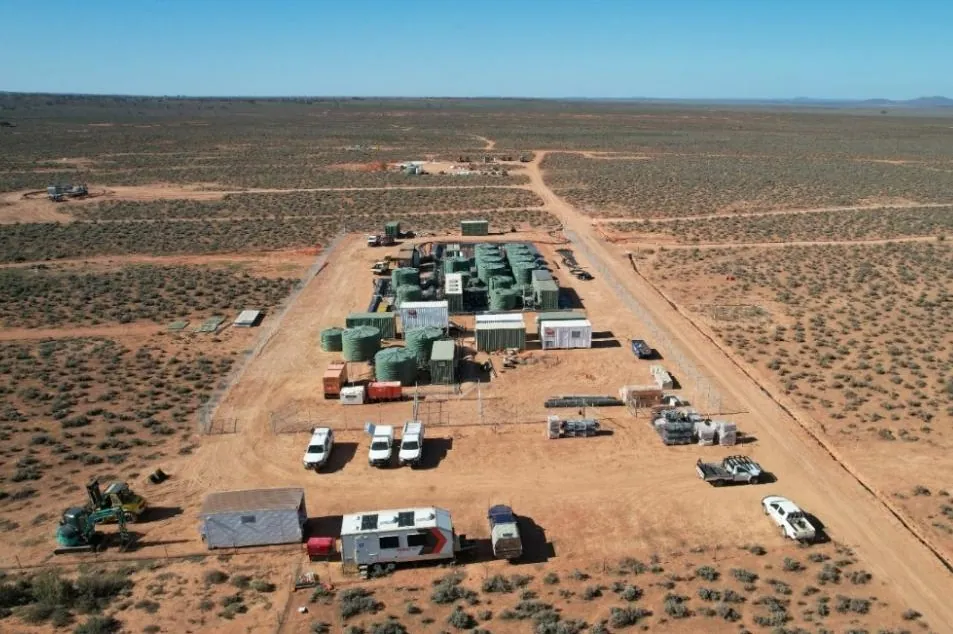
Samphire’s field recovery trial completed the key process sequence across two test well patterns: uranium was leached through in-situ recovery, captured using resin ion exchange and then eluted. Alligator is incorporating the results into the Samphire Feasibility Study and its next stage of wellfield planning.
Pattern 1, representing areas of Blackbush targeted for future wellfield development, achieved about 70% uranium recovery at roughly 70 pore-volume exchanges, with flow rates and pregnant liquor grades described as consistent with ISR industry benchmarks. Pattern 2 tested a lower-grade, lower-permeability margin of Blackbush and reached approximately 17% recovery after 15 pore-volume exchanges over 54 days. Alligator said the observed trend, if extrapolated, would be consistent with about 70% recovery at roughly 70 pore-volume exchanges. That extrapolation is not the same as a demonstrated final recovery outcome, a distinction that matters as the feasibility work advances. The result builds on the earlier first Samphire recovery trial, which reported about 70% recovery in the initial well pattern.
Capital raising lifts cash but leaves exploration runway to manage
The quarter’s most immediate balance-sheet change was the $17.1 million capital raising at 4.5 cents a share, comprising a $15 million placement and a $2.1 million Share Purchase Plan before costs. Alligator also received $1.75 million in final escrowed proceeds from the sale of its Northern Territory uranium assets and $1.05 million in R&D Tax Incentive refunds.
Those receipts produced $18.7 million in cash inflows during the quarter and helped lift cash and cash equivalents from $12.9 million to $25.4 million at 30 September. Against that, Alligator spent $4.9 million on exploration and evaluation and recorded a net operating cash outflow of $854,000. The Appendix 5B estimates about four quarters of funding based on the quarter’s relevant outgoings, making the next drilling and study milestones important to the company’s funding equation even after the raise.
Big Lake drilling tests a larger roll-front uranium system
At Big Lake, 33 aircore holes covering 4,112 metres continued to test the redox boundary associated with the project’s interpreted roll-front system. Two reported intersections included 1.9 metres at 320 ppm eU3O8 from 100.9 metres and 1.0 metre at 180 ppm from 98.1 metres. Similar oxidised and reduced sands were identified six kilometres south, while seismic interpretation indicates the prospective host formation may extend another 12 kilometres to the south-east.
Big Lake remains at an early exploration stage with no Mineral Resource estimated. The final 33 holes from the 2026 program are expected to produce results in November, while Samphire drilling is scheduled to continue into the December 2026 quarter. The company has also flagged a planned Samphire Mineral Resource update in the fourth quarter of financial year 2027, alongside ongoing feasibility and Mining Lease Application work. The key question is whether the new drilling can convert geological continuity and encouraging recovery data into a larger, higher-confidence resource and a bankable development case.
Get ASX:AGE news the moment it breaks
 iPhone & iPad
 Android
Bottom Line?
Alligator now has more cash and a larger Samphire drilling footprint, but the next test is conversion: resource upgrades, feasibility outputs and permitting must turn exploration momentum into a defined development pathway.
Questions in the middle?
- How much of the newly extended Samphire mineralisation can be converted into a formal Mineral Resource?
- Will the lower-grade, lower-permeability Pattern 2 results translate into acceptable wellfield performance in the feasibility design?
- Can the $25.4 million cash balance fund the next phase of drilling, feasibility work and permitting without another capital raising?
Sources
1-
Quarterly Report and Appendix 5B for 30 September 2026 (opens in a new tab)Verified company source. Alligator Energy Limited · 30 Oct 2026 · alligatorenergy.com.au