Gold Hydrogen’s Ramsay helium tests open path to modular pilot

Gold Hydrogen says its Ramsay project has demonstrated helium flow across three wells, with concentrations averaging 15.2% and modelled potential of up to 37 Mscf per well per day. The technical progress comes with a sharper financial constraint: cash fell to A$3.96 million, equal to only 0.57 quarters of reported funding, while a capital raising remains in prospect.
- Helium flowed to surface across three Ramsay wells spanning 2.2 kilometres
- Project-wide air-corrected helium concentration averaged approximately 15.2%
- Modelled potential reached up to 37 Mscf per well per day
- Maiden Contingent Resource sign-off targeted for November 2026
- A$3.96 million cash balance and proposed capital raising add funding pressure
 Add us as a preferred source on Google
Three-well testing moves Ramsay towards resource classification
Gold Hydrogen Limited (ASX:GHY) has cleared a significant technical hurdle at its Ramsay project in South Australia: helium flowed to surface from all three tested wells, was separated and purified onsite, and was bottled for demonstration. The campaign also connected the helium-bearing Kulpara Dolomite across roughly 2.2 kilometres, giving the company a project-wide dataset rather than a single-well result.
The company reported stabilised or sustained air-corrected helium concentrations averaging approximately 15.2% across Ramsay 1, 2 and 3. Ramsay 1 recorded 19%, Ramsay 2 recorded 20%, while Ramsay 3 recorded a stabilised 6.5%, with samples reaching up to 12.6%. Gold Hydrogen’s project-wide modelling points to helium gas-rate potential of up to approximately 37 Mscf per well per day, above the approximately 27 Mscf per well per day case identified in an independent Worley assessment as potentially commercially viable. That remains a model, not demonstrated commercial production.
The latest result builds on the three-well Ramsay testing that had already established reservoir continuity and highlighted the gap between measured performance and modelled output. Ramsay 3 reached a record fluid pumping rate of approximately 14,000 barrels per day, around seven times the rates achieved at Ramsay 1 and Ramsay 2, with a reported Productivity Index of about 40 barrels per day per psi.
Modular helium pilot enters development planning
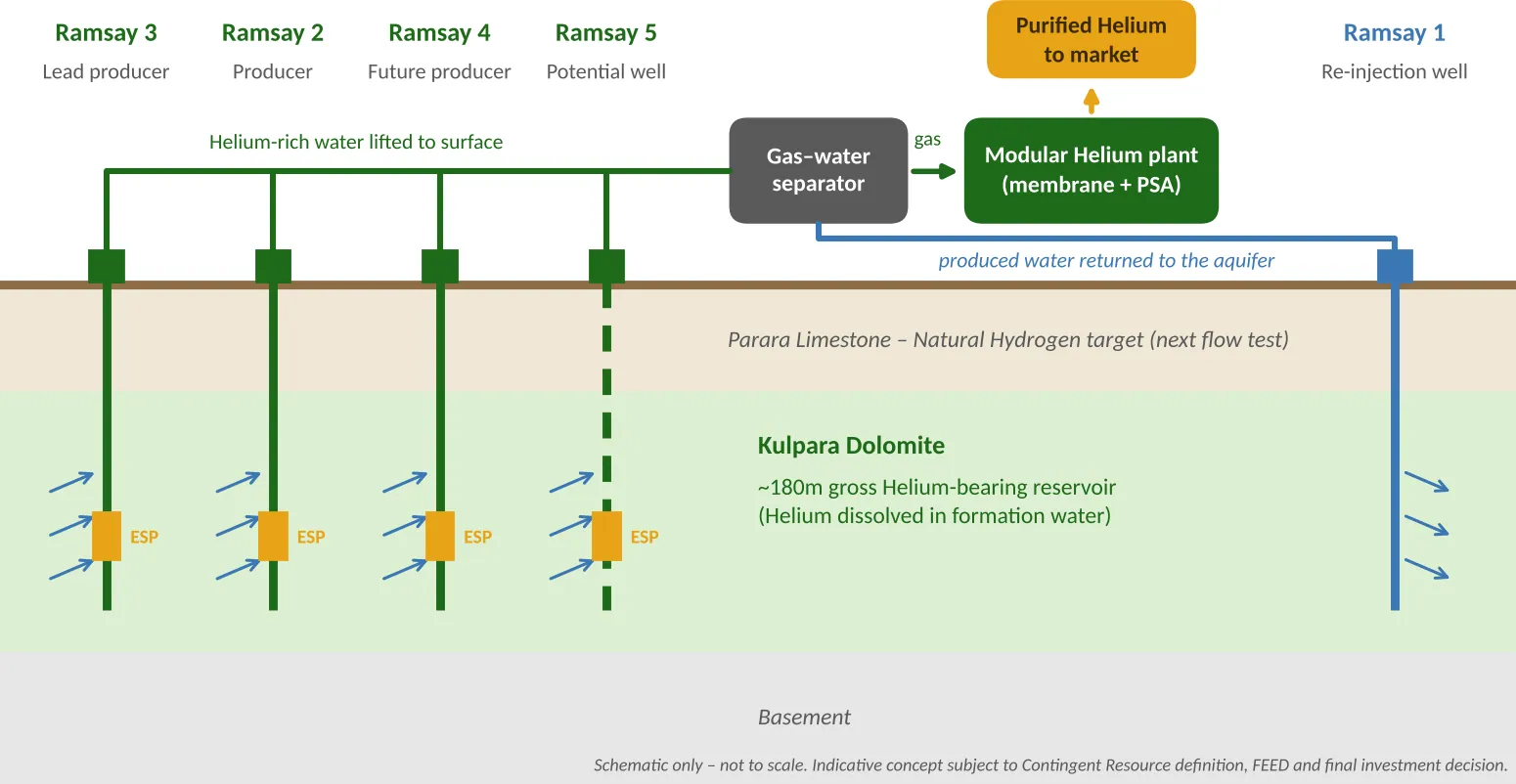
Gold Hydrogen is now accelerating work on a staged, modular helium pilot that could use existing Ramsay wells. The indicative concept considers Ramsay 2, 3 and 4 as potential producers, Ramsay 1 as a reinjection well and a possible Ramsay 5 development well. A skid-mounted purification plant using membrane separation and pressure-swing adsorption would be designed to produce commercial-grade helium of approximately 99%, subject to further evaluation.
The company is targeting independent sign-off of a maiden Contingent Resource in November 2026. Before that can happen, it must complete laboratory compositional and isotopic analysis, integrate flow and pressure data into its reservoir models, define a development project and obtain independent resource-evaluator certification. No SPE-compliant reserve or resource has been reported in this announcement, and the Worley scenarios remain hypothetical rather than feasibility-study results.
Cash position leaves little room for delay
The technical progress is paired with a much less comfortable balance-sheet position. Gold Hydrogen spent A$6.48 million on exploration during the quarter, largely on drilling, well testing and related Ramsay activities, and reported net operating cash outflow of A$7.00 million. Cash and cash equivalents fell from A$10.96 million to A$3.96 million, which the quarterly report equates to approximately 0.57 quarters of funding at the reported spending rate.
The company says field expenditure should fall after completion of the 2026 flow-testing campaign, while also disclosing a proposed capital raising without giving its size, structure or timing. It has access to up to A$2 million against its verified FY2026 research and development claim, with an option for a further A$4 million against FY2027 eligible expenditure. The R&D-backed funding carries a 1.75% establishment fee and 16.5% annual interest, with a 120-day minimum interest period; the A$2 million R&D loan was previously reported as near-term support for testing analysis and commercialisation work.
PEL 687 is also being renewed, with one-third of the tenement area subject to relinquishment and the precise area still awaiting departmental confirmation. For Ramsay, the next test is no longer whether helium can be made to flow in the field. It is whether independent resource work, commercial design and new funding can arrive quickly enough to turn an encouraging technical case into a financeable pilot.
Get ASX:GHY news the moment it breaks
 iPhone & iPad
 Android
Bottom Line?
The November Contingent Resource target is the next technical catalyst, but funding the path from resource definition to pilot construction remains the immediate constraint.
Questions in the middle?
- What size and structure will Gold Hydrogen’s proposed capital raising take, and when will it be completed?
- Will independent laboratory results and reservoir modelling support a maiden Contingent Resource in November?
- Can the modular pilot achieve credible economics before further drilling, plant and permitting costs consume the remaining cash?
Sources
1-
Quarterly Activities/Appendix 5B Cash Flow Report (opens in a new tab)Verified company source. Gold Hydrogen Limited · 30 Oct 2026 · investorhub.goldhydrogen.com.au