Taruga’s Weioko drilling arrives as gold recoveries clear 90%

Taruga Minerals has mobilised its first diamond drill rig at the Weioko Gold Deposit since 2009, while preliminary oxide testwork returned gold recoveries of up to 96.27%. The results are encouraging, but the company’s cash position remains tight before a post-quarter option exercise raised A$1.5 million.
- 1,000-metre maiden diamond drilling program mobilised at Weioko
- Preliminary oxide gold extraction of 92.60% to 96.27%
- Selective rock chips returned up to 33.1 g/t gold and 867 g/t silver
- A$1.024 million cash at quarter end, with A$1.5 million raised after quarter end
- Eric de Mori appointed Managing Director
 Add us as a preferred source on Google
Weioko drilling reaches the starting line
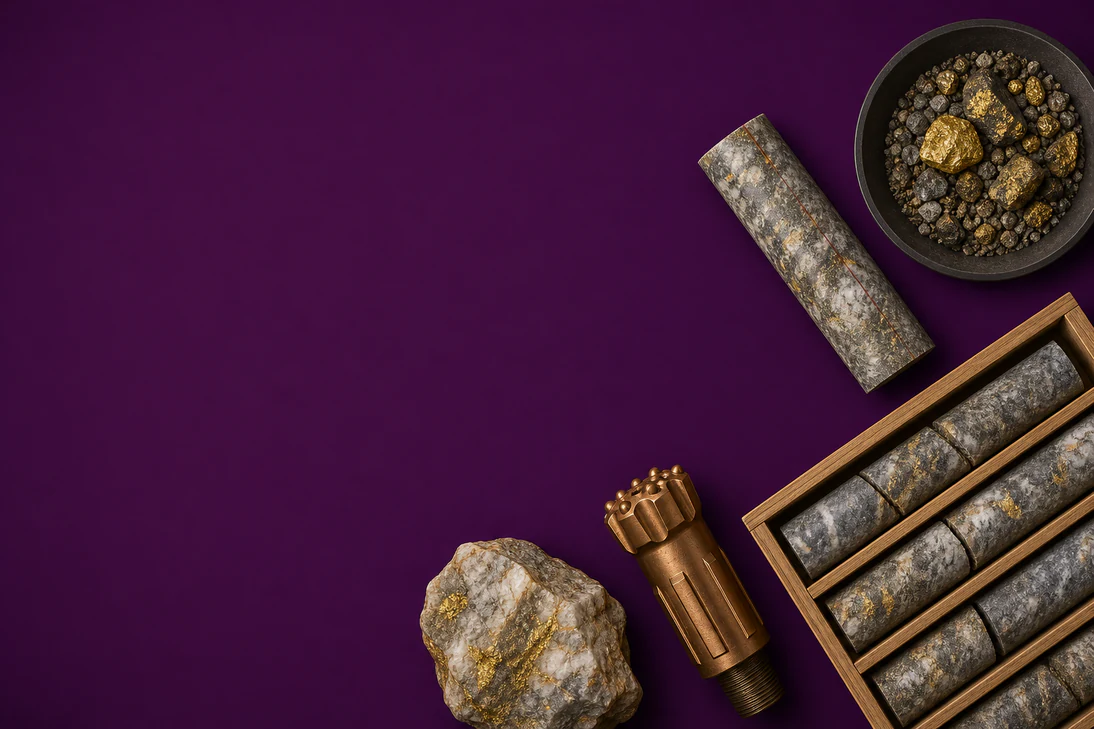
Taruga Minerals Limited (ASX:TAR) has reached the most consequential stage of its Papua New Guinea exploration campaign: the diamond rig is now on site at Weioko, where the first drilling since 2009 is targeting a series of shallow and deeper gold zones. The initial program covers about 1,000 metres across 10 holes, with scope for additional drilling under the contractor agreement.
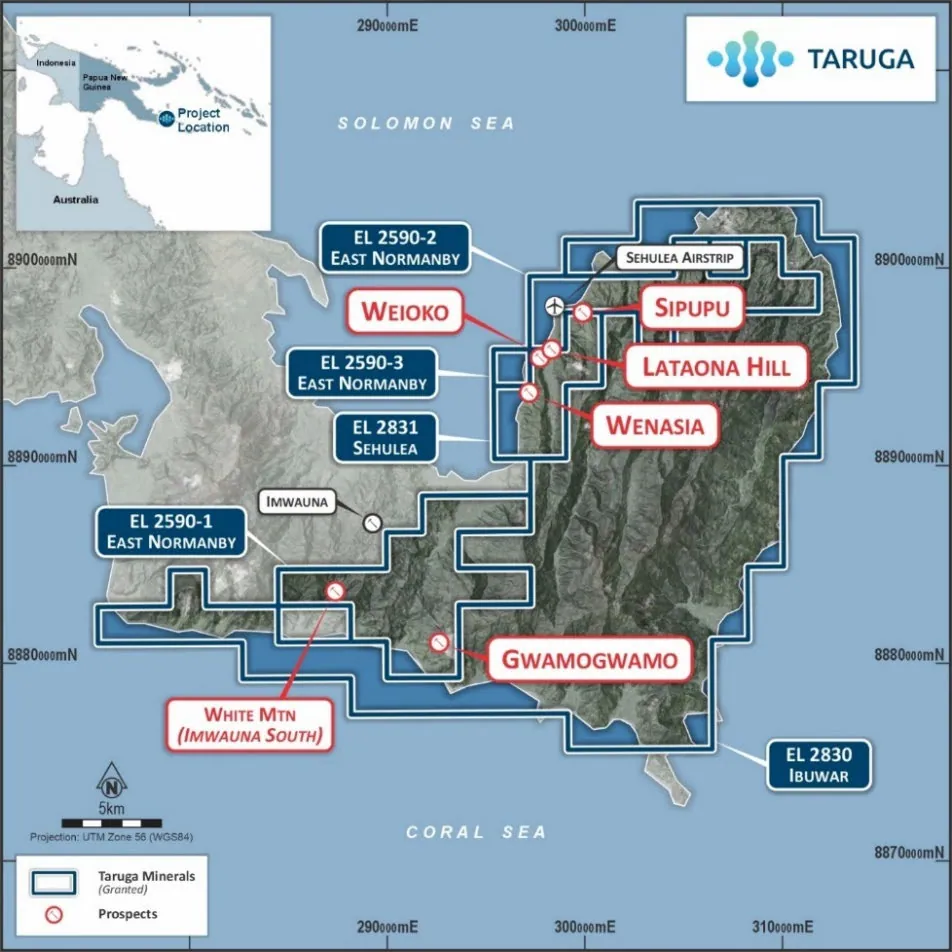
The program is designed to test historical high-grade intercepts, extend holes that ended in mineralisation and examine strike, depth and parallel extensions. Those historical results include intervals such as 64.6 metres at 2.2 g/t gold and 51.4 metres at 2.0 g/t gold, but Taruga cautions that the results were not reported under the JORC Code 2012 and that true widths have not been determined. The company’s maiden Weioko drilling had previously been flagged alongside high-grade surface results across the broader district.
Preliminary metallurgy points to recoverable oxide gold
Before the drill results arrive, Taruga has a technical signal it wanted: preliminary metallurgical testing extracted 92.60% of gold from a low-grade oxide composite grading 0.59 g/t, and 96.27% from a high-grade composite grading 14.15 g/t. Gravity recovery accounted for 23% and 25% respectively, with optical microscopy identifying visible coarse gold in both gravity concentrates.
The results came from only two near-surface oxide composites tested at a 75-micron grind and 48-hour leach. The high-grade sample was deliberately weighted towards the upper end of the grade range and included a selective 99.45 g/t gold rock chip, so the results should not be treated as representative of the broader deposit. Taruga still needs to test transitional and fresh material, as well as hardness and grind-size requirements. The preliminary Weioko testwork had earlier identified recoveries above 90% across the tested grades.
Surface sampling expands the Weioko target pipeline
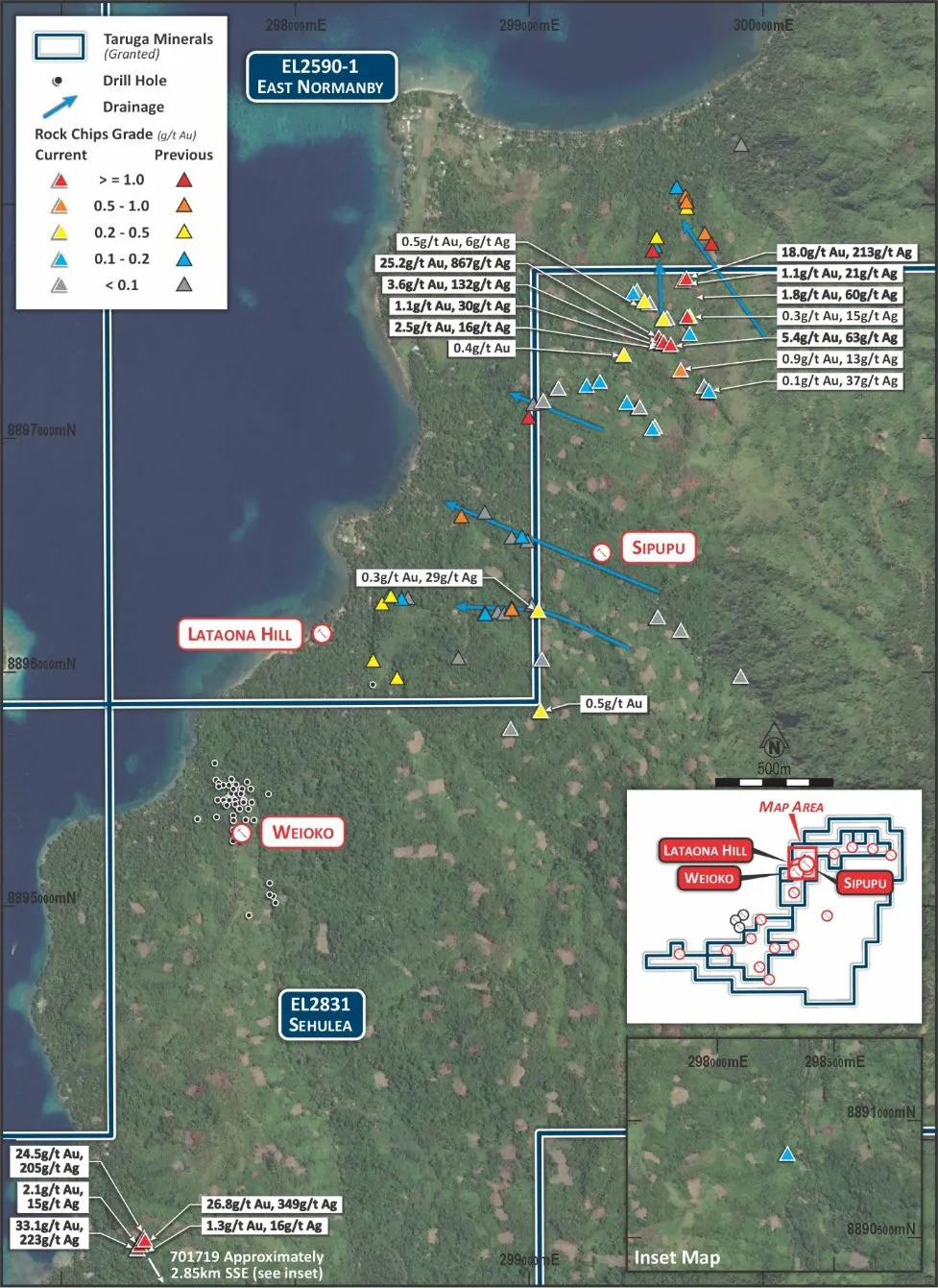
Surface work has added plenty of targets for the drill program to chase, although the strongest numbers remain selective rock-chip results rather than estimates of average deposit grade. At Wenasia, samples from a newly exposed quartz vein returned up to 33.1 g/t gold and 349 g/t silver, while the Sipupu source vein produced 25.2 g/t gold and 867 g/t silver. The Weioko corridor extends for about 8 kilometres from Wenasia to Sipupu.
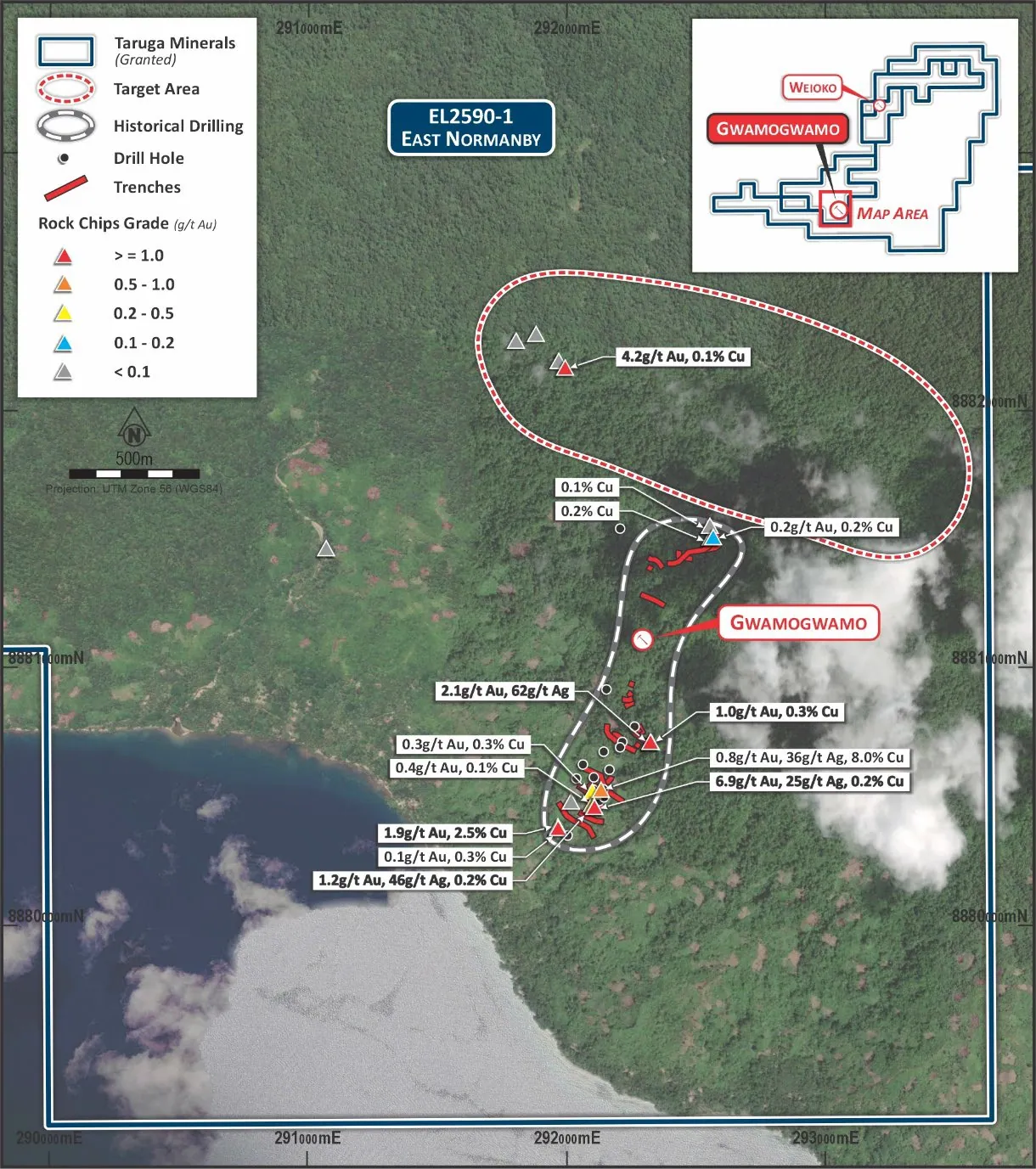
Elsewhere at East Normanby, Gwamogwamo sampling returned up to 6.9 g/t gold and 8.0% copper, with a 4.2 g/t gold float sample identifying a target roughly 900 metres north of the previously defined 1.5-kilometre mineralised corridor. Taruga also reported a new 500-metre northeast-trending gold-copper trend at Uaroo Ridge in Western Australia, led by a rock chip grading 1.4 g/t gold and 4.3% copper. That result is similarly reconnaissance-scale, with follow-up soil sampling and geophysics still required.
Funding improves after a thin quarter-end cash balance
Taruga finished September with A$1.024 million in cash and no debt. Exploration spending was A$618,000 during the quarter, while operating and administrative outflows took total relevant outgoings to A$853,000. On that basis, the Appendix 5B estimated only 1.20 quarters of funding at quarter end.
That position changed after the reporting date, when 60 million options were exercised at 2.5 cents each to raise A$1.5 million. The company also reported that directors Paul Cronin and Eric de Mori exercised options for a combined A$1.5 million investment, while de Mori became Managing Director on 28 October. His Managing Director appointment came as Weioko drilling moved from preparation into execution.
Assays and continuity become the next test
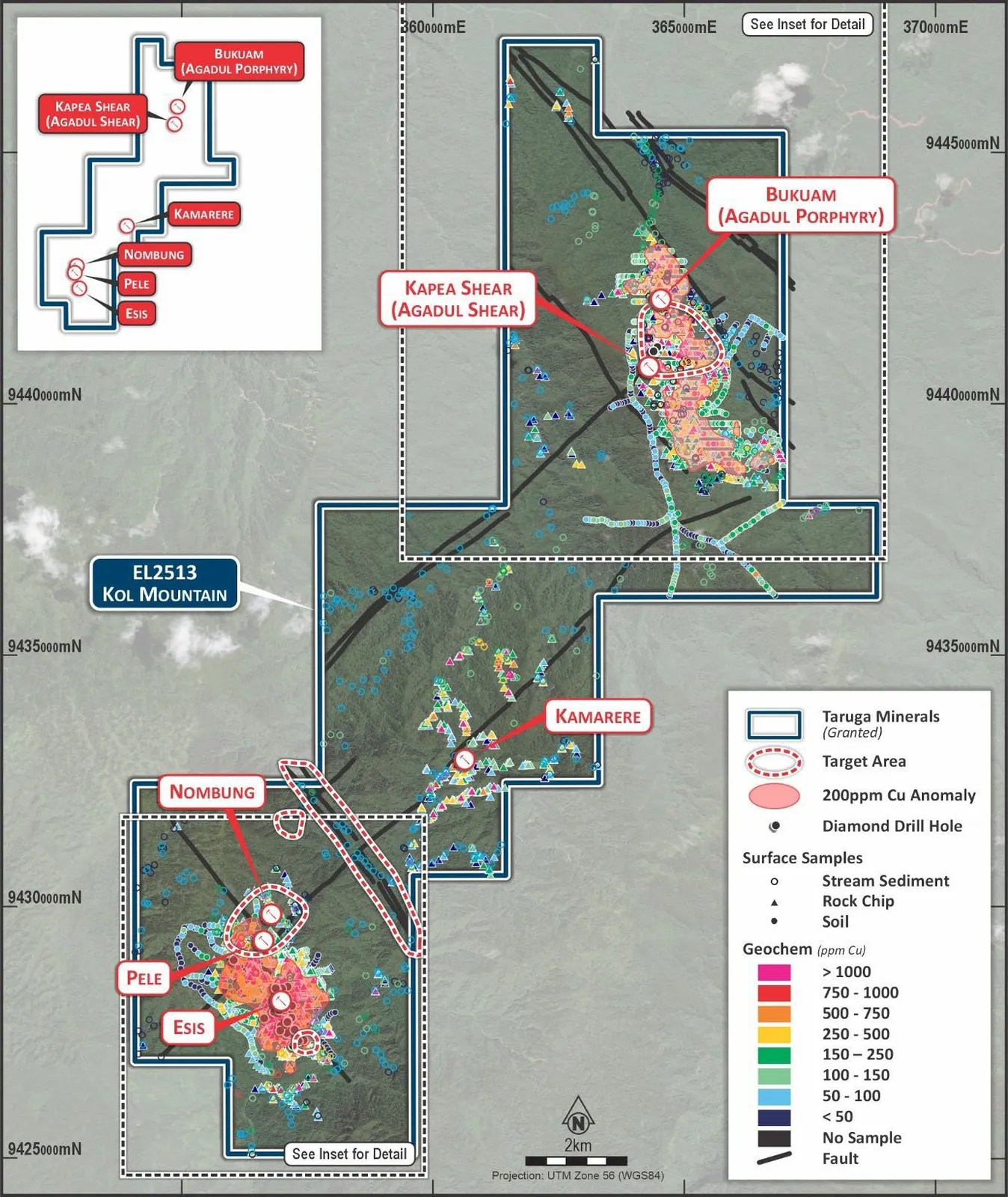
Taruga’s December-quarter plan is built around completing the Weioko drilling program and reporting assays as they arrive, alongside trenching and infill sampling at Wenasia and Sipupu. At Kol Mountain, the company expects trench and channel results from the Agadul Porphyry and Agadul Shear, where earlier field work identified a 2.33% copper skarn float sample and a copper-molybdenum zone.
The central question is no longer whether Taruga can produce eye-catching surface numbers or encouraging oxide recovery figures. It is whether drilling can demonstrate continuity, establish reliable widths and show that the historical mineralisation forms a coherent deposit. The coming assays will carry more weight than the strongest rock chips, particularly while the company balances an expanded exploration program against a still-limited funding base.
Get ASX:TAR news the moment it breaks
 iPhone & iPad
 Android
Bottom Line?
Weioko now has its first modern drilling catalyst, but the investment case depends on assays that convert selective surface results and historical intercepts into a continuous, JORC-compliant body of mineralisation.
Questions in the middle?
- Will the 1,000-metre program confirm continuity between the historical high-grade Weioko intercepts?
- How representative will the strong oxide recoveries prove once transitional and fresh material are tested?
- How long will the post-quarter option proceeds fund drilling and wider exploration before another capital decision is required?
Sources
1-
Quarterly Activities/Appendix 5B Cash Flow Report (opens in a new tab)Official market announcement. Taruga Minerals Limited · 30 Oct 2026 · tarugaminerals.com.au