Realty Income expands its growth engine as AFFO guidance rises

Realty Income delivered 3.7% year-on-year growth in quarterly AFFO per share and raised its 2026 AFFO guidance, while keeping its US$10.0 billion investment target intact. The net lease REIT is also expanding its European private capital platform with KKR, but leverage and modest same-store growth remain part of the equation.
- AFFO per share rose 3.7% to US$1.12
- 2026 AFFO guidance increased to US$4.45-US$4.46 per share
- US$2.6 billion invested during the quarter at a 6.8% initial weighted average cash yield
- Occupancy held at 98.8%, with same-store rental revenue up 1.1%
- European KKR joint venture launched with an initial €528.0 million investment

 Add us as a preferred source on Google
Realty Income Corporation (NYSE:O) has nudged up its 2026 AFFO guidance after another quarter of higher recurring earnings, although the improvement is modest rather than dramatic. Adjusted funds from operations, a non-GAAP measure widely used by REIT investors, rose 3.7% year on year to US$1.12 per diluted share for the three months ended September 30, while management lifted full-year guidance to US$4.45-US$4.46 per share from US$4.44-US$4.45.
AFFO growth supports a higher full-year target
Quarterly net income available to common stockholders increased to US$403.9 million, or US$0.43 per diluted share, from US$315.8 million a year earlier. Revenue rose to US$1.62 billion from US$1.47 billion, while AFFO increased to US$1.06 billion from US$992.0 million. The company’s GAAP result benefited from a larger gain on property sales, which reached US$113.9 million compared with US$49.1 million in the prior-year quarter, making AFFO the cleaner measure of recurring operating performance here.
The guidance picture is not uniformly stronger. Realty Income lowered its 2026 net income per share range to US$1.55-US$1.56 from US$1.59-US$1.60, while leaving its assumptions for same-store rent growth, occupancy and investment volume unchanged. The company does not forecast future impairments, property-sale gains or certain foreign currency and derivative movements, which helps explain why GAAP earnings and AFFO are moving in different directions.
US$2.6 billion deployed across property and credit investments
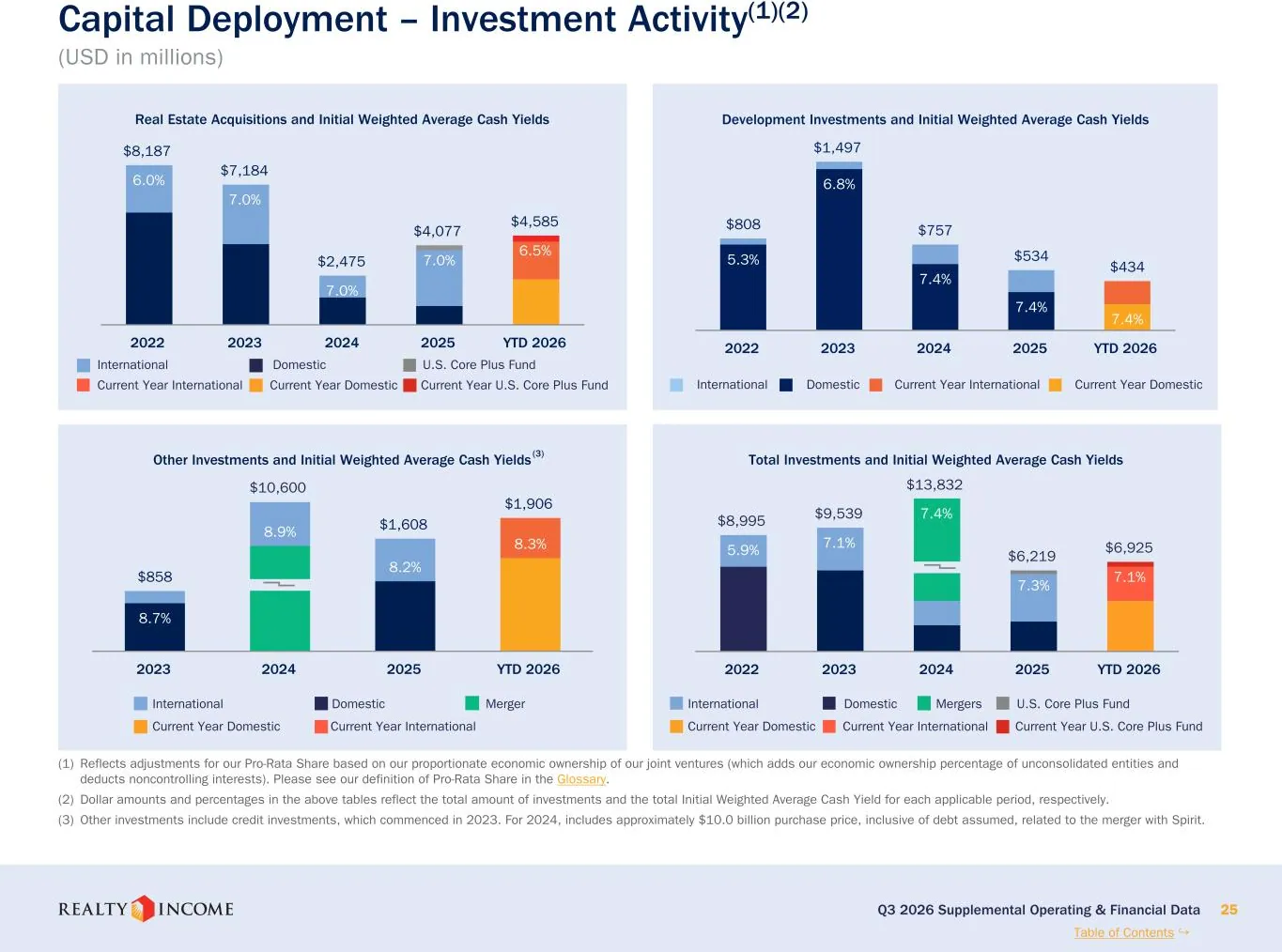
Capital deployment was the quarter’s larger strategic message. Realty Income invested US$2.6 billion on a pro-rata basis, including US$1.84 billion in real estate acquisitions, US$143.7 million in development and US$246.2 million in credit investments. The combined initial weighted average cash yield was 6.8%, with 53% of the investment activity linked to investment-grade clients. Management reaffirmed its US$10.0 billion investment-volume target for 2026, with US$7.9 billion completed by September 30.
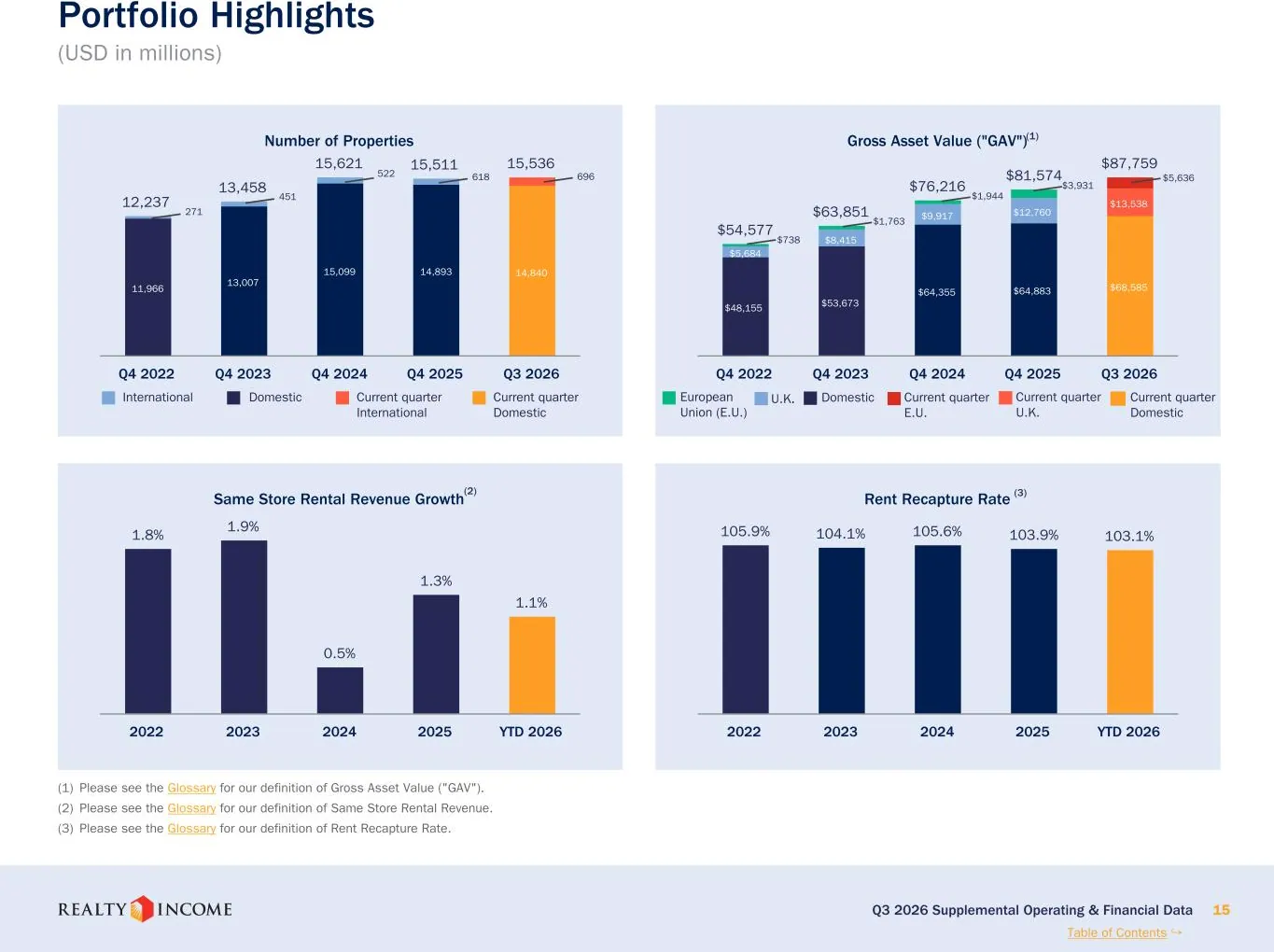
The portfolio remained heavily occupied at 98.8%, matching June and edging up from 98.7% a year earlier. Same-store rental revenue rose 1.1% to US$1.16 billion, while the rent recapture rate was 103.5% on properties re-leased during the quarter. Those figures describe a stable base, though not a high-growth one: the company’s ability to add earnings continues to depend substantially on acquisitions, developments and financing activity beyond the mature portfolio.
KKR partnership broadens private capital platform
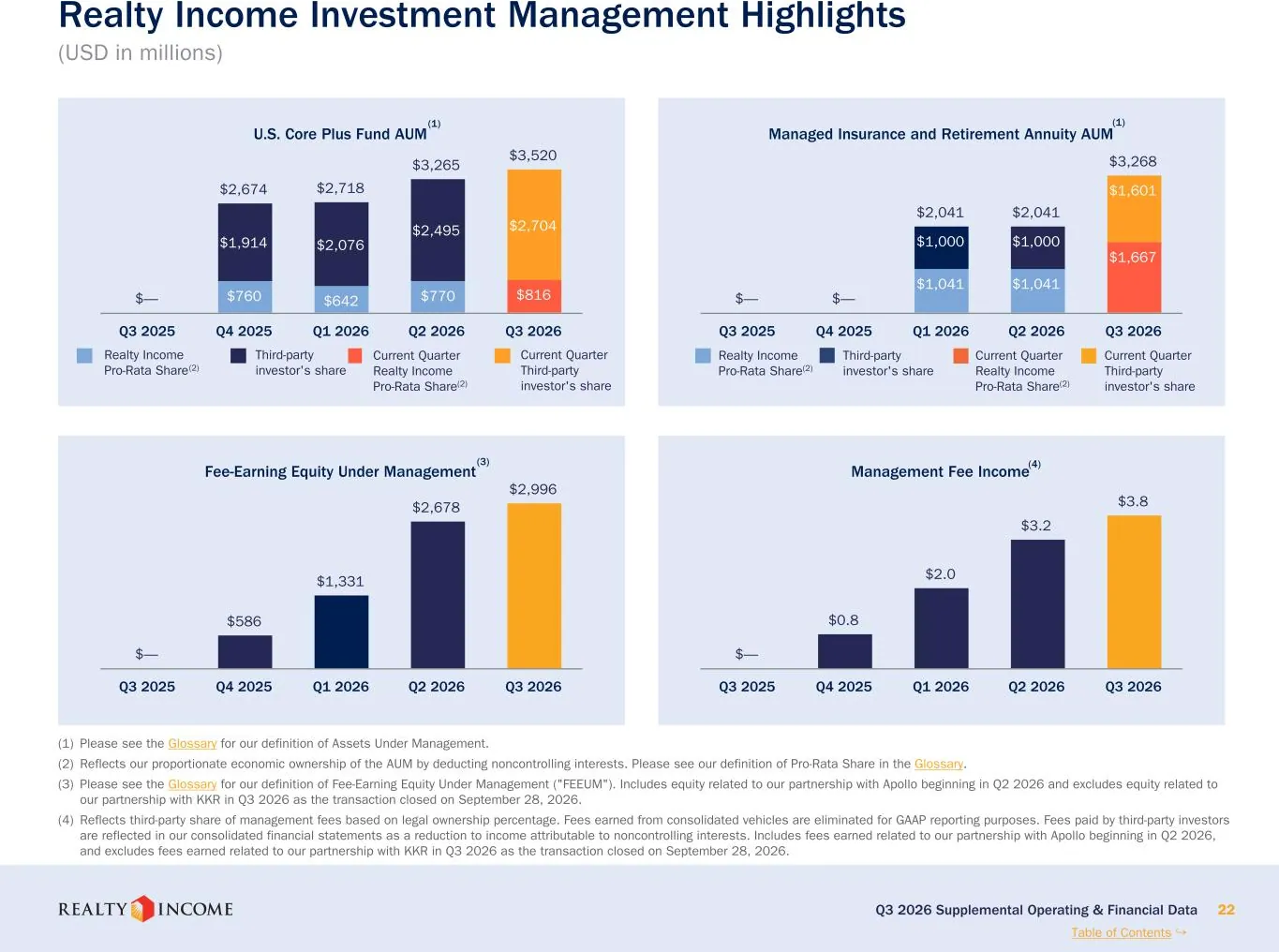
Realty Income also completed a strategic European partnership with KKR, which invested €528.0 million for a 49% interest in a newly formed joint venture holding 54 stabilised net lease properties across four European countries. The transaction expands Realty Income’s private capital platform and contributes to a broader investment-management operation, but the filing does not provide a standalone earnings contribution from the partnership for the quarter.
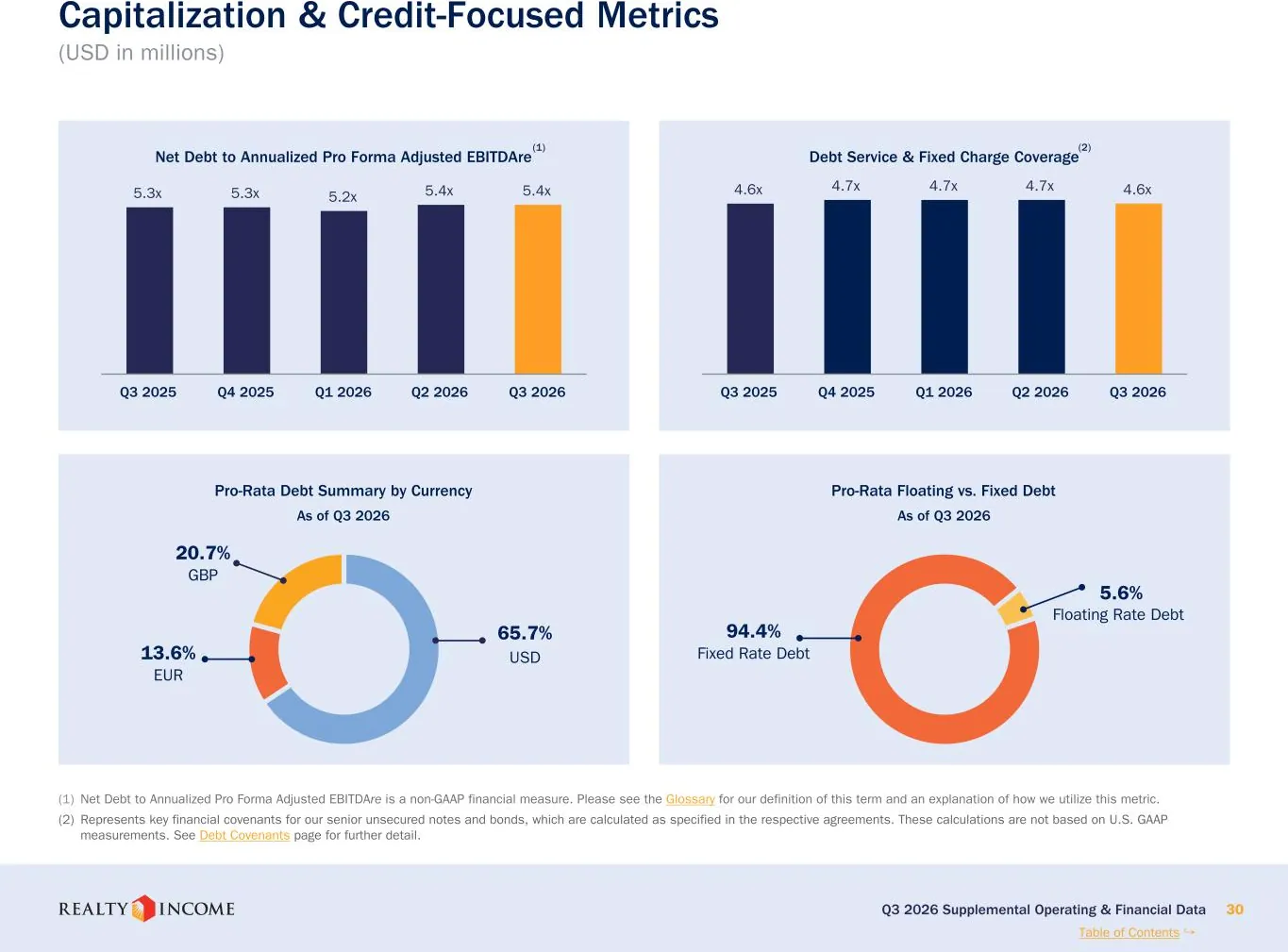
The balance sheet has room to fund the strategy, with US$5.4 billion of available liquidity at the company’s pro-rata share and net debt at 5.4 times annualised pro forma Adjusted EBITDAre, another non-GAAP measure. Realty Income also had 18.5 million shares subject to unsettled ATM forward-sale agreements, representing approximately US$1.1 billion of expected net proceeds. That equity pipeline improves reported leverage to 5.2 times on the company’s calculation, but it also leaves future share settlement and capital allocation important variables.
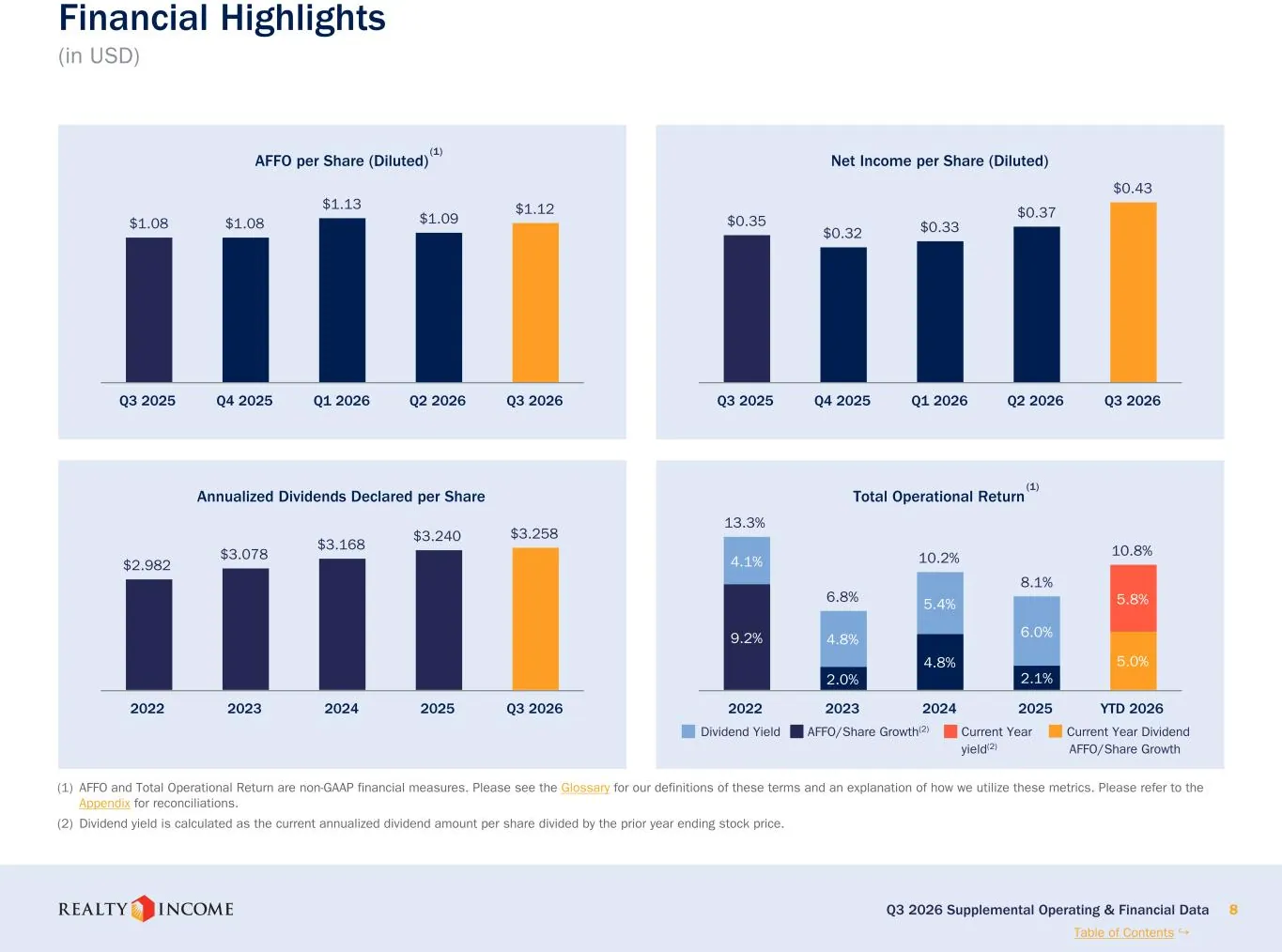
The dividend remains central to the investment case: the annualised rate was US$3.258 per share at September 30, equivalent to 72.6% of quarterly diluted AFFO. The next test is whether the company can convert its unusually busy investment programme, including the KKR platform, into sustained per-share growth without allowing leverage, equity issuance or acquisition yields to dilute the benefit.
Get NYSE:O news the moment it breaks
 iPhone & iPad
 Android
Bottom Line?
Realty Income enters the final quarter with slightly better AFFO guidance, substantial liquidity and a larger investment platform, but future per-share progress will depend on the returns from that capital deployment.
Questions in the middle?
- Can Realty Income maintain AFFO growth if acquisition yields continue to sit below some earlier investment levels?
- How much recurring earnings and fee income will the KKR European platform contribute once it is fully reflected in results?
- Will the planned settlement of US$1.1 billion in ATM forward equity improve leverage enough to offset the dilution to existing shareholders?
Sources
1-
Results of Operations and Financial Condition; Regulation FD Disclosure (opens in a new tab)Official market announcement. SEC filing · Realty Income Corporation · 2 Nov 2026 · sec.gov