Black Canyon finds new iron and manganese seams north of Wandanya

Black Canyon has extended the exploration footprint north of its Wandanya resource, intersecting consistent iron mineralisation over 1.8km and manganese over about 1km. The wide-spaced results strengthen the growth case, but follow-up drilling and the December Scoping Study remain crucial tests.
- High-grade iron intersections over 1.8km of northern strike
- Manganese mineralisation identified across about 1km with multiple seams
- Wide-spaced drilling leaves several zones open for follow-up
- Four deep gravity-targeted holes found no significant visual mineralisation
- Wandanya Scoping Study due in Q4 2026

 Add us as a preferred source on Google
Northern drilling extends Wandanya’s mineralised footprint
Black Canyon Limited (ASX:BCA) has found a substantial northern extension to the iron-rich part of its Wandanya project, with drilling delineating iron mineralisation over 1.8km of strike and manganese over roughly 1km. The strongest iron result was 6 metres at 56.5% Fe from 28 metres, including 3 metres at 61.3% Fe, while manganese assays reached 4 metres at 24.7% Mn and 3 metres at 27.4% Mn.
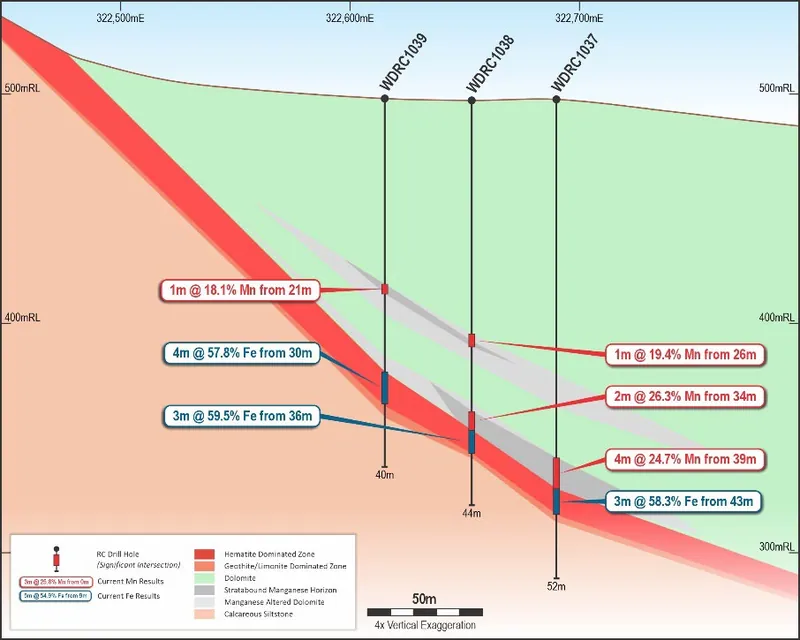
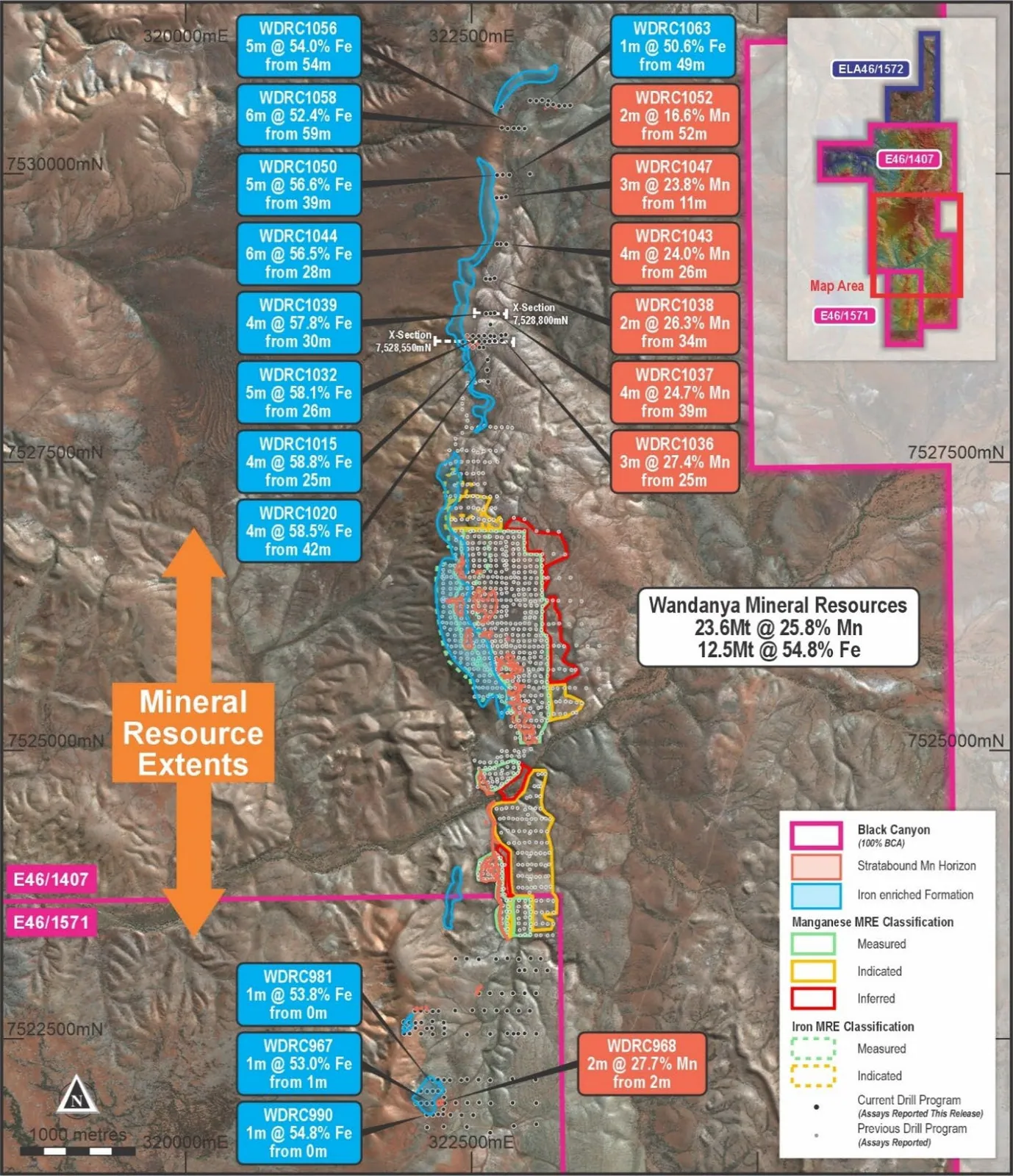
The results sit beyond the company’s recently established maiden resource, which contains 23.6 million tonnes at 25.8% Mn and 12.5Mt at 54.9% Fe. That resource provided the initial development base for Wandanya; these assays point to possible additions, rather than representing an updated Mineral Resource Estimate.
Iron continuity stands out across the northern ridge
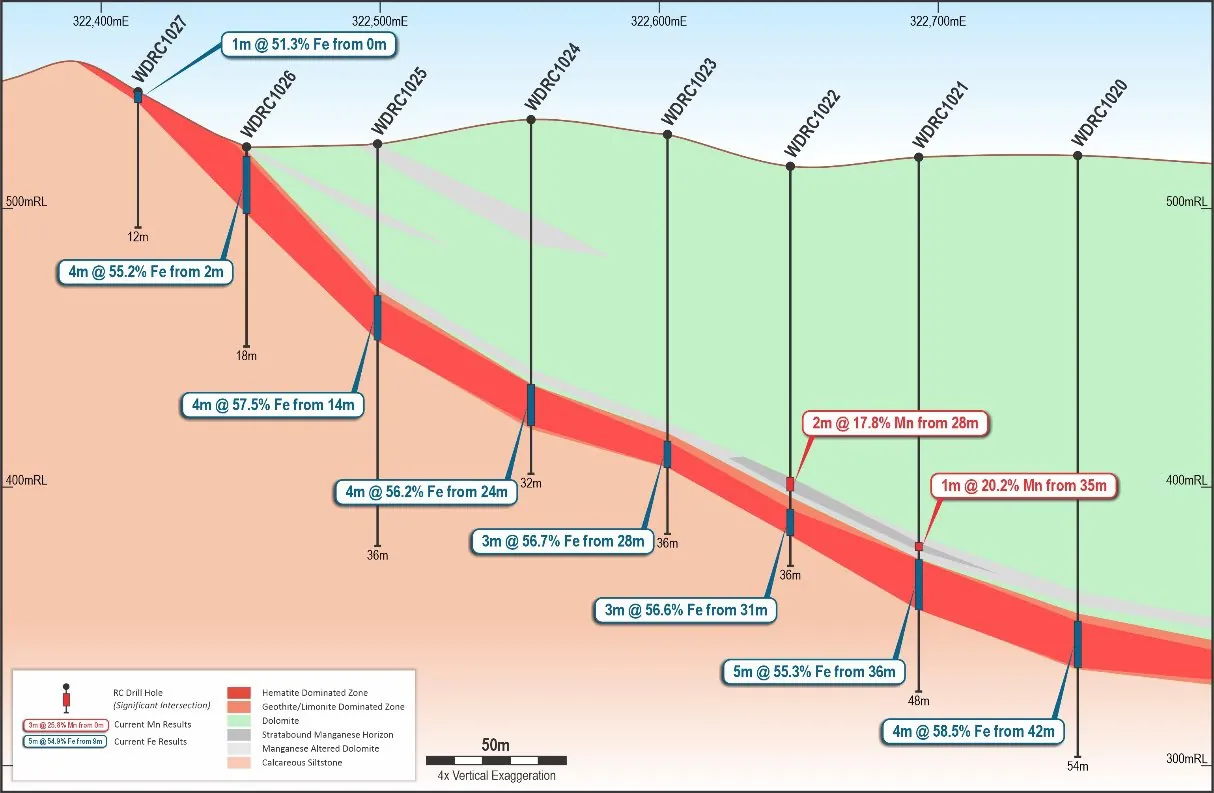
Black Canyon’s 2026 program covered 151 reverse-circulation holes and 4,804 metres, testing 2.8km of outcropping iron mineralisation north of Wandanya and 1.4km of southern targets. In the north, several 3m to 5m iron intervals returned grades between 55% and 60% Fe, with consecutive hematite-rich sections often above 60% Fe.
The company says the drilling demonstrated continuity from outcrop down dip to as far as 250 metres east. Notable results included 5m at 58.1% Fe from 26m, 5m at 56.6% Fe from 39m and 4m at 58.8% Fe from 25m. These results extend the same high-grade iron style that helped underpin the maiden resource estimate, although the spacing of the new drilling is not yet tight enough to establish comparable confidence.
Multiple manganese seams reshape the exploration target
The manganese results are smaller in width but potentially important for the geological model. Drilling encountered manganese horizons between 1m and 4m thick, generally grading in the low to mid-twenties, with isolated intervals reaching 35.5% Mn over 1m. Several lower-grade seams also appeared above the principal manganese horizon.
That pattern differs from the main Wandanya resource area, where the company typically identified a single manganese horizon. Black Canyon says the northern results raise the possibility of multiple manganese seams within the dolomite package. However, the southern extension was less encouraging: iron intersections were generally less than a metre thick and did not persist down dip, while higher-grade manganese appears to have been disrupted by faulting and erosion.
Wide spacing leaves continuity and depth unresolved
The northern drilling lines were spaced between 100m and 400m apart, with holes generally 50m to 100m apart along each line. Black Canyon plans tighter infill drilling to test continuity, with further reverse-circulation work also intended to follow the northern iron and manganese zones. Several cross-sections remain open up-dip and down-dip.
A detailed gravity survey covering 38 square kilometres has also produced additional structural targets, supported by up to $264,800 in Western Australian Government Exploration Incentive Scheme funding. But the deeper test was not uniformly successful: four 180m RC holes drilled into gravity anomalies failed to encounter significant visual iron or manganese enrichment and were not assayed. Other gravity targets are scheduled for testing in the 2027 field season.
Scoping Study becomes the next valuation checkpoint
Black Canyon is planning larger test-pit samples for density-separation metallurgical work, while its 12-month flora, vegetation and fauna baseline surveys are due to finish by the end of November. The Wandanya Scoping Study is expected in the fourth quarter of 2026, after optimisation work and mine-pit designs and schedules have advanced.
That study will have to put the new exploration upside in its proper place. The northern results add scale and geological interest, but the project’s economic case still depends on how much of the extension can be converted into a coherent resource, how it responds to processing, and whether the development assumptions survive the move from exploration to mine planning.
Get ASX:BCA news the moment it breaks
 iPhone & iPad
 Android
Bottom Line?
The northern assays improve Wandanya’s growth narrative, but tighter drilling and the Q4 Scoping Study must convert geological continuity into a credible development case.
Questions in the middle?
- How much of the northern iron and manganese extension can be incorporated into a future resource update?
- Will tighter drilling confirm continuity across areas currently tested on lines up to 400m apart?
- Can the Scoping Study demonstrate a viable dual-commodity operation before further capital is required?
Sources
1-
Wandanya Extension Drill Results (opens in a new tab)Official market announcement. Black Canyon Limited · 4 Nov 2026 · blackcanyon.com.au