Regions sees stronger income ahead as credit quality improves

Regions Financial expects fourth-quarter net interest income to rise 1% to 2% sequentially, while third-quarter adjusted earnings reached US$622 million. The bank also reported improving non-performing loans and net charge-offs, but flagged interest-rate and commercial credit risks that remain central to its outlook.
- Fourth-quarter net interest income expected to rise 1% to 2%
- Adjusted diluted EPS of US$0.73 in the third quarter
- Net interest margin reached 3.68%, with approximately 3.70% expected in the fourth quarter
- Non-performing loans fell to 0.59% of loans and net charge-offs to 0.29%
- Full-year adjusted non-interest income growth tracking towards the lower end of 3% to 5% guidance

 Add us as a preferred source on Google
Regions Financial Corporation (NYSE:RF) is heading into the final quarter of 2026 with a relatively favourable earnings setup: management expects net interest income to increase 1% to 2% from the third quarter, while credit metrics improved and fee income gained momentum. The Birmingham-based bank reported US$622 million in adjusted net income available to common shareholders, or adjusted diluted earnings of US$0.73 a share, for the third quarter.
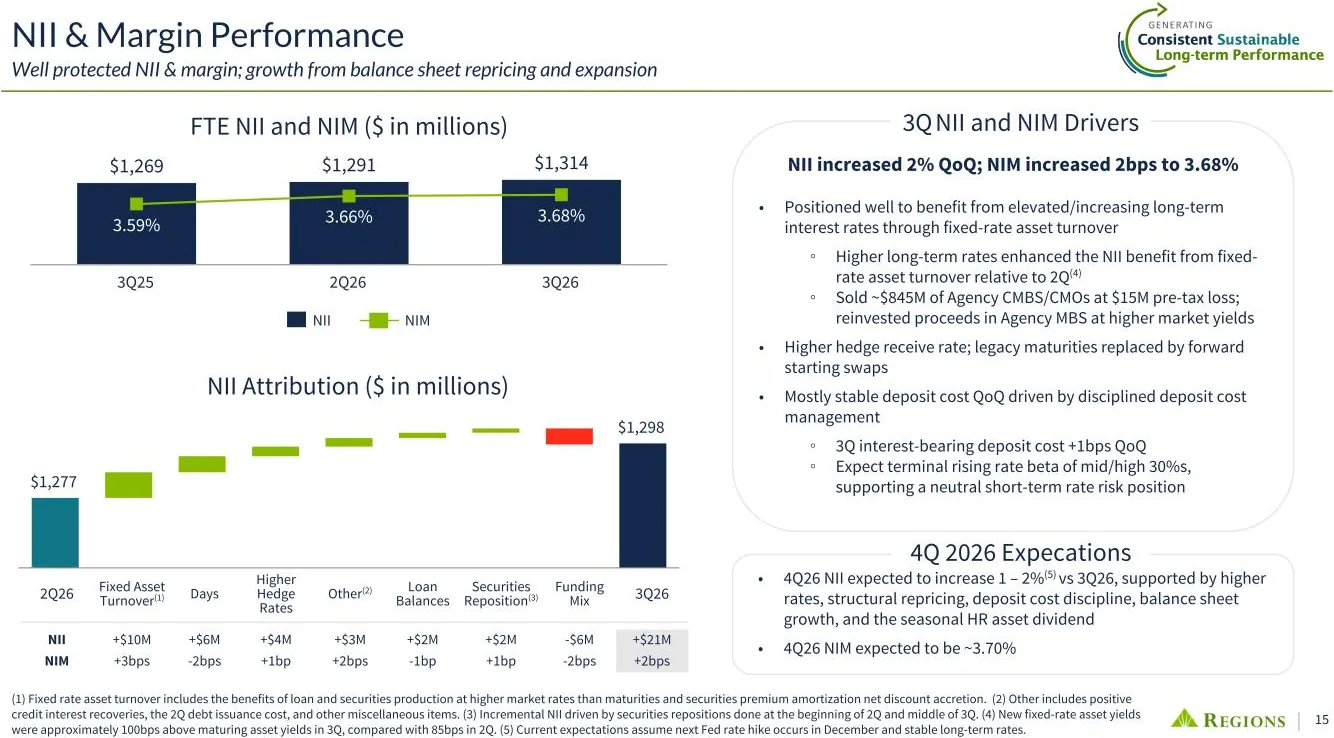
The result was built on both sides of the income statement. Reported net interest income rose to US$1.298 billion from US$1.277 billion in the second quarter, while net interest margin expanded two basis points to 3.68%. Adjusted total revenue reached US$1.988 billion, up from US$1.947 billion a quarter earlier, and adjusted return on average tangible common equity was 21.66%. The corresponding GAAP figures were US$611 million of net income available to common shareholders, US$0.71 of diluted EPS and US$1.973 billion of total revenue.
Fourth-quarter margin outlook leans on repricing and deposit discipline
Regions expects fourth-quarter net interest margin of approximately 3.70%, assuming the next Federal Reserve rate increase occurs in December and longer-term rates remain stable. Management said the expected improvement should come from balance-sheet growth, structural repricing, disciplined deposit costs, higher hedge receive rates and the seasonal human-resources asset dividend.
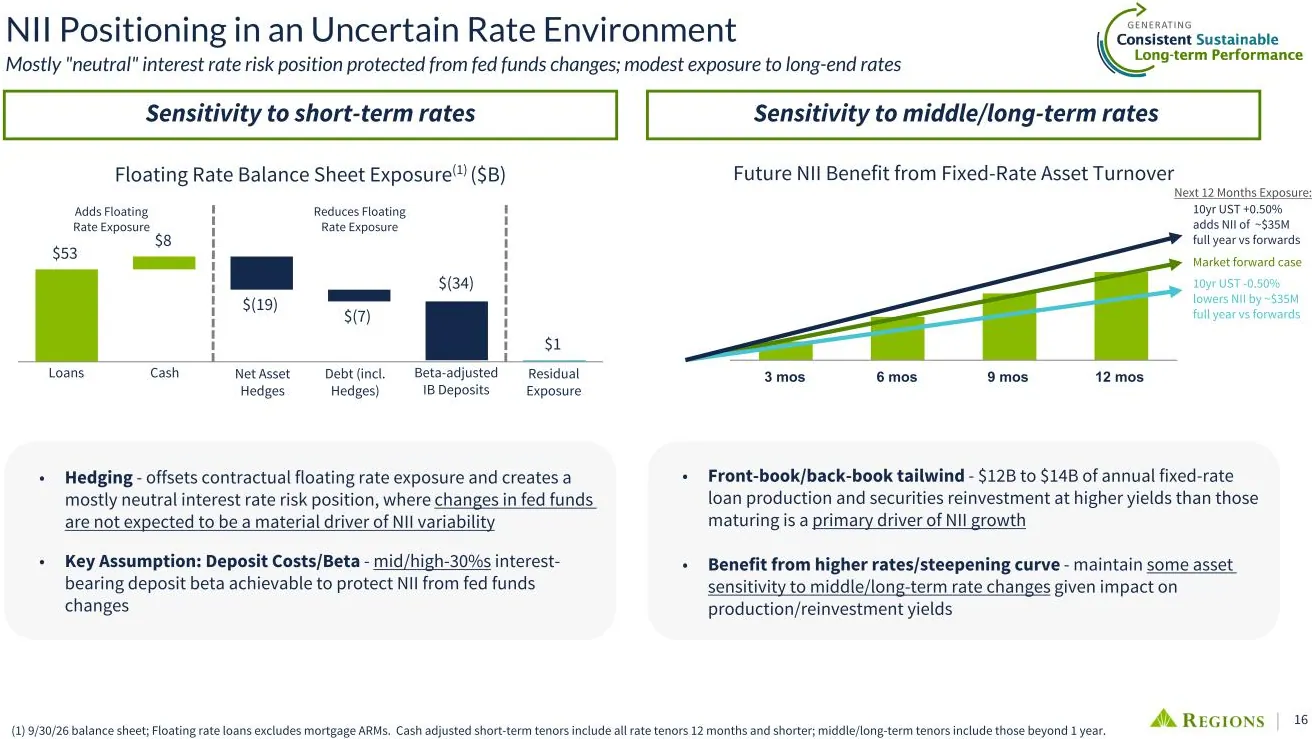
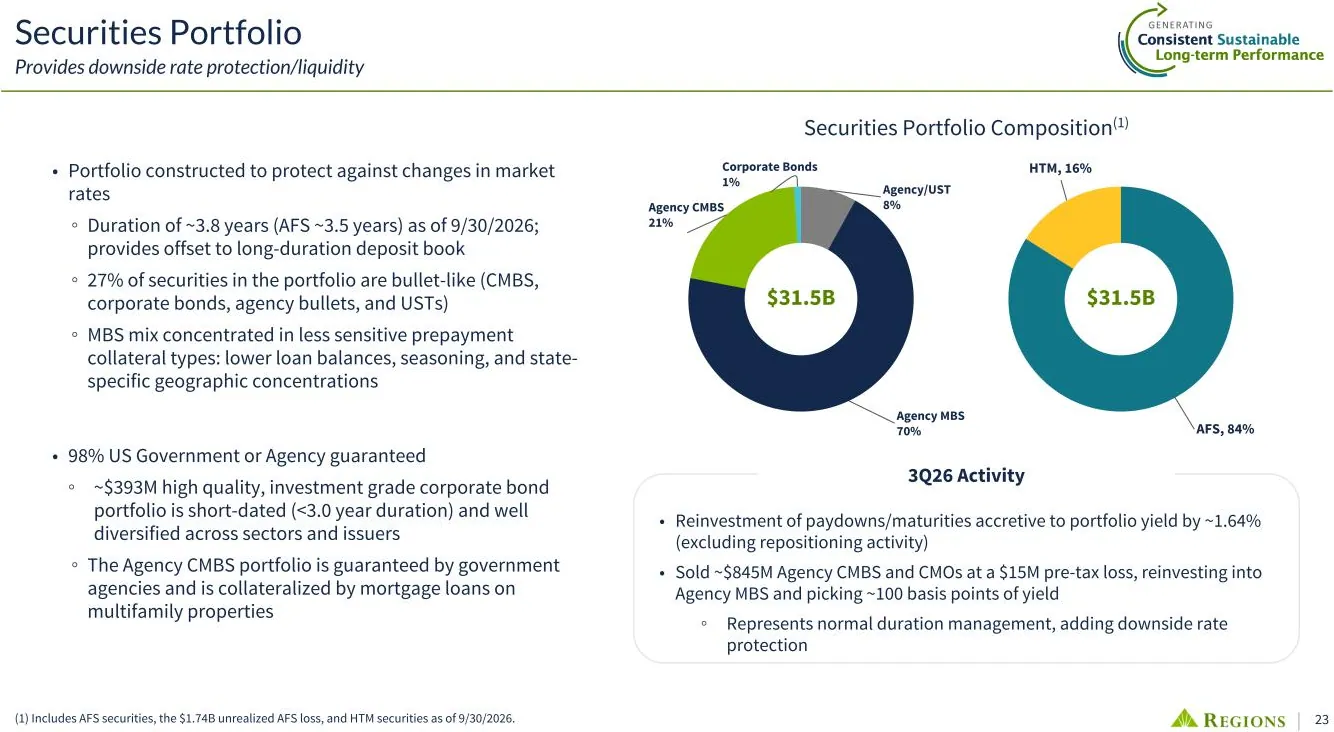
The bank’s interest-rate position is described as mostly neutral to changes in short-term rates, supported by hedges and a deposit beta assumption in the mid-to-high 30% range. Longer-term rates still matter: Regions said new fixed-rate assets carried yields about 100 basis points above maturing assets in the third quarter. It also sold approximately US$845 million of agency commercial mortgage-backed securities and collateralised mortgage obligations at a US$15 million pre-tax loss, reinvesting the proceeds into agency mortgage-backed securities at higher yields.
Fee businesses offset uneven quarterly performance
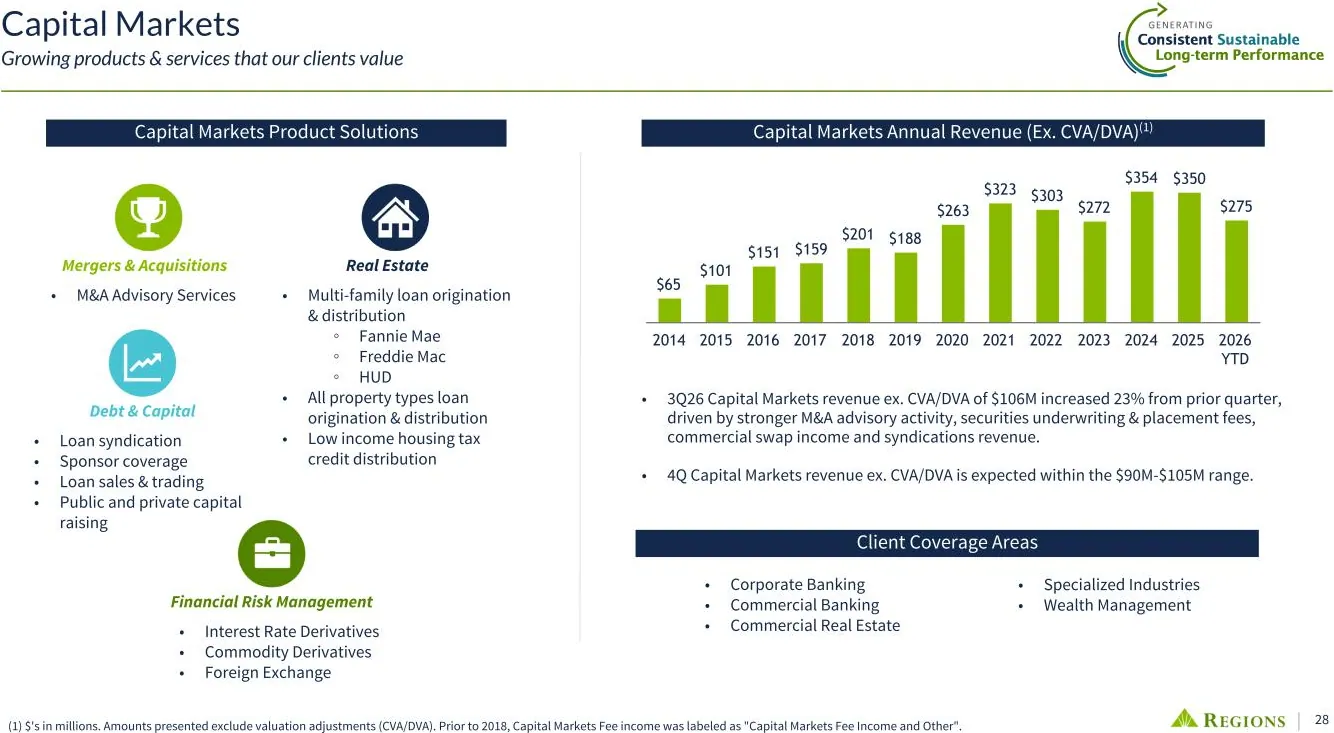
Adjusted non-interest income rose 3% from the second quarter to US$690 million. Capital markets revenue excluding credit valuation adjustments and debit valuation adjustments climbed 23% to a record US$106 million, helped by mergers and acquisitions advisory work, securities underwriting, commercial swaps and syndications. Regions expects fourth-quarter capital markets revenue in the US$90 million to US$105 million range, suggesting some moderation from the latest quarter.
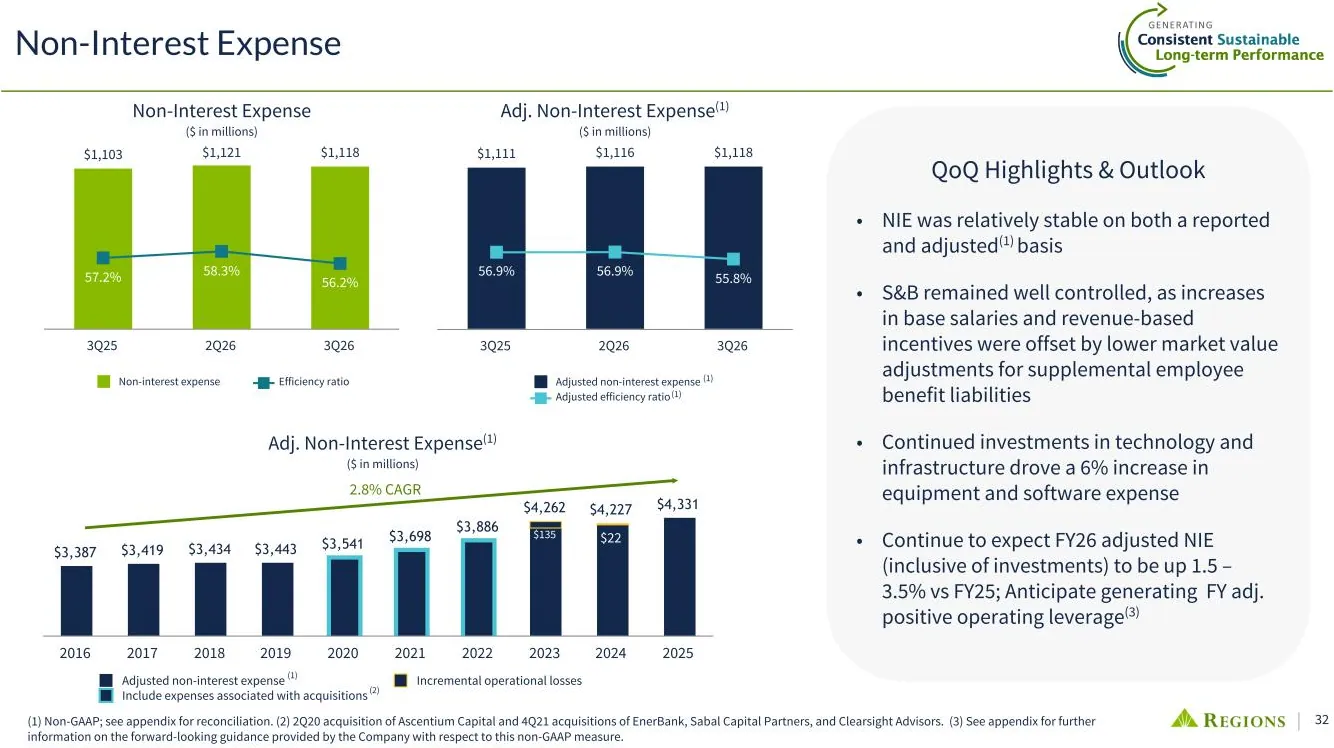
Treasury management also delivered a record quarter, while wealth management income fell 3% from the second quarter after an unusually strong prior period. The company retained its full-year expectation for adjusted non-interest income growth of 3% to 5% over 2025, although results are currently tracking towards the lower end of that range. Adjusted non-interest expense is expected to increase 1.5% to 3.5%, inclusive of continued technology and infrastructure investment, with positive operating leverage still expected for the full year.
Credit quality improved, but concentrated exposures remain relevant
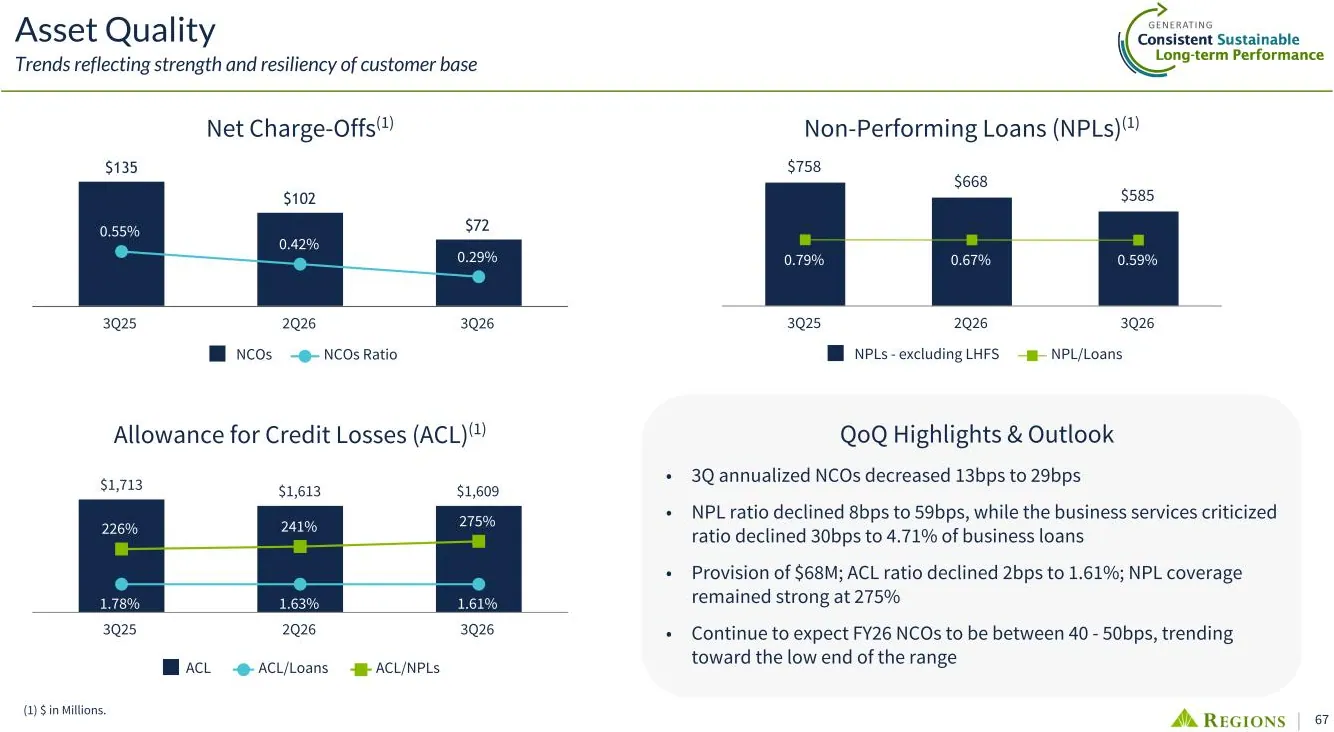
Credit data moved in the right direction during the quarter. Non-performing loans excluding loans held for sale fell to US$585 million, or 0.59% of loans, from 0.67% in the second quarter. Net charge-offs declined to US$72 million, equivalent to 0.29% of average loans, while the allowance for credit losses edged down to US$1.609 billion, or 1.61% of loans. Regions continues to expect full-year net charge-offs of 40 to 50 basis points, towards the low end of that range.
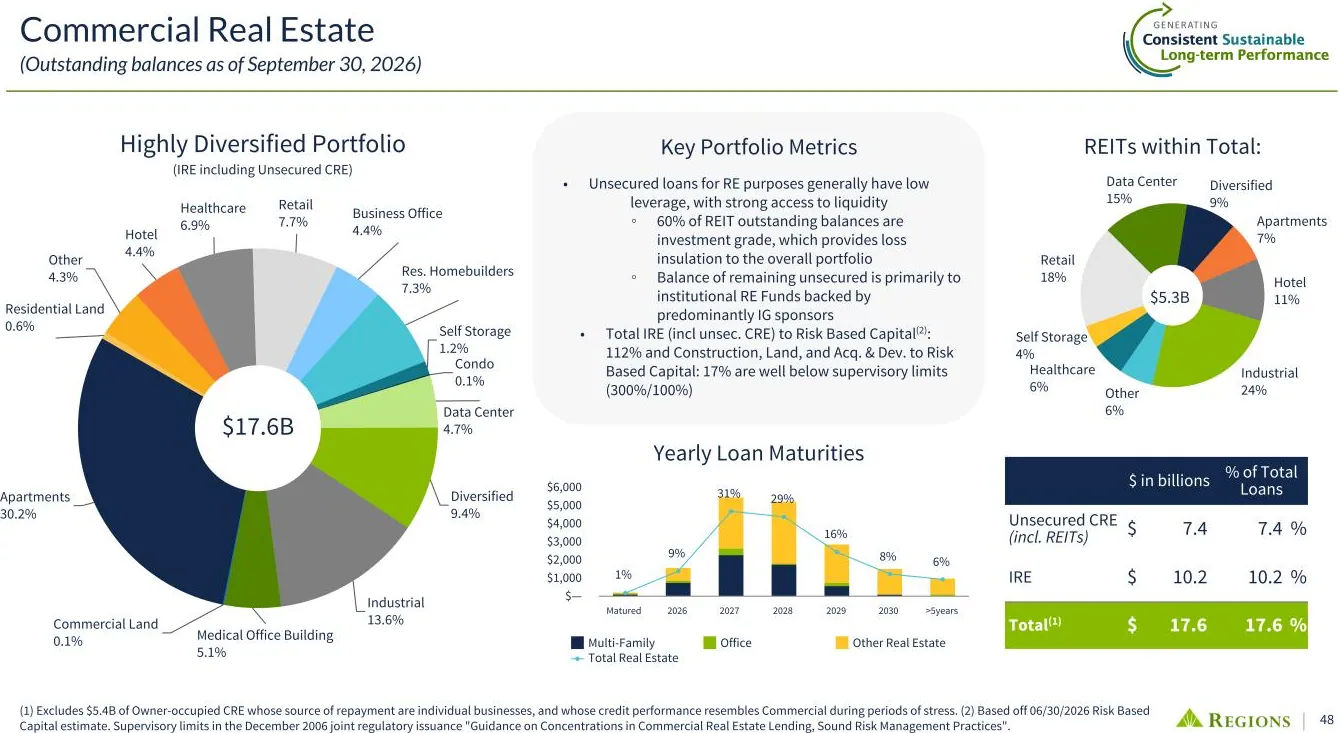
The portfolio is not without pressure points. Commercial real estate, including unsecured commercial real estate, represented 17.6% of total loans, with the office portfolio accounting for 0.8%. Approximately US$508 million, or about 66% of office balances, matures over the next 12 months. Trucking balances declined 20% year on year, but the segment still carried a 4.0% annualised charge-off rate for the first nine months of 2026. These figures do not dictate the outcome, but they identify where the bank’s improving headline credit trends could face a tougher test.
Capital returns continue as regulatory changes approach
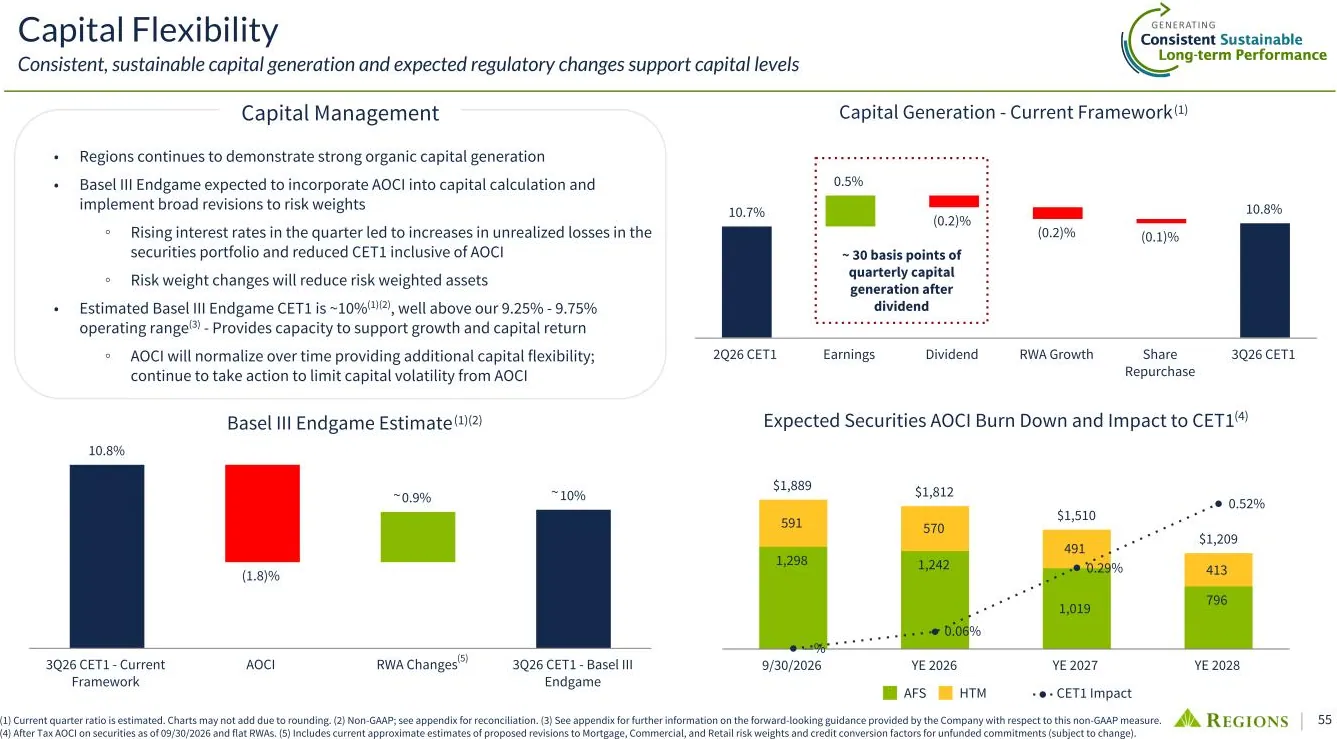
Regions declared US$255 million of common dividends and repurchased US$95 million of shares during the quarter. Its estimated common equity Tier 1 ratio was 10.8% under the current framework, while management estimated a roughly 10% ratio after incorporating assumed Basel III Endgame changes and accumulated other comprehensive income. The bank said that level sits above its stated 9.25% to 9.75% operating range, although the regulatory framework and its eventual impact remain subject to change.
For shareholders, the next test is whether the bank can convert its balance-sheet positioning into sustained income growth without giving back the recent credit gains. The fourth-quarter margin target and the next update on deposit costs will provide the clearest evidence of whether repricing benefits are becoming durable rather than merely favourable timing.
Get NYSE:RF news the moment it breaks
 iPhone & iPad
 Android
Bottom Line?
The near-term numbers point higher, but Regions still needs stable deposit funding, contained commercial losses and successful rate hedging to turn that momentum into a repeatable earnings pattern.
Questions in the middle?
- Can Regions deliver the expected 1% to 2% fourth-quarter net interest income increase if rate and deposit assumptions change?
- Will office maturities and trucking losses remain contained as the bank maintains its 40 to 50 basis-point full-year charge-off outlook?
- How much capital flexibility will remain once Basel III Endgame treatment of accumulated other comprehensive income is finalised?
Sources
1-
Regulation FD Disclosure (opens in a new tab)Official market announcement. SEC filing · Regions Financial Corporation · 4 Nov 2026 · sec.gov