ANZ turns cost savings into a $7.59 billion cash profit

ANZ Group Holdings reported a 31% rise in FY26 cash profit to A$7.591 billion, helped by sharp cost reductions and stronger Australian banking performance. The 83-cent final dividend was maintained, but rising impairments, weaker New Zealand earnings and heavier capital demands leave the next phase of the turnaround less straightforward.
- A$7.591 billion cash profit, up 31%
- A$7.270 billion statutory profit, up 23%
- 83-cent final dividend, 80% franked
- Operating expenses down 14% to A$11.074 billion
- Non-performing exposures up 7% to A$9.048 billion

 Add us as a preferred source on Google
ANZ Group Holdings Limited (ASX:ANZ) has produced a markedly stronger headline result, with full-year cash profit climbing 31% to A$7.591 billion and statutory profit attributable to shareholders rising 23% to A$7.270 billion. The final dividend stayed at 83 cents a share, although its Australian franking rate increased to 80% from 75% for the interim payment.
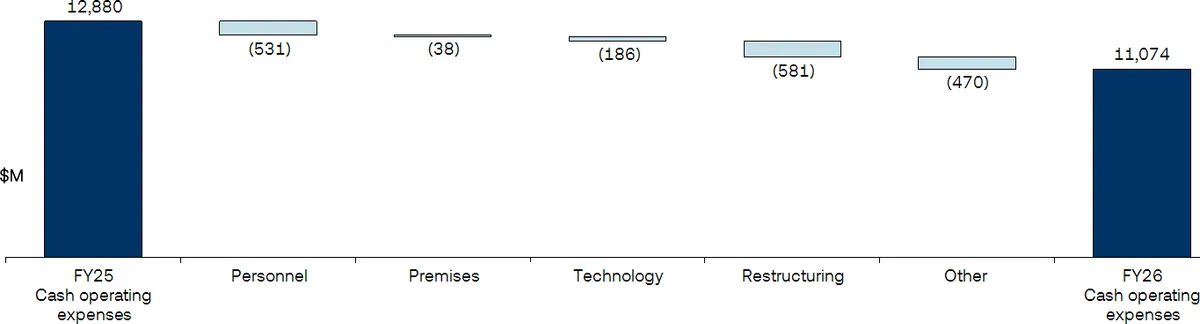
The result was powered less by revenue than by the bank’s cost base. Cash operating income increased 3% to A$22.479 billion, while operating expenses fell 14% to A$11.074 billion. ANZ said it realised A$902 million in gross cost savings during FY26, exceeding its previously stated A$875 million target, taking the cash cost-to-income ratio down to 49.26% from 58.82%.
Cost savings carry the earnings result
The comparison is flattered by significant items recorded in FY25, including restructuring costs, ASIC penalties, the PT Bank Pan Indonesia impairment and Suncorp Bank migration costs. On ANZ’s own adjusted basis, cash profit still rose 10% and cash return on tangible equity increased 109 basis points to 11.56%, a more useful measure of underlying progress than the reported 31% jump.
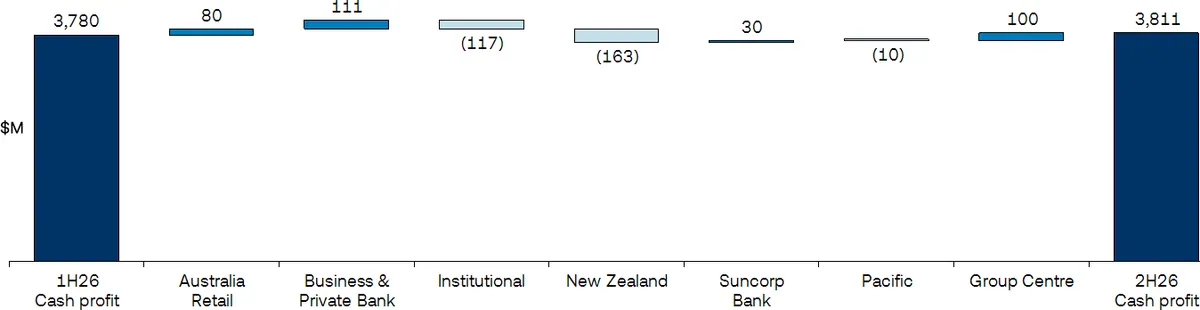
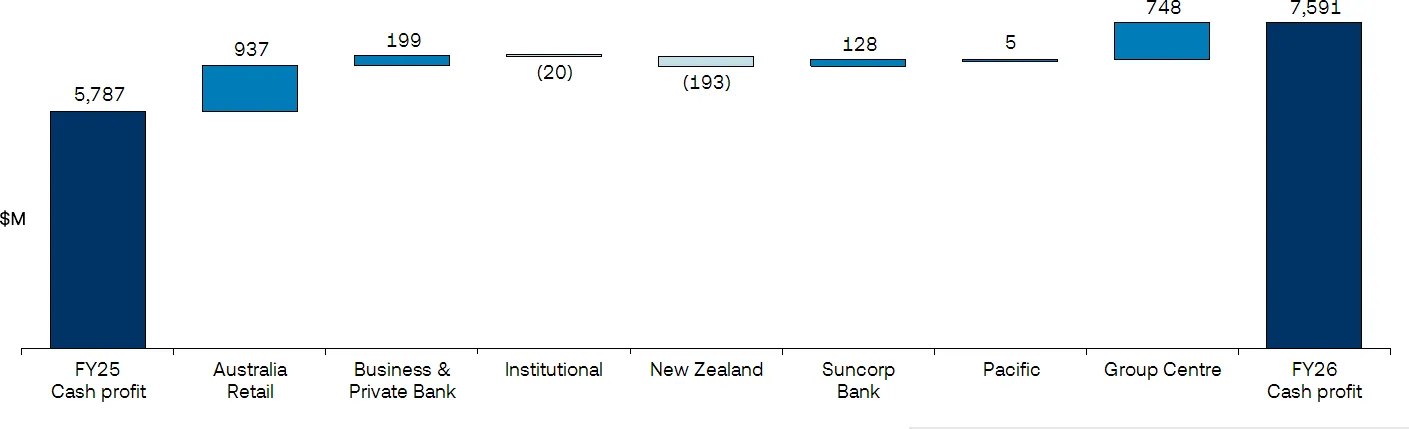
Australia Retail delivered the sharpest improvement, with full-year cash profit rising to A$1.708 billion from A$771 million after expenses fell 25%. Business & Private Bank increased cash profit 14% to A$1.655 billion, while Suncorp Bank rose 31% to A$546 million. Institutional cash profit was broadly flat at A$2.427 billion, and New Zealand declined 12% in Australian-dollar terms to A$1.429 billion.
New Zealand remains the awkward part of the otherwise upbeat picture. ANZ NZ cash profit fell 3% to NZ$2.306 billion as expenses rose 9%, including a provision linked to the Credit Contracts and Consumer Finance Act class action. The bank has appealed the High Court decision, following the NZ class action appeal reported earlier this year. Excluding the provision, ANZ NZ said cash profit increased 1%, but its net interest margin still contracted seven basis points to 2.52% amid lending competition.
Credit costs are rising beneath the surface
Credit impairment charges increased 32% to A$582 million. The collective provision charge almost doubled to A$222 million, reflecting portfolio growth, a weaker economic outlook, housing-market weakness and methodology changes. Individually assessed impairments rose 10% to A$360 million, driven partly by new impairments on several Institutional exposures.
ANZ’s total allowance for expected credit losses reached A$4.903 billion, while non-performing exposures increased 7% year on year to A$9.048 billion. The bank said non-performing exposures remained 0.57% of total committed exposure, and its collective provision balance of A$4.53 billion stood A$2.1 billion above the base economic scenario. That buffer offers protection, but it also signals that management is carrying a meaningful allowance against a less forgiving economic backdrop.
Capital remains sound as transformation accelerates
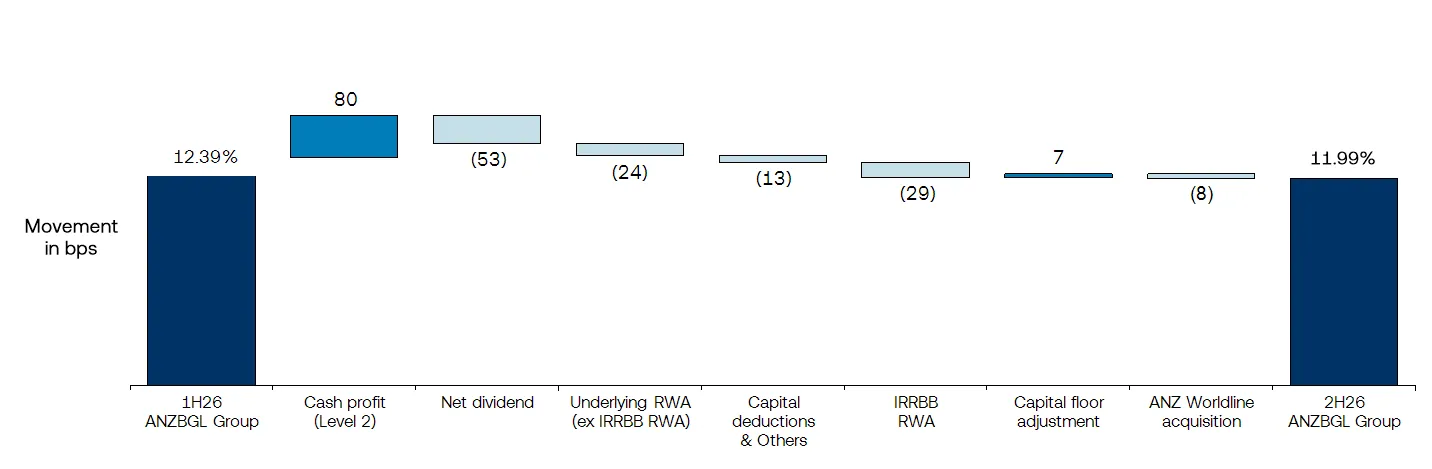
ANZ’s APRA Level 2 CET1 ratio was 11.99%, down four basis points from September 2025. Risk-weighted assets increased 6% to A$485.9 billion, with interest-rate risk in the banking book and lending growth absorbing much of the capital generated by earnings. Liquidity remained above regulatory thresholds, with an average liquidity coverage ratio of 132% and a net stable funding ratio of 116%.
The bank says it is on track to complete the Suncorp Bank migration by June 2027, with 60% of activities completed at September, and to deliver a single customer front-end for retail and small-business customers by September 2027, with 45% completed. It also completed the acquisition of the remaining 51% of Payment Acceptance Australia, formerly Worldline Australia, during the year and recognised a A$27 million step-acquisition gain.
The proposed final dividend is payable on 18 December to shareholders on the register at 13 November, taking FY26 dividends to 166 cents per share. ANZ intends to neutralise the dividend reinvestment plan through on-market share purchases, rather than applying a discount. The payout is therefore generous without adding an immediate planned share issuance burden, but the more important test arrives in FY27: whether cost savings can keep earnings moving while credit losses, regulatory capital requirements and two large technology integrations compete for the same balance sheet.
Get ASX:ANZ news the moment it breaks
 iPhone & iPad
 Android
Bottom Line?
ANZ has banked a strong first year of cost-led improvement, but FY27 will test whether that momentum can survive higher credit costs and the execution risk of Suncorp and digital-platform projects.
Questions in the middle?
- Can ANZ sustain earnings growth once the benefit from FY25 comparison items fades?
- Will rising non-performing exposures and collective provisions translate into materially higher losses?
- Can the Suncorp migration and single customer front-end be delivered on schedule without eroding the cost gains?
Sources
5-
News Release - ANZ NZ 2026 Full Year Result (opens in a new tab)Official market announcement. ANZ Group Holdings Limited · 9 Nov 2026 · anz.com
-
ANZ 2026 FY Results Presentation & Investor Discussion Pack (opens in a new tab)Official market announcement. ANZ Group Holdings Limited · 9 Nov 2026 · anz.com
-
News Release - 2026 Full Year Result & Proposed Dividend (opens in a new tab)Official market announcement. ANZ Group Holdings Limited · 9 Nov 2026 · anz.com
-
Dividend/Distribution - ANZ (opens in a new tab)Official market announcement. ANZ Group Holdings Limited · 9 Nov 2026 · anz.com
-
ANZ Full Year Results, Dividend Announcement & Appendix 4E (opens in a new tab)Official market announcement. ANZ Group Holdings Limited · 9 Nov 2026 · anz.com