Critica advances Jupiter’s gallium and scandium recovery potential

Critica has lifted gallium extraction to as high as 91.9% and scandium extraction to 84.7% in Jupiter testwork, opening potential by-product pathways alongside its rare earths operation. The results are promising, but they measure metals entering solution rather than finished-product recovery, with separation and economics still unresolved.
- Gallium extraction reached up to 91.9%, versus approximately 63% previously reported
- Scandium extraction reached up to 84.7% in acid-bake and water-leach testing
- Both metals entered the pregnant leach solution alongside rare earth elements
- Jupiter’s approximately A$2.0 billion after-tax NPV8 excludes gallium and scandium value
- Resin selectivity, separation, purification and product economics remain to be tested
 Add us as a preferred source on Google
Jupiter testwork opens two unpriced by-product pathways
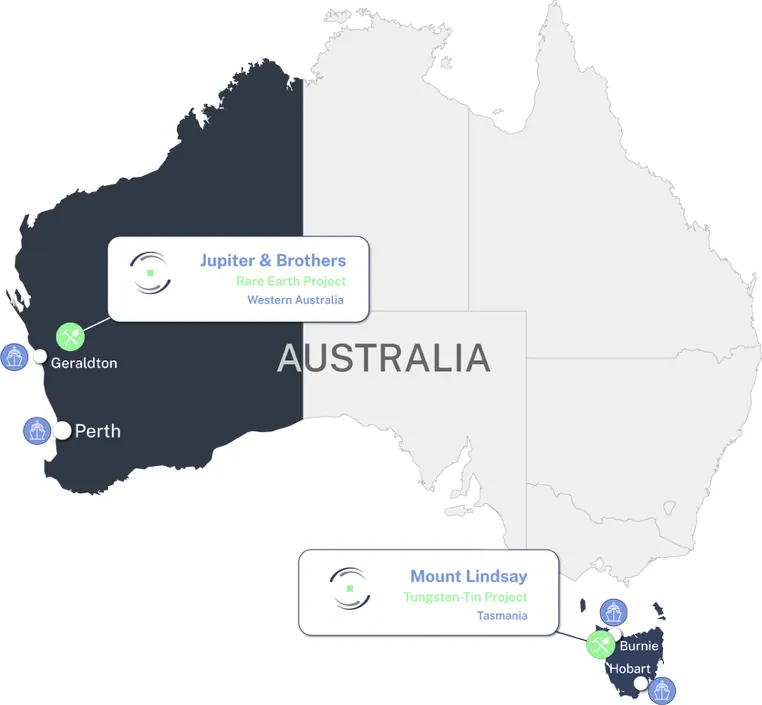
Critica Limited (ASX:CRI) has produced its strongest gallium and scandium extraction results to date from the Jupiter rare earths project in Western Australia, with up to 91.9% of gallium and 84.7% of scandium transferred into solution. The company says the results advance potential recovery pathways for two critical minerals that are not included in Jupiter’s approximately A$2.0 billion after-tax NPV8 Scoping Study Base Case.
The improvement is most notable for gallium, where the best result compares with approximately 63% extraction previously reported. Five of seven tests produced gallium extraction above 84%, while scandium extraction exceeded 80% in four tests.
Extraction is not yet finished-product recovery
The headline percentages come from acid baking followed by water leaching. In that process, gallium and scandium moved into the pregnant leach solution alongside the rare earth elements. That is an important metallurgical step, but it is not the same as recovering saleable, separated products.
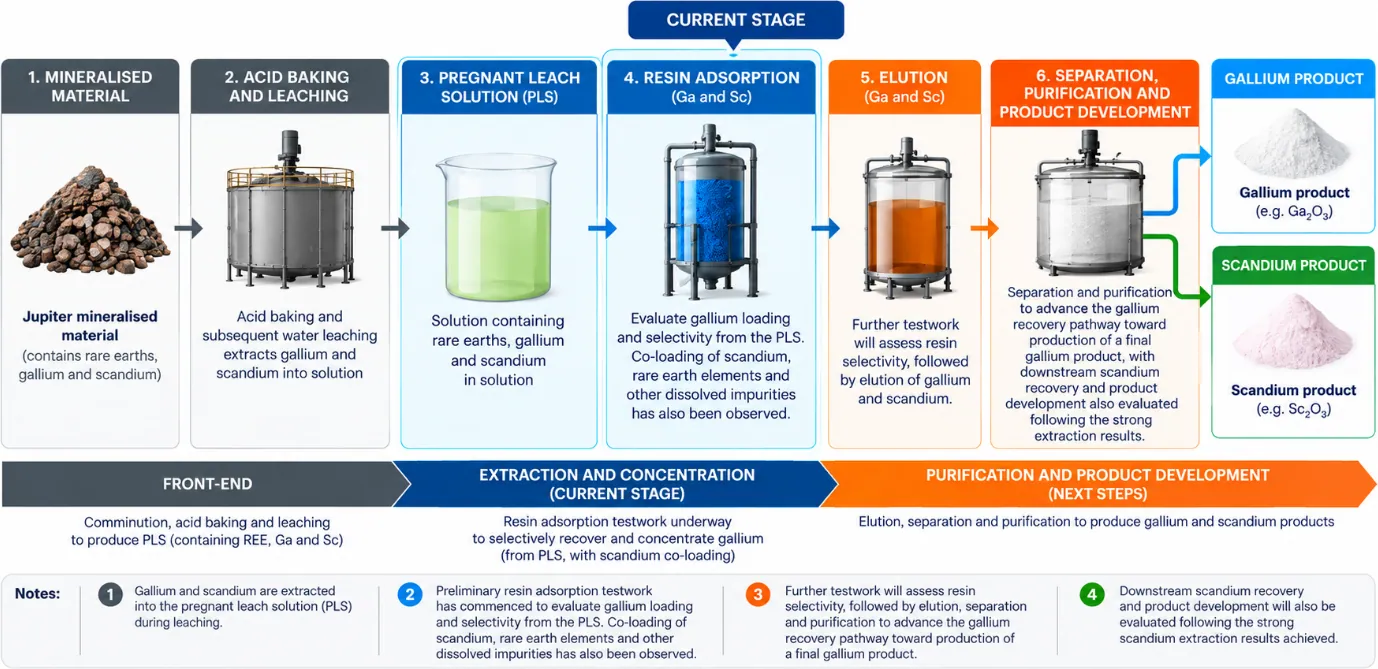
Preliminary resin adsorption work has begun, with gallium, scandium and rare earth elements all loading onto the resin. The co-loading is a technical complication as much as a positive signal: further work must establish selectivity, elution, separation, purification and product specifications before the by-product concept can be assessed commercially.
Resource contains substantial approximate metal inventories
Critica says Jupiter’s 160 million-tonne Indicated Resource contains approximately 6,400 tonnes of Ga₂O₃ and 7,200 tonnes of Sc₂O₃. Its much larger 1.5 billion-tonne Inferred Resource contains approximately 60,000 tonnes of Ga₂O₃ and 54,000 tonnes of Sc₂O₃, calculated from rounded tonnages and grades.
Those figures describe gallium and scandium contained within the existing resource, not separate standalone Mineral Resources. The higher-confidence portion of the resource was reported in the 160 Mt Indicated resource upgrade, while Jupiter’s A$2.0 billion Scoping Study modelled the rare earths development without assigning value to either by-product.
Next phase targets separation and economic evidence
Critica’s next steps are to complete gallium resin-loading and selectivity work, assess gallium separation and purification, progress downstream scandium recovery testing and integrate the results into Jupiter’s broader process flowsheet. The company describes the recovery pathway and potential value streams as aspirational and says it does not yet have reasonable grounds to believe they can be achieved.
That qualification matters. The work was performed on a metallurgical composite representing the iron-clay mineralisation type, and the announcement does not establish final recoveries, operating costs, capital requirements, product prices or commercial viability. Jupiter’s existing study economics therefore remain the relevant disclosed case until the next round of testwork supplies evidence that these metals can be separated and sold.
Get ASX:CRI news the moment it breaks
 iPhone & iPad
 Android
Bottom Line?
The next value test is not a higher extraction percentage but whether Critica can turn co-loaded metals into separate, specification-ready products at an economic cost.
Questions in the middle?
- Can the resin circuit selectively separate gallium and scandium from rare earths and other dissolved impurities?
- What final product recoveries and quality specifications will downstream testwork establish?
- Will future Jupiter studies assign meaningful by-product value after capital and operating costs are modelled?
Sources
1-
Jupiter Metallurgical Testwork Advances Gallium & Scandium (opens in a new tab)Verified company source. Critica Limited · 9 Nov 2026 · investorhub.critica.limited