Krakatoa uncovers more high-grade gold and antimony at Zopkhito

Krakatoa Resources has reported another batch of high-grade gold and antimony assays from its Zopkhito project in Georgia, led by 16.25g/t gold over 0.60 metres and 8.27% antimony over 0.70 metres. The results add geological detail as drilling, ore-sorting tests and work towards a maiden JORC 2012 resource continue.
- 16.25g/t gold over 0.60m in underground hole UG26ZOP-027
- 8.27% antimony over 0.70m in Vein 61
- Surface drilling returned 5.31m at 2.03g/t gold and 0.63% antimony
- Results include mineralisation in areas outside the foreign resource estimate
- Ore-sorting and metallurgical test work are now progressing
 Add us as a preferred source on Google
Underground drilling produces the headline grades
Krakatoa Resources Limited (ASX:KTA) has produced its strongest individual result in this batch at the Zopkhito Antimony-Gold Project, with underground hole UG26ZOP-027 returning 16.25g/t gold over 0.60 metres within a broader 2.72-metre interval grading 4.66g/t gold. The same round of assays also delivered 8.27% antimony over 0.70 metres in UG26ZOP-024, drilled into Vein 61, a structure the company says was not included in the foreign resource estimate.
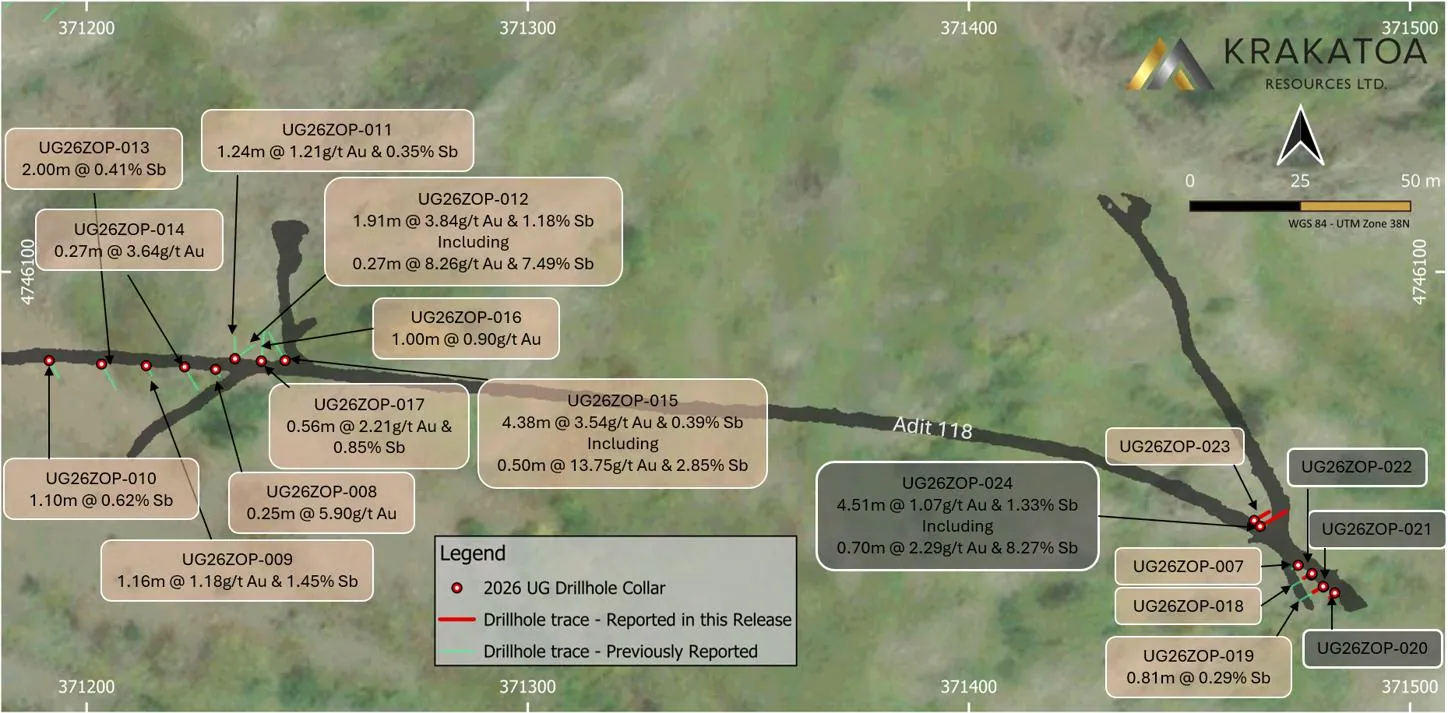
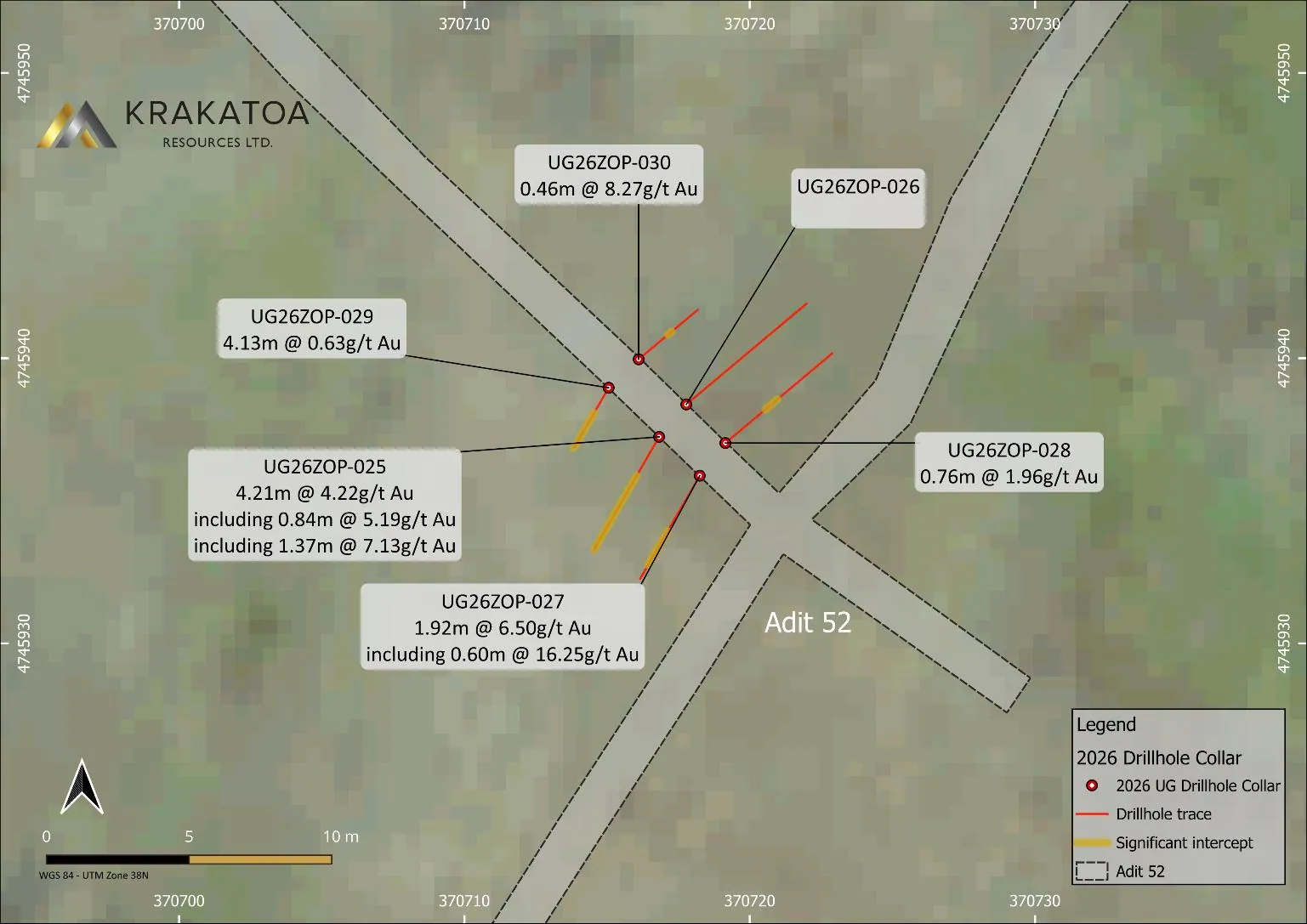
The latest batch extends the run documented in the October Zopkhito assays, which also identified high-grade mineralisation outside the historical estimate. In Adit 52, described as the first underground drilling in the deposit’s central zone, holes targeting Vein 19 returned 4.22g/t gold over 4.21 metres in UG26ZOP-025 and 6.50g/t gold over 1.92 metres in UG26ZOP-027.
Surface holes extend gold and antimony zones
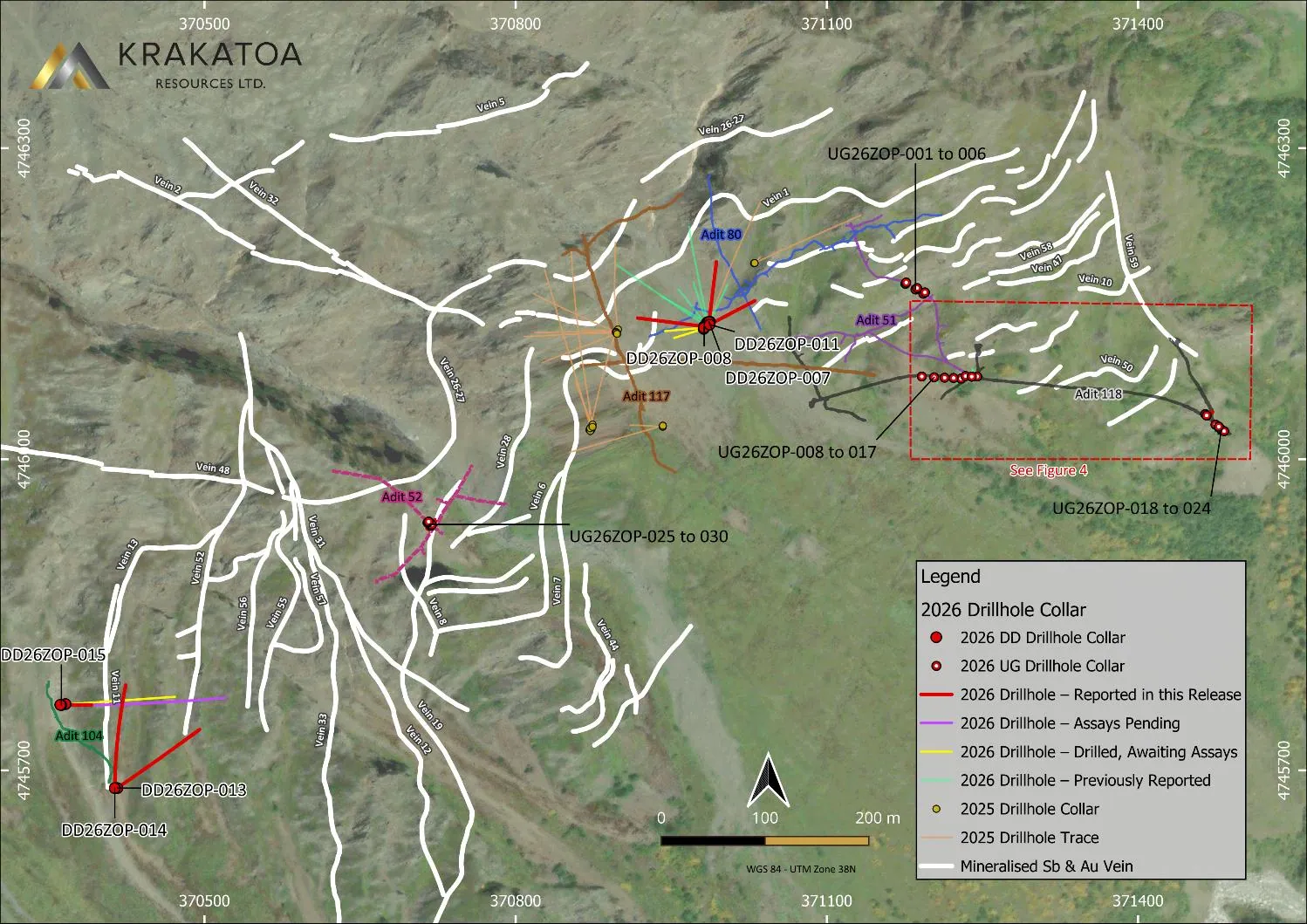
Surface drilling added a different set of signals. Hole DD26ZOP-011 intersected 5.31 metres at 2.03g/t gold and 0.63% antimony, including 0.80 metres at 4.12g/t gold. The hole was part of work testing the shallow-dipping Vein 6 before drilling moved towards the south-west flank, where Krakatoa is testing Vein 33 and other historically mapped structures.
Other surface results were narrower but high grade, including 4.13g/t gold over 0.23 metres in DD26ZOP-014 and 2.29g/t gold over 0.14 metres in DD26ZOP-008. The company describes the assays as consistent with both earlier 2025-2026 drilling and historical high-grade mineralisation, as well as a wider gold halo around the veins.
Resource work remains ahead of the assays
The exploration program is intended to convert Zopkhito’s existing foreign resource estimate into a Mineral Resource Estimate compliant with the JORC 2012 Code. That remains a work in progress rather than an established outcome: surface and underground coring continues, further assay batches are pending, and the reported intersections are downhole lengths rather than confirmed true widths.
The distinction matters particularly underground, where the company estimates true thicknesses at roughly 55% to 65% of sampled lengths because drilling angles were constrained by the existing adits. Surface intersections are generally considered closer to true width, but the company says the relationship varies by hole and vein orientation.
Ore sorting and metallurgy move into testing
Krakatoa has collected representative ore-style samples for sensor-based sorting tests in Germany, with processing due to commence this month. A separate bulk sample for metallurgical work is being prepared for shipment to an Australian laboratory. The company says the two programs will contribute to its broader development assessment, but this announcement contains no new recovery results or economic study.
Environmental baseline studies and permitting activities are also continuing while drilling expands coverage across the vein system. The next material evidence will therefore come from the pending assays and test work, followed by the quality and scale of any maiden JORC resource. High grades are now appearing across several veins; continuity, recoveries and mineable widths remain the harder questions.
Get ASX:KTA news the moment it breaks
 iPhone & iPad
 Android
Bottom Line?
The assay stream remains encouraging, but Zopkhito still needs continuity data, metallurgical results and a JORC-compliant resource before its development potential can be properly measured.
Questions in the middle?
- Will further drilling demonstrate enough continuity and true width to support a meaningful maiden JORC 2012 resource?
- Can ore-sorting and metallurgical test work establish recoveries that support a viable processing route?
- How quickly can Krakatoa complete the remaining drilling, assays, permitting and resource-modelling work?
Sources
1-
Drill Results Continue to Return High-Grade Antimony & Gold (opens in a new tab)Verified source. Krakatoa Resources Limited · 9 Nov 2026