EBR warns of going concern risk despite A$150 million capital raising

EBR Systems delivered higher reimbursement, manufacturing and revenue milestones in the third quarter, but a sharp September slowdown and a formal going-concern warning have shifted attention to execution and funding. The company says it holds US$93.2 million in cash, cash equivalents and marketable securities, while US$41.8 million of debt falls due within 12 months.
- 40 commercial WiSE implants in Q3, taking cumulative implants to 157
- September procedures fell to about half the July-August monthly average
- US$2.5 million Q3 net sales against a US$16.6 million net loss
- US$93.2 million in cash, cash equivalents and marketable securities at 30 September
- Form 10-Q raises substantial doubt over going concern with US$41.8 million debt due within 12 months
 Add us as a preferred source on Google
September slowdown puts commercial reset under scrutiny
EBR Systems, Inc. (ASX:EBR) has reached 157 commercial implants of its WiSE CRT System, but the quarterly figure masks a more uncomfortable finish: September procedures ran at roughly half the average monthly volume recorded in July and August. EBR completed 40 implants in the three months to 30 September, below the level needed to make its early US rollout look routine rather than episodic.
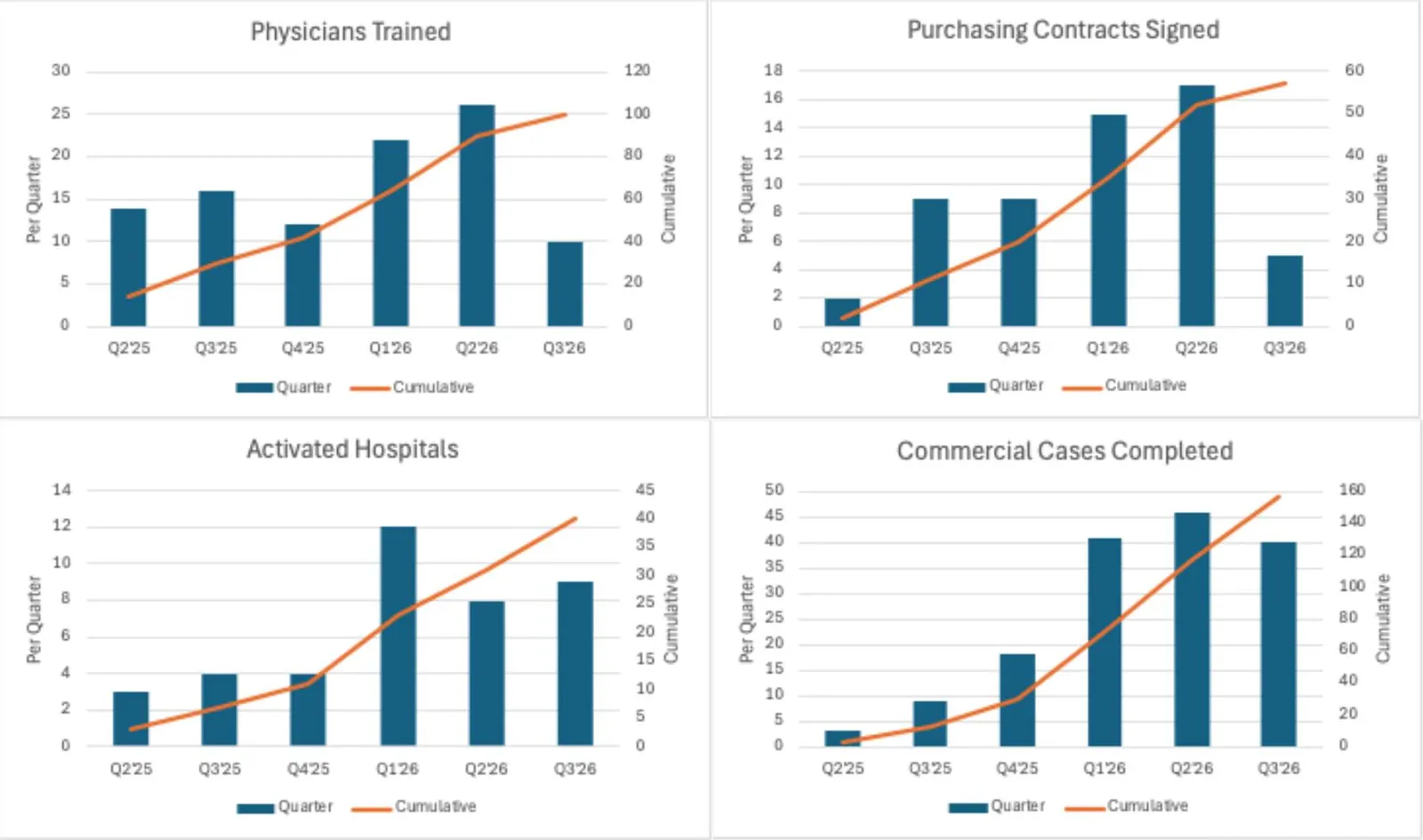
The company began realigning its US commercial organisation during the quarter after its Chief Commercial Officer departed. Chief executive John McCutcheon assumed responsibility for the function while EBR searches for a replacement and other commercial staff. Management says the immediate priorities are account utilisation, procedure frequency, field training and support. Five purchasing contracts took the total to 57, while 100 physicians are now trained to implant WiSE.
The weakness was already evident in Q3 commercial implant slowdown, which reported the same 40-procedure quarter and a sales strategy reset. EBR’s stated challenge is now conversion: turning trained physicians, activated accounts and purchasing access into repeat procedures.
Revenue grows, but losses and margins remain heavy
Q3 net sales rose to US$2.487 million from US$512,000 a year earlier, almost entirely from the WiSE CRT System. Yet cost of goods sold reached US$2.238 million, leaving gross profit of just US$249,000 and a 10% gross margin. EBR said previously expensed clinical-trial inventory had supported the margin, but that inventory was fully used during the quarter; excluding that benefit, the quarter would have produced a negative 8.9% gross margin.
Operating expenses totalled US$16.497 million, producing a quarterly net loss of US$16.644 million. For the first nine months, revenue reached US$7.486 million while the net loss widened to US$51.171 million, compared with US$34.710 million in the corresponding period. Operating cash outflow was US$17.254 million in Q3 and US$54.698 million for the nine months.
Reimbursement and manufacturing milestones advance
There are meaningful commercial supports in the filing. Medicare inpatient reimbursement for eligible WiSE procedures increased from 1 October, with base payment rates rising by approximately 58% and 93% for the relevant categories. Eligible procedures remain capable of receiving a New Technology Add-on Payment of up to US$41,145, although actual hospital payments depend on case-specific factors, eligibility and CMS criteria.
The reimbursement change follows higher Medicare payment rates, but its value to EBR still depends on hospitals performing more procedures. CMS is expected to issue a proposed National Coverage Determination decision in early December, with a final decision expected in March 2027. A favourable determination could create a more consistent national Medicare coverage framework, subject to the eventual criteria.
EBR’s Santa Clara facility also achieved ISO 13485 certification and completed its FDA pre-approval inspection. The FDA identified two Form 483 observations, both of which EBR has promised to correct. The company continues to anticipate approval of the site as a WiSE manufacturing location by the end of 2026, subject to FDA review. Once fully operational, the facility is expected to support annual production of up to 9,600 systems. The facility’s FDA inspection milestone therefore remains progress rather than a completed regulatory approval.
Capital raising buys time but not financial certainty
EBR completed an A$150 million capital raising during 2026 and reported US$93.183 million in cash, cash equivalents and marketable securities at 30 September. That figure includes US$13.985 million of cash and cash equivalents and US$79.198 million of marketable securities. Cash, cash equivalents and restricted cash alone stood at US$16.589 million.
Despite the capital raising, the Form 10-Q states that substantial doubt exists about EBR’s ability to continue as a going concern for at least the next 12 months. The company expects continuing operating losses and negative cash flow, while US$41.8 million of debt is due in 2027, within the period considered by the filing. EBR says it was compliant with its debt covenants at 30 September, but warns that additional equity or borrowing may be required and that financing may not be available on acceptable terms, or at all.
That disclosure does not say insolvency is imminent. It does make the commercial timetable more consequential: EBR must improve procedure activity, work through the manufacturing approval process and preserve liquidity while its WiSE economics remain below break-even on the reported figures. The next quarter’s implant count and cash burn will show whether the September dip was a disruption during the commercial reset or an early sign that adoption is taking longer than the balance sheet can comfortably fund.
Get ASX:EBR news the moment it breaks
 iPhone & iPad
 Android
Bottom Line?
EBR has secured reimbursement, manufacturing and funding building blocks, but Q4 must demonstrate that those assets can translate into recurring procedures before the debt maturity and ongoing cash burn become more pressing.
Questions in the middle?
- Will Q4 implant volumes recover after the US commercial organisation reset and the search for a new Chief Commercial Officer?
- Will higher Medicare reimbursement and a proposed National Coverage Determination materially increase hospital procedure activity?
- How will EBR fund operations and address the US$41.8 million debt maturity if losses and negative operating cash flow persist?
Sources
1-
Q3 2026 Quarterly Activity Report and Form 10-Q Submission (opens in a new tab)Verified source. EBR Systems Inc · 10 Nov 2026