OFX recovery depends on cost cuts as cash and earnings fall

5 min read
8:20am on Tuesday 10th of November, 2026 AEDT ~8am, 10th Nov, 26
OFX Group has swung from a A$2.4 million profit to a A$6.7 million statutory loss after weaker client activity and margin pressure cut first-half revenue. The company is betting that A$15 million in annualised cost reductions and modest revenue growth can restore profitability in the second half.
- Statutory net loss of A$6.7 million, compared with A$2.4 million profit
- Net operating income fell 15.0% to A$89.2 million
- Underlying EBITDA dropped 72.4% to A$4.0 million
- A$15 million of annualised cost actions executed
- Equals discussions continue on a non-exclusive basis

 Add us as a preferred source on Google
First-half revenue slump pushes OFX into the red
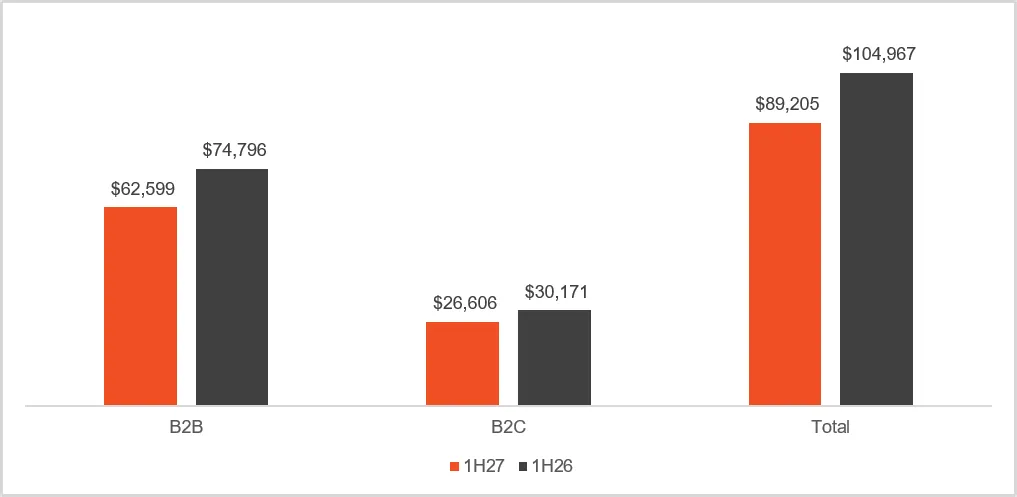
OFX Group Limited (ASX:OFX) has entered the second half under pressure after subdued business confidence, lower foreign-exchange activity and margin compression turned a prior-year profit into a statutory net loss of A$6.7 million. The international payments group reported A$92.2 million of fee and trading income for the six months to 30 September 2026, down 15.5% on the prior corresponding period.
Net operating income fell 15.0% to A$89.2 million, while underlying EBITDA plunged 72.4% to A$4.0 million. The underlying result also moved into a A$3.3 million loss after tax. OFX said the decline in income more than offset a 5.9% reduction in underlying operating expenses to A$85.2 million.
Corporate and consumer activity both weakened
Corporate revenue fell 15.8% to A$55.0 million as cross-currency turnover declined 11.0%, transactions fell 7.2% and average transaction values dropped 4.1%. Consumer revenue was down 14.5% to A$26.2 million, with transactions declining 13.0% and active clients falling 14.3%. Enterprise revenue provided one of the few clear offsets, rising 7.2% to A$6.9 million.
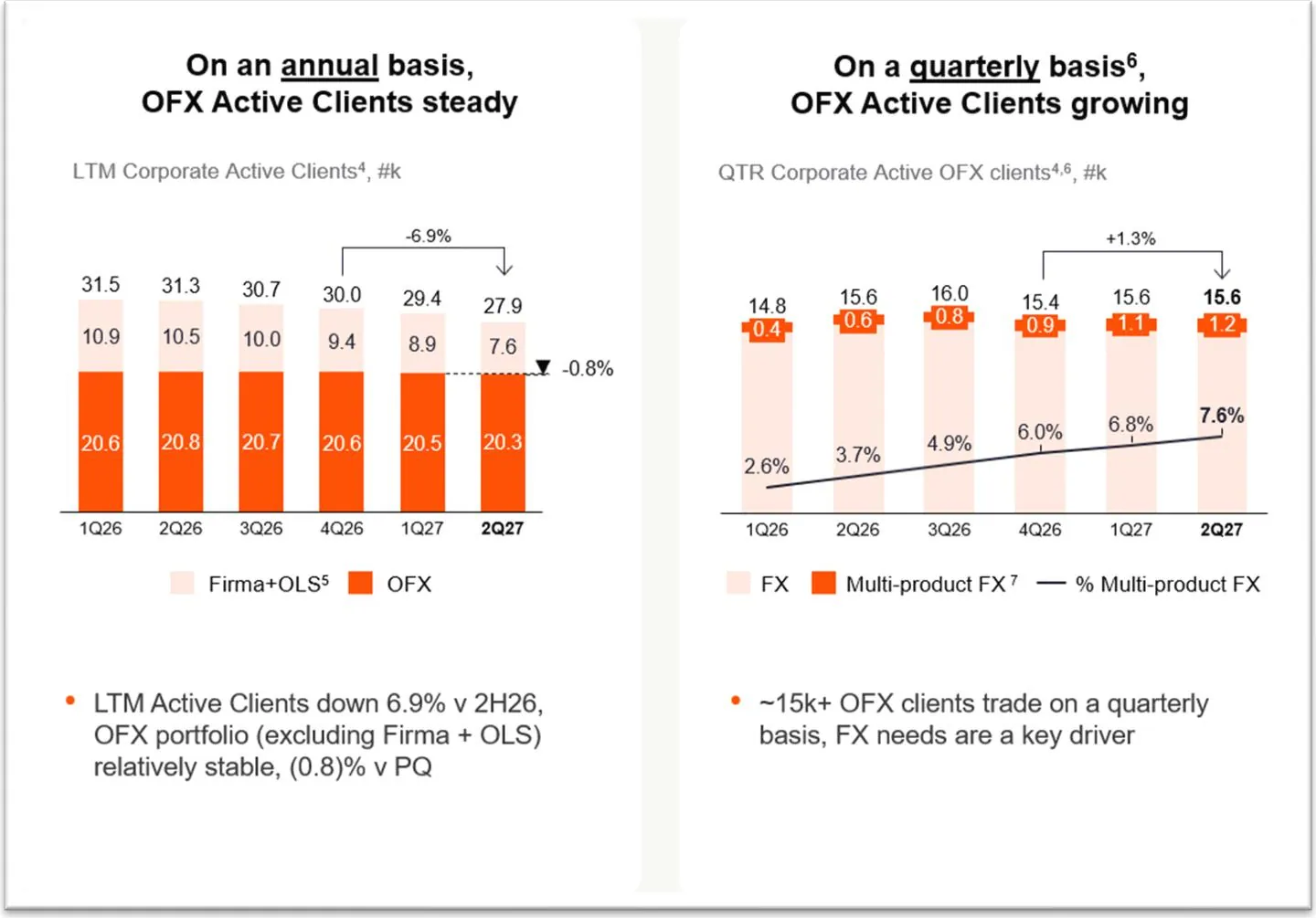
There are signs that OFX’s product expansion is beginning to carry more weight, though from a small base. Non-FX revenue rose to A$1.8 million, while interest income increased 49.4% to A$5.6 million as client wallet balances grew. The company said 11.7% of active clients on its New Client Platform were using more than one non-FX product, with those customers generating nearly twice the quarterly average revenue of FX-only clients and showing a lower subsequent lapse rate.
Cost-out program is carrying the recovery case
OFX says it executed A$15 million of annualised cost actions during the half, including an expected A$10 million benefit in the second half. The reductions include lower employment costs after a 65-person reduction, less promotional spending and changes to the product and technology teams. Management expects full-year FY27 operating expenses of between A$159 million and A$162 million.
The company is targeting a return to positive underlying net profit after tax in the second half, supported by expected net operating income growth of 2% to 3% and the cost savings. That is a forecast rather than an outcome: it depends on the savings arriving as planned, bad debts moderating and client activity improving from the weak first-half base. Bad and doubtful debt expense rose to A$3.8 million, including A$1.1 million linked to consumer losses, although OFX said additional controls had been introduced during the second quarter.
Platform investment is complete, but returns remain to be proven
OFX described its OFX 2.0 transformation as largely complete, with corporate clients migrated onto the New Client Platform across all major markets. The strategic logic was set out in the corporate platform migration, which had been reported as nearing completion earlier this year. The immediate financial question is whether the broader product range can generate enough additional revenue to replace the volume and margin lost in the core FX business.
Cash has also narrowed. Net cash held was A$63.3 million at 30 September, down from A$75.4 million a year earlier, while net available cash stood at A$36.6 million after collateral and bank guarantees. OFX remained compliant with its debt covenants, but its A$18.1 million loan matures in May 2027 and management intends to seek an extension or refinance the facility before then.
Equals discussions remain unresolved
The strategic review remains live, with discussions between OFX and Equals continuing on a non-exclusive basis. The situation is less certain than it appeared when the proposed takeover was first announced: Equals takeover talks had earlier lost exclusivity after the UK bidder failed to reconfirm its proposal by the agreed deadline. OFX said shareholders do not need to take action and that there is no certainty a transaction will proceed.
For now, the operating turnaround is the more immediate test. OFX must convert cost reductions, rising wallet balances and growing multi-product adoption into stronger earnings while navigating weak confidence, higher bad debts and a looming refinancing decision. The second-half numbers will show whether the promised profitability is a reset in the business or simply the benefit of a temporary cost squeeze.
Get ASX:OFX news the moment it breaks
 iPhone & iPad
 Android
Bottom Line?
OFX has bought itself a second-half recovery opportunity, but the result now rests on execution: revenue must stabilise while the cost base falls and debt refinancing remains ahead.
Questions in the middle?
- Will the targeted 2% to 3% second-half NOI growth materialise in a still subdued trading environment?
- Can the A$15 million annualised cost program offset weaker FX volumes without damaging future product growth?
- How will OFX resolve the May 2027 debt maturity and the unresolved Equals discussions?
Sources
3-
1H27 Results Announcement (opens in a new tab)Official market announcement. Ofx Group Limited · 10 Nov 2026 · ofx.com
-
1H27 Report and Accounts (opens in a new tab)Official market announcement. Ofx Group Limited · 10 Nov 2026 · ofx.com
-
1H27 Results Presentation (opens in a new tab)Official market announcement. Ofx Group Limited · 10 Nov 2026 · ofx.com